


A referral program is a system where a brand identifies and reaches out to the people who like or love the brand and asks them to tell friends and family about them.
The program usually provides an easy and safe means to share a message, accurately tracks the success of the referral, and offers a reward for each verified transaction.
Considering building a referral program for your business? Our guide will take you through what referral programs are, the different types of program, tips to ensure success and examples from the most successful programs to inspire you.
Table of Contents
- What is a referral program?
- What is referral marketing?
- Why use referral programs?
- What are the different types of referral program?
- How to build a great referral program
- Who has the best referral programs? 25 examples to inspire you
- Koodo Mobile Refer a Friend – C$25 bill credit
- Tesla Referral Program – Up to US$1,000 discount
- Airbnb Refer-a-Friend Program – US$18 credit per qualifying stay
- Harry’s Refer a Friend – Free shaving for a year
- Evernote Rewards Program – 10 points for 3 referrals
- T-Mobile Stock Rewards – One T-Mobile Share for each referral
- Revolut – Varying time-limited cash payments
- Robinhood – Random stock drawn from a pool
- Gousto – £18 account credit
- SMARTY – Free month of service
- IG – Using referral for a complex product
- Google – Scaling rewards with referral value
- Vitality – Referring for a healthy lifestyle
- Kaizen – Rapidly scaling across international markets
- Kwiff – A free bet for you and your friend
- Dropbox – Give and get storage space
- Google Pixel 8 – Offering Google store coupons
- Uber – Selective referral rewards
- Sky – Rewarding referrals according to the value of each referred-in friend
- Wise – Protecting margins by paying out for valuable referrals only
- Admiral – Promoting multiple products with unique rewards
- Wealthsimple – Using Referral to control CAC and ROI
- Monzo – Taking inspiration from the psychology of online gaming
- Trupanion – Harnessing pet owners’ passion for referral
- Club Med – Aligning reward value and product value
What is a referral program?
A referral program is a marketing strategy that encourages existing or past customers to share your brand with their friends and family. When someone refers a new customer who makes a purchase, the original customer receives a reward from the company. Referral programs are a great way to acquire new customers and build loyalty among your existing customers.
Without a referral program, you’re relying on natural word of mouth to get customers to recommend your brand to their friends, family and colleagues, which will probably only ever reach a small percentage of its full potential. And while word of mouth is a natural social behavior, it’s more common for some products and services than others, such as passion products including music, film, fashion, beauty and interior design.
Although conversely, the recommendation of a trusted friend can add more value for more considered purchases such as telecommunications, insurance, banking and utilities. And given that the value of a referred-in customer is often much higher in these industries, the opportunity cost of not having a referral program is greater.
Typically, a modern referral program uses software that’s built in-house, by an agency or outsourced, but in some industries referral programs are still operated manually.
What is referral marketing?
Referral marketing is a growth marketing tactic that seeks to encourage existing and past customers to recommend a brand to their friends, family, and colleagues. Often called word-of-mouth marketing, it seeks to supercharge natural or latent positive word of mouth with easy-to-use sharing tools such as referral links or codes, referral rewards and gamification.
Hear from David Hixon, Executive Director – Head of Product & Lifecycle Marketing at ally Bank on the cultural shift away from traditional media toward referrals from trusted friends:
Robin Bresnark: "Why do you think referral is such a hot trend in FS particularly, because it really does seem to be at the moment?"
David Hixon: "I think it's just a hot trend in general.
I agree it's a hot trend in financial services, but it feels like it's one in general across all industries.
And I guess I would say primarily because people are just more in tune with just this notion of influencers and finding people that you trust and respect and following the things that they want you [to do] or taking the recommendations that you get from them.
The access to those influencers is at your fingertips today, so there's a lot of people chirping in your ear about what you should be doing.
So I guess it's just a sort of a cultural shift on I'm less likely to listen to a traditional channel, a traditional commercial today. I'm less likely to do that than I am to go ask my neighbor 'hey where do you bank? I'd like to learn more about that.' It's an interesting phenomenon for sure.
Why use referral programs & referral marketing
Modern marketing is getting harder and more expensive all the time, due to a combination of (i) the ever increasing costs and reduced effectiveness of digital marketing; (ii) the fact it’s getting harder and harder to reach customers due to ad blockers, spam filters, banner blindness, the requirements to comply with regulations like GDPR and the CCPA, and the fact that many customers no longer watch terrestrial tv; (iii) and because consumers increasingly distrust adverts, celebrity endorsements and influencers. And to cap it all, consumers are typically less loyal than they used to be.
By comparison, the business case for referral marketing is clear. This is because studies consistently show that consumers trust word-of-mouth, or recommendations from friends and family, above all other forms of advertising. Also people tend to open and read emails and text messages from trusted friends and family. And, in addition, as highlighted by research from the Keller Institute, the reason that referral marketing often works so well is due to better matching and social enrichment, which means that a referral is likely to reach the right person at the right time, be read and be received from a trusted source. As a result, new customers gained from referral marketing are often better customers than those obtained from other marketing channels, and spend more and are more loyal as detailed in the seminal research by Wharton University in 2013.
“People are just more in tune with just this notion of influencers and finding people that you trust and respect and following the things that they want you [to do] or taking the recommendations that you get from them…..So I guess it’s just a sort of a cultural shift on I’m less likely to listen to a traditional channel, a traditional commercial today. I’m less likely to do that than I am to go ask my neighbor ‘hey where do you bank? I’d like to learn more about that.’ It’s an interesting phenomenon for sure.”
David Hixon, Executive Director – Head of Product & Lifecycle Marketing – ally Bank
And recent research from Rachel Gershon of UC San Diego and Zhenling Jiang of the University of Pennsylvania, which analyzed the anonymized data of 41.2 million customers of a large US mobile carrier over a ten year period, found that referred-in customers were 32% more valuable based on their increased spending alone. However, by failing to take into account that referred-in customers are themselves more likely to refer in new customers, we risk underestimating their value by a third.
But in addition to the economic reasons for having a referral program, perhaps one of the strongest reasons is that your customers expect you to have one. Buyapowa’s Referral Codebreakers research found that eight out of ten customers expect to be able to refer their favorite brands and that two-thirds of respondents said they’d view a brand positively or slightly positively if they knew it had a referral program. And our Reward Revolution research found that an amazing 95% of respondents reported having referred a brand in the past year, with 71% of respondents reporting having referred a friend between two and five times over the same period.
And Buyapowa’s recent The Referral Myth Debunked research also showed that referral marketing does bring in incremental customers, with less than half of respondents claiming a brand had been on their radar screen before it was referred to them, and nearly a fifth saying that the brand referred was better than the one they already used. And even in cases where the referred-in friend already knew of the brand referred, most said knowing that their friend also appreciated the brand was very important, and two thirds claimed that the referral was what moved them from consideration to purchase.
What are the different types of customer referral program?
Referral programs can be operated by B2C and B2B brands to encourage customers or clients to refer the brand within their circles of influence. While many of the mechanics of B2C and B2B referral programs are often the same, there can be important differences, not least in the time scales between the referral and the action, the fact that many more actors may be involved in a B2B referral and the rewards for a B2B referral can be much higher.
While referral programs are often directed at customers or clients, they can also be restricted to certain audiences such as a class of customers or clients (e.g. loyalty scheme members), employees (as an employee perk to allow friends and family of the employee to receive special deals) or for business partners, affiliates and influencers. And while often the action being driven is a sale or subscription, it’s not always the case, as any action that has value to the business and can be tracked can be driven by a referral program such as joining a loyalty scheme, downloading an app, signing up to a newsletter etc.
In addition, we can also distinguish between the typical referral program that offers both a reward to the referrer and an incentive to the referred-in friend (a dual or double-sided referral program), from those that offer only a reward to the referrer or only an incentive to the referred-in friend (a one-sided referral program), and occasionally programs that offer no reward or incentive to either side. In our view, unless you have a good reason not to, we think that a dual sided referral program often works best as a referral rewards acts as thank you to the referrer for the effort expended and, as documented by Yale and UC Berkeley, can overcome the psychological barriers to referral, whereas research from Harvard showed that the presence of a good deal for the friend can encourage a customer to refer.
Finally, our Reward Revolution research found that 74% of people said that they would be less likely to refer a friend if there were no reward. and the vast majority of those surveyed across all ages said an uninspiring reward had stopped them referring at least once. With regards to the referred-in friend, almost 70% reported that they wouldn’t act on a referral from a friend without an incentive. So we think that you should give serious consideration to the structure of rewards and incentives in your program.
How to build a great referral program
A good referral program is clearly one that succeeds in bringing good quality customers who spend more and stay for longer. We’ve set out an exhaustive list of tips to improve your customer referral program in another blog, but here we dive deeper into the main concepts you need to master to create a great program:
Hear from Michael Goodbody, former VP, Head of Marketing & Comms at Robinhood, why you need a great product that your customers want to recommend:
Why you need a great product | Robinhood
"The way that you think about referrals, for the most part, if you want it to be affordable and economical, and a good part of your marketing mix, is you have to have an incredible product that people want to talk about. And then you're just giving them a little bit more of an incentive to tell their friends and family about it.
Actually before I joined Wise, I used to use Wise. I lived in Hong Kong and was moving backwards and forwards between Hong Kong and Switzerland, I used it a lot and I would tell people about it
Because it was a really useful product that I was using. It's a way of being like "Hey I like this product, I want to tell my friends, there's a bunch of people I know that that could benefit from the product, and if I do it now I'll benefit."
At the end of the day referrals only work [if you're] making sure that you understand that your product, in and of itself, is something that people want to recommend.
I think that's a really important part of it because if you don't have that, the cost of getting somebody to make the recommendation goes exponentially higher.
It just becomes a financial transaction."
Make Sure You Have a Great Product or Service
While it might seem obvious, referrals is all about motivating positive word of mouth, so you first need to have a great product or service that your customers love and want to talk to their friends and family about. Without that, as explained by Michael Goodbody, former VP, Head of Marketing & Comms at Robinhood, it just becomes a financial transaction. And, as a result, you’ll probably have to pay too much to get referrals, you’ll attract the wrong type of referrer and get the wrong type of referred-in friend.
“If you want [referrals] to be affordable and economical, and a good part of your marketing mix, you have to have an incredible product that people want to talk about. And then you’re just giving them a little bit more of an incentive to tell their friends and family about it….because if you don’t have that…the cost of getting somebody to make the recommendation goes exponentially higher. [And] it just becomes a financial transaction.
Michael Goodbody, former VP, Head of Marketing & Comms – Robinhood
Hear from Jacob Tice, Senior Marketing Specialist at Trupanion, why you need to identify the most compelling moments to ask your customers to refer you:
Robin Bresnark: "In terms of activating people, when do you tend to do that? Do you do that when people first come along or after they've received treatment? When do you find people are more likely to refer and when would you sort of encourage them to do that?"
Jacob Tice: "We encourage them to refer after they've had a really strong experience with us for one, and after that initial enrollment period. That first hospital visit is when we really want to see them enroll so that they can get the absolute most out of their coverage. And so for us, when we're talking about referrals that means as a part of their enrollment process of getting oriented and familiar with Trupanion, with our coverage with our policies.
Those are the moments where we're like 'hey if we know that this is something that you're going to love and use, then you should bring your family, bring your loved ones, bring your friends in along with you because they'll love it too.
And I would say identifying specific moments in the journey where that is going to be the most compelling ask is an important part of building your referral program.
After a successful claim, after someone has gone through the Trupanion experience, they've had their vet paid directly upfront, no waiting for reimbursement, their pet is feeling better. They're feeling good about their interaction with us, with their veterinarian. Again, we have that opportunity to put that forward and say therefore, you know, refer your friends."
See the full interview here.
Ask Your Audience
Make sure that you ask your audience (customers, clients, employees, partners etc.) to refer you, because if you don’t ask, they will probably default to their standard way of showing appreciation by simply repeat buying from you. Our Referral Codebreakers research found that most customers prefer to be told that you have a referral program rather than find it themselves, and they’d like to be reminded about it at least once every two months. And when they do hear from you, what they most want to hear about are the rewards you offer and any changes to the rewards.
“We encourage them to refer after they’ve had a really strong experience with us…I would say identifying specific moments in the journey where [asking for a referral] is going to be the most compelling ask is an important part of building your referral program.”
Jacob Tice, Senior Marketing Specialist Trupanion
Choose Your Moment
Ask at moments when you think those people are most likely to have a net positive view of your brand. For example, after a purchase (particularly a repeat purchase), a renewal, upgrade or moving from freemium to premium, or after having left a positive review or given you a high NPS, having liked or defended your brand in social media, or having any positive touch point with your store staff, call center or even via chat. It’s in these moments that you can identify potential brand ambassadors. Our Referral Codebreakers research found that the moment when your customers are most willing to refer you is after a positive interaction with your customer support staff.
Andrew Chen of Andreessen Horowitz shares the insights he gained from his involvement with the Uber and DropBox referral programs, and advises that you ask potential referrers as often as possible given the context of what you’re asking them to do, and in particular as part of the onboarding process.
Ask many times, in many places, with different messages, and in-context with whatever action you’re asking the user to take…..Thus, make the referral ask part of the main flows….And add it to the onboarding flow, and at the end of key transactions when the user is otherwise done.
Andrew Chen, Partner – Andreessen Horowitz
Ask The Right People
Analyze your customers and clients, and then target your most loyal, satisfied and profitable customers. Due to the natural tendency of people to socialize with people who share the same values and lifestyles (what the Keller Institute called passive matching), it’s likely that your good customers know people like them and can refer more good customers to you.
Hear from Katie Brooks, Product Owner at toob, why your referral program should be on brand and on your website not a supplier’s:
Katie Brooks: "We know our customers and we know that they want things to be easy to find and accessible.
Which is why we put our refer friend scheme where we did on our website.
And also we not only wanted them to get to the page, but to stay on it.
And we did our research on how other people did their refer a friend schemes and it would [often] send you off to an external page or suddenly all the branding would look completely different.
And what we loved, was where we could put your embed on our page on our site. So people felt like they were still with toob and on toob's page and they didn't have to leave or go anywhere.
They're always on our website, a familiar place that they trust. So yeah, not only getting them to the site, but keeping them there because, like you say, people only have limited time. So if they don't think they're in the right place or they don't recognize it, they'll just click off.
Whereas our campaign, we can really make it feel like us, which is what people were on our site for in the first place."
See the full video here.
Be On Brand
Make sure that the bond between your brand and your customer or client is not broken, by asking as you the brand and not letting a supplier put its branding in the way of your brand relationship. In other words, ensure that the colors, fonts, tone and messaging is on brand and that any third party software you use is 100% white label.
“We put our refer friend scheme on our website. We also not only wanted [our subscribers] to get to the page, but to stay on it. And we did our research on how other people did their refer a friend schemes and it would [often] send you off to an external page or suddenly all the branding would look completely different. And what we loved, was where we could put your embed on our page on our site. So people felt like they were still with toob and on toob’s page and they didn’t have to leave or go anywhere. They’re always on our website, a familiar place that they trust. [because] if they don’t think they’re in the right place or they don’t recognize it, they’ll just click off.”
Katie Brooks, Product Owner – toob
Have A Clear CTA
Make sure that you have a clear call to action and that the wording of your program is clear and understandable so that each participant knows exactly what they have to do to earn a reward or incentive.
Hear from Jacob Tice, Senior Marketing at Trupanion why referral can add a ‘therefore, what?’ CTA to your content and stories:
Jacob Tice: "One of our annual campaigns is a photo contest, where we ask people to submit images of their pets and we bring it down to some finalists, and then allow the membership and friends of members to vote on the most beautiful pet picture. And as a part of that, we ask people to tell their Trupanion stories. And the call to action on the end of that, the therefore, is 'So you should join Trupanion'.
Here is this story of how they saved my pet. They brought my pet back from the brink. Or I've never had to worry about it. We've never had to use it, but we're so grateful it's in our corner and, therefore, 'You should join Trupanion.'
And I think you're absolutely right. There's a lot of content generation out there that sort of lacks that final part of the argument, that final 'therefore what?'. And with a strong referral program, you always have that to reach for.
Now we have something where we can leverage those experiences to bring more people into the Trupanion pack. Those kinds of stories are so huge.
And we know that when you hear that sort of thing from a friend, when you're able to get that compelling firsthand testimonial and you're able to use a referral link, or something like that, where your friend gives you a method to enroll, those memberships last longer. That trust is built much more quickly.
See the full interview here.
Use Stories in Your Marketing and Link These To Your Referral Program
One of the most impactful tactics in marketing is storytelling. Particularly when you use the stories from or about your customers to show the impact that your product or service has on their lives. That’s because stories make your brand more memorable and relatable and drives emotional connections from shared experiences that influence consumer behavior. And these stories are the perfect opportunity to add a CTA from your referral program. You’ve just read our story and identified emotionally with what we wrote, therefore you should refer your friend.
“There’s a lot of content generation out there that sort of lacks that final part of the argument, that final ‘therefore what?’. And with a strong referral program, you always have that to reach for. [For example], Here is this story of how [Trupanion] saved my pet. They brought my pet back from the brink. Or I’ve never had to worry about it. We’ve never had to use it, but we’re so grateful it’s in our corner and, therefore, ‘You should join Trupanion.’
Jacob Tice, Senior Marketing – Trupanion
Hear from Ollie Moore, AVP, Product & Member Marketing at Delta Community Credit Union on the importance of keeping your referral program simple:
Is your referral program simple enough? | Delta Community Credit Union
Ollie Moore: "You want to make sure that your referral program is simple."
"One of the things that we do love about our program is the ease, the simplicity of it. So that our members don't feel like they have to share too much of their information."
"They don't really have to share anything. Just a link to their friends and family."
"Before we partnered with Buyapowa, there were some things that were clunky there. When we did have it where you'd have to have the member's name. Or where the member would go by a nickname in their personal life but for their banking they would go by the formal name."
"You know a unique link that each member can use to bring their family and friends on, works just perfectly and smoothly. And we think it encourages people to use the program even more so."
See Full Video
Keep It Simple
Provide a safe and easy way for participants to share using any of their favourite sharing tools with natural sharing direct from mobile phones and using links or memorable words or codes that can be shared in other channels.
Ensure your design and user experience is as simple and easy to use as possible, and constantly work to reduce any unnecessary friction points that might stop referrals or actions by referred-in friends.
“You want to make sure that your referral program is simple….a unique link that each member can use to bring their family and friends on, works just perfectly and smoothly. And we think it encourages people to use the program even more so.”
Ollie Moore, AVP, Product & Member Marketing – Delta Community Credit Union
Offer A Choice Of Rewards
Use rewards and incentives that appeal to your audiences and, in particular, don’t limit them to one reward or incentive but offer a choice of rewards and change your rewards and incentives from time to time. Our Reward Revolution research found that on average a referrer expects to gave a choice of between 3 and 4 rewards in return for successfully referring a new customer.
Hear from Buyapowa’s referral experts as to whether a referral reward needs to have a monetary value:
Referral marketing: Does a reward have to have a monetary value?
Gideon Lask: "Guys, one of the questions I'm asked most frequently is whether a reward for a referral has to actually have a monetary value or not?"
Robin Bresnark: "No is the honest answer. It just has to have a value.
People have to want it, so totally depends on what your brand is. If you're a paper company, maybe they're going to want something with hard money and [that's] fine. If you're an extraordinarily sexy, glamorous brand, then there may be experiential things you can do, so it isn't necessarily money. Way back in the Buyapowa annals we did a campaign with O2 and Ed Sheeran where there was a chance to meet Ed Sheeran.
[Didn't] cost anyone anything, but millions and millions of people got involved with that. So, doesn't have to have monetary value, but does have to have value."
Gideon Lask: "OK. Peter?"
Peter Cunningham: "Difficult to add much to what Robin said. [But] it has to have value in the eyes of your customer.
So it doesn't have to have a cost for you. Ideally, it's something they can't get elsewhere, like a money can't buy thing, like the Ed Sheeran option you talked about.
But again, just think about what other options they've got. Are other people offering money or is it something that doesn't have an immediate cost to you?
It could be loyalty points, it could be a gift card, it could be a product that's in-stock that you need to give away."
Gideon Lask: "Think about, think about the answer to this one carefully. If I was to have a personal referral program for myself, nothing to do with the business, would I have to give away monetary value or would the experience be enough?"
Robin Bresnark: "For you?"
Gideon Lask: "Yes."
Robin Bresnark: "Monetary value."
Gideon Lask: "Ah. Not the answer I wanted, but expected. Thanks."
Offer Valuable Rewards
Think how you can offer rewards that have a high value in the eyes of the referrer or referred-in friend but little cost to you, like how DropBox and Evernote offered extra online storage. And if your brand has a high affinity (i.e. your customers love you) than why not consider swag like branded t-shirts, mugs or even online status badges.
“It has to have value in the eyes of your customer. So it doesn’t have to have a cost for you. Ideally, it’s something they can’t get elsewhere, like a money can’t buy thing…[But it] doesn’t have an immediate cost to you. It could be loyalty points, it could be a gift card, it could be a product that’s in-stock that you need to give away.”
Peter Cunningham, Director of Marketing – Buyapowa
Hear from Katie Brooks, Product Owner at toob, why you should pay out rewards as quickly as possible after a referral:
Robin Bresnark: "Your cooling off period is 14 days, because that's all the cooling off period needs to be. It's not always the case.
We have plenty of clients where it just has to be longer.
In the case of a business like yours, often a bit of engineering work is done or equipment is sent out. But when you're in you're in right?"
Katie Brooks "We didn't want anyone to have to wait longer than they needed to. And we knew that a scheme that makes you wait 30 days or even perhaps 60 days, just might not have suited a lot of our customers.
We just think that it's a really nice treat, when you've passed that 2 week cooling off period. Hopefully enjoying all the benefits of full fiber and the router that we've sent out to you, that then we reward you for enjoying that two weeks with your voucher."
Robin Bresnark: "And you actually prolonged that magic period at the beginning of a relationship as well, because you're right [that in] those first two weeks, hopefully people are saying my internet is so good. That's a joy for a few days, and then it just becomes part of the furniture and you don't get excited about it. But then you get that little present."
See the full interview here.
Pay Out Promptly
Subject to any necessary post completion rules to protect your margins, for example only paying after cooling-off periods have expired, aim to pay out rewards as soon as you can to keep your referrers engaged and encourage them to refer again.
“We didn’t want anyone to have to wait longer than they needed to. And we knew that a scheme that makes you wait 30 days or even perhaps 60 days, just might not have suited a lot of our customers. We just think that it’s a really nice treat, when you’ve passed that 2 week cooling off period. Hopefully enjoying all the benefits of full fiber and the router that we’ve sent out to you, that then we reward you for enjoying that two weeks with your voucher.”
Katie Brooks, Product Owner – toob
Hear from Natasha Saviuk, Director of Growth at Wealthsimple how combining an always on program with time limited promos can really skyrocket the number of referrals your program gets:
Drive Referrals with FOMO & Tiered Rewards | Wealthsimple
Natasha Saviuk: "For us, just cycling through different promos and having a baseline that works well and coming to our clients with different types of offers is what helps keep the program top of mind for our client base"
"Limited time Promos, because again it gives you an excuse to remind your clients that you have a referral program in the first place, and where those referrals need to be made within a critical window, we see that the number of share my referral button clicks just skyrockets."
"And one of the promotion types that works the best is exactly what you're describing where based on the number of referrals you make the client gets an increasingly exponential bonus, especially for clients that maybe are inclined to be repeat refer or have a bigger network, we really see it effective at tapping into those networks and getting people saturate the number of referrals that they can make."
See the full interview here.
Use Smart Psychology
Use gamification and smart psychological tools to encourage participants to share again and again and to encourage referred-in friends to take action and take action now by using tiered rewards, booster campaigns to create time jeopardy and the fear of missing out (FOMO) and league tables.
“For us, just cycling through different promos and having a baseline that works well and coming to our clients with different types of offers is what helps keep the program top of mind for our client base. Limited time Promos, because again it gives you an excuse to remind your clients that you have a referral program in the first place, and where those referrals need to be made within a critical window, we see that the number of share my referral button clicks just skyrockets.”
Natasha Saviuk, Director of Growth Wealthsimple
Hear from Mobile Expert David Caton why finding a mutual benefit, like the free phone calls between referrers and referred-in friends, can really make your referral program fly:
David Caton: "In my experience, there are are two sides to when someone refers a company.
The irst is altruistic: I'm going to do something for my friend. I'm benefiting from this product or service. So then now they can benefit from it as well. So there's the altruistic side, but then there's also the selfish side.
Because [the referrer is] going to get something from it as well.
Maybe some people are completely altruistic. Maybe some people are selfish. Maybe it's a bit of both.
But the thing about referral schemes is it satisfies both of those sides of the the psyche of the person recommending the service.
And that's one of the things that I think will always be something great for any referral scheme, if the two people who connect can have some mutual benefit.
SMARTY'S program for example is a voucher. You get voucher, they get voucher. But if there's anything else that can be put on top of that, maybe a proposition or some other perk, then that's what really accelerates it.
And that was what Giff Gaff really benefited from at the beginning, the unlimited calls between referred customers and the whole positioning of 'we're a community together. We do everything together'.
It was absolutely beautiful for them and because they were one of the first as well, that's probably why they became so famous for it.
So say you're a business who wants to run a referral program and you're sitting down with a finance team and you're writing a business case and you know the [value of the new] customers that you acquire and the loyalty of them, and the amount that they spend exceeds the cost of doing those extra perks between the two.
For any anyone who wants to do referral scheme, whether it's in mobile or any other industry, if you can get that mutually beneficial thing for the referrer and the referee, then that's what's going to really make it fly."
See the full interview here.
Find a Mutual Benefit for the Referrer and Referee
As in the DropBox example below, one of the reasons for the success of the referral program was that both parties benefitted from the referral by being able to share files between them. In the case of Giff Gaff, this was the idea that calls would be forever free between the referrer and the referred-in friend, whereas for Uber this was being able split the taxi fare or see where you friend would likely arrive. So in addition to paying rewards and incentives, if you can find or create a mutual benefit from both parties using the product or service, this can greatly boost the effect of your program.
And that’s one of the things that I think will always be something great for any referral scheme, if the two people who connect can have some mutual benefit…. And that was what Giff Gaff really benefited from at the beginning, the unlimited calls between referred customers and the whole positioning of ‘we’re a community together. We do everything together’….For any anyone who wants to do referral scheme, whether it’s in mobile or any other industry, if you can get that mutually beneficial thing for the referrer and the referee, then that’s what’s going to really make it fly.”
Mobile Expert David Caton
Keep It Fresh
Refresh your campaign from time to time with different rewards, different messaging and look and feel so that it doesn’t go stale. As mentioned above, our Referral Codebreakers research showed that what customers most want to hear about when it comes to a referral program are the rewards and any changes to the rewards.
Improve Your Reach
Market your campaign across all touchpoints using the principles of activation and discovery to ensure your audience knows you have a referral program and knows where to find it. As a minimum, you should be marketing on your website, in emails and newsletters, on your blog and in social media etc.
Remarket & Remind
Remarket your program to those who showed an interest but didn’t refer or transact by reminding them of the offer and the rewards and incentives available, or if a referrer hasn’t made a referral in a few months why not offer an extra reward incentive for a new referral? And where a friend has not accepted a referral, perhaps because they are tied-in to a contract, why not, subject to getting data protection permissions, send them reminders that the referral offer is still there waiting for them.
Analyze and Improve
Make sure you have advanced reporting and analytics to track the performance of your campaigns and understand what moved the needle for you. Based on the detailed analysis of your reporting and analytics, tweak and test all the elements of your system to improve conversion rates, and keep testing and improving.
The need to ensure all of these elements is why we recommend looking at a best-in-class provider of referral program software.
Who has the best referral programs? 25 examples to inspire you
Like all marketing programs, referral marketing is most effective when managed efficiently and optimized to attract the right customers. But having the best referral marketing software is only half the battle; ensuring that your marketing actively encourages the referrals — meaning that your loyal customers recommend your business to their friends and family — is the real challenge. Like other marketing programs, you can build it, but that doesn’t necessarily mean that they will come.
So, to inspire you, we have put together a list of twelve leading referral programs to highlight the ideas and tactics they have used to get their customers referring. You can think how these can fit into your own referral marketing template to generate more and more customer referrals.
- Koodo Mobile Refer a Friend – C$25 bill credit
- Tesla Referral Program – up to US$1,000 discount
- Airbnb Refer-a-Friend Program – US$18 credit per qualifying stay
- Harry’s Refer a Friend – Free shaving for a year
- Evernote Rewards Program – 10 points for 3 referrals
- T-Mobile Stock Rewards – One T-Mobile Share for each referral
- Revolut – Varying time-limited cash payments
- Robinhood – Random stock drawn from a pool
- Gousto – £18 account credit
- SMARTY – Free month of service
- IG – Using referral for a complex product
- Google – Scaling rewards with referral value
- Vitality – Referring for a healthy lifestyle
- Kaizen – Rapidly scaling across international markets
- Kwiff – A free bet for you and your friend
- Dropbox – Give and get storage space
- Google Pixel 8 – Offering Google store coupons
- Uber – Selective referral rewards
- Sky – Rewarding referrals according to the value of each referred-in friend
- Wise – Protecting margins by paying out for valuable referrals only
- Admiral – Promoting multiple products with unique rewards
- Wealthsimple – Using Referral to control CAC and ROI
- Monzo – Taking inspiration from the psychology of online gaming
- Trupanion – Harnessing pet owners’ passion for referral
- Club Med – Aligning reward value and product value
Here’s Who Got it Right: Best Referral Program Examples
These brands have tapped into the perfect blend of understanding their audience, offering rewards that their customers will value, and streamlined user experiences to create some of the best referral programs.
1. Koodo Mobile Refer a Friend

(Image source: Buyapowa)
Though Koodo Mobile was voted three years in a row the wireless provider with the “Highest customer satisfaction rate” by JD Power & Associates, the telecommunications company’s decision to look at referral marketing was driven by the fact that it was facing ever increasing acquisition costs per new customer. Koodo needed a way to bring in new customers at less cost, all the while keeping their current member base satisfied and happy. So they decided to build a referral program which offered:
Referrer Rewards: C$25 off your tab
Referee Rewards: C$25 off your first bill
Result: Through their program, Koodo reduced their cost of customer acquisition (CPA) by 167% and a return on investment (ROI) of more than 10X in 2019 alone.
What they did right: Koodo was able to provide a seamless program experience for their customers through single sign-on and kept their fun, bright branding consistent throughout their program design. It worked so well, in fact, that Koodo made referral an integral part of their marketing mix; rolling out regional campaigns across Canada and making it available in different languages to maximize accessibility and engagement.
Read more about Koodo’s referral program and other telecoms referral schemes.
2. Tesla Referral Program

(Image source: Buyapowa)
To this day, Elon Musk and Tesla Motors are rarely out of the news. Tesla is a ubiquitous name in tech and energy circles. Like their namesake, Nikola Tesla, Tesla Motors is futurist, forward-thinking, and divisive. Though critics have labelled their methods as aggressive and controversial, Tesla’s customer satisfaction rate is a staggering 89 out of 100, putting it ahead of all other car manufacturers around the globe.
In 2016, Musk capitalized on his customers’ loyalty and launched a referral program that provides a great example of how to reward referrals with something other than pure product discounts. With its resounding success, Tesla closed out Phase 9 of their referral program and introduced a new referral program in March 2019; continuing to make referral a key part of their growth strategy.
Since then it’s been constantly changing its strategy, with different programs, and trying different rewards and incentives. Over the years, it’s offered everything from:
- free Roadsters;
- US$1,000 discounts;
- cash bonuses;
- solar panel chargers for the car roof;
- free supercharger miles, getting your photo launched into Space, etc.,
And the programs have been turned on and off. The program was paused 30th April 2024 after Elon Musk fired the entire marketing team of 40 people. However, the referral program has now re-appeared, this time with the chance to earn US$500, which can be applied to any Tesla product, and give the referred-in friend US$1,000 off a new Tesla.
In a very interesting interview published on the Ride the Lightning, the Unofficial Tesla Podcast, in December 2024, Taylor Robinette, who previously ran the Tesla Referral Program, shared some insights, including that Tesla wanted to give something to the community of Tesla fans in its referral program that made them feel special, but it had to be scalable and they couldn’t overpromise. He highlighted how they always started from the question of first thinking if this was right for the customer and asked the simple question ‘would I want this’?, rather than starting by asking if this was good for the brand. And when thinking of rewards to offer, they would often start by thinking what would motivate themselves to refer 12-13 friends and then worked back from that. He added that it was important that Tesla fans never felt like they ‘were selling their contact list of friends’ in order to get rewards.
He also made an interesting comment about balancing complexity and simplicity, and that the basic rule is that your program should be as simple as possible. So every time they considered adding complexity, they challenged themselves to justify the incremental gain from adding that extra step or requirement. And in a final aside, he suggested that brand fans should communicate with the brands they love and tell them the kinds of referral rewards they would like to see if their programs.
“What’s going to drive a really good referral program is offering things money can’t buy…How do we offer these experiences.. [given that people are] already having conversations with friends and family.. [to] offer them something to go above and beyond and help their friends go for a test drive or spend extended time with them, helping them get onboarded into the ecosystem.”
Taylor Robinette, Former Senior Staff Product Manager – Tesla
Referrer Rewards: Ranked by amount of qualifying referrals (“QRs”), the car manufacturer’s early referral program ensured Tesla owners were able to obtain an invite to tour Tesla’s factory and attend the grand opening party (5 QRs), then the right to purchase a Founder Series Model X, which wasn’t available to the public (10 QRs). The first owner to achieve 10 orders in North America, Europe, and Asia received a free Model X SVU.
From 2023 and until it paused the program in April 2024, Tesla offered “Loot Box Credits” that could be redeemed for software upgrades, up to 10,000 kilometers of free Supercharging, etc; with 2,000 Loot Box Credits paid to the referrer for each referral.
In July 2023, Telsa further updated their US referral program to reward referrers with 10,000 Tesla credit points which could be used for free Supercharging and Tesla accessories/upgrades.
As of November 2025, Tesla has added tiered incentives to promote Full Self-Driving (FSD) Supervised adoption:
- Referrers now earn $15 in Tesla Credits when someone they refer completes an FSD demo drive.
- If the referral results in a vehicle purchase, the reward increases to $500.
- If the purchase includes FSD (Supervised), the reward doubles to $1,000.
In 2026, Tesla removed the Model S and Model X from its referral program. Customers can now only earn rewards when friends purchase a Model 3, Model Y, or Cybertruck through their referral link.
The change reflects Tesla’s evolving product strategy, as the company prepares to wind down production of the Model S and X and focus on newer initiatives such as the Roadster, Cybercab robotaxi, and Optimus humanoid robot. By concentrating referrals on its higher-volume vehicles, Tesla continues to use the program to drive mainstream EV adoption.
Referee Rewards: At the time of writing, Tesla has reverted to offering a US$1,000 discount on the purchase of a new Tesla vehicle for the referred-in customer.
Result: By Tesla’s second referral program, they were making a return multiple in excess of 42x on every dollar spent towards their referral program, with 25% of their sales in Q4 2015 coming from their referral program. As mentioned above, Tesla has constantly been changing the rewards and incentives offered in its referral program, and is currently offering Loot Box Credits. As soon as Tesla publishes results of the new referral program we’ll update this article.
What they did right: Tesla has generated a relentless spirit of evangelism around their vehicles. The referral program targeted Tesla owners – who are already ecstatic with the brand and their vehicle’s performance – with rewards that their clientele would find truly valuable. Their current program not only offers a meaningful reward for each successful referral in the form of Loot Box Credits, which can be redeemed for free Supercharging etc, but they cleverly use tiered rewards and gamification to drive repeat referrals.
Tesla is a great example of how a referral program can be adapted throughout the life of a company from start-up to high growth and maturity, and how ingenuity with rewards and incentives can keep a program relevant and exciting.
3. Airbnb Refer-a-Friend Program

(Image source: Buyapowa)
It’s difficult to find someone who hasn’t heard of Airbnb or even used them themselves. The internet lodging titan that we know today as Airbnb started out when the founders rented out an air mattress in their living room and the rest is history. Now, Airbnb is one of the defacto examples people cite when they think about a startup unicorn. While Airbnb paused its main consumer referral program in April of 2021, we understand that it’s still active in mainland China, Germany, Japan, Italy, and Mexico. However, the information below summarizes the details of the main program before it was closed.
Referrer Rewards: US$18 per qualifying stay and US$10 per qualifying experience
Referee Rewards: Up to US$46 account credit
Results: In some cases, Airbnb’s referral program increased bookings by over 25%, and the last version came in even stronger than before, boosting referrals by more than 300%.
What they did right: Their approach was successful for two key reasons: they streamlined the sharing and shopping experience, and leaned into their users’ desire to help, using A/B testing to prove that positioning the reward as a gift to a friend produced better results than a message emphasizing receiving a reward for yourself.
If you want to know more about how using prosocial or friend benefiting rewards can improve the performance of your referral program, then this recent research from Harvard Business School, Olin Business School, and the University of California should interest you.
4. Harry’s Refer a Friend
(Image source: Buyapowa)
Harry’s isn’t your average shaving brand. The shave accessory giant boasts a billion-dollar subscription service through their e-commerce store and a barbershop in Manhattan. A large part of that 10-figure success has their referral program to thank.
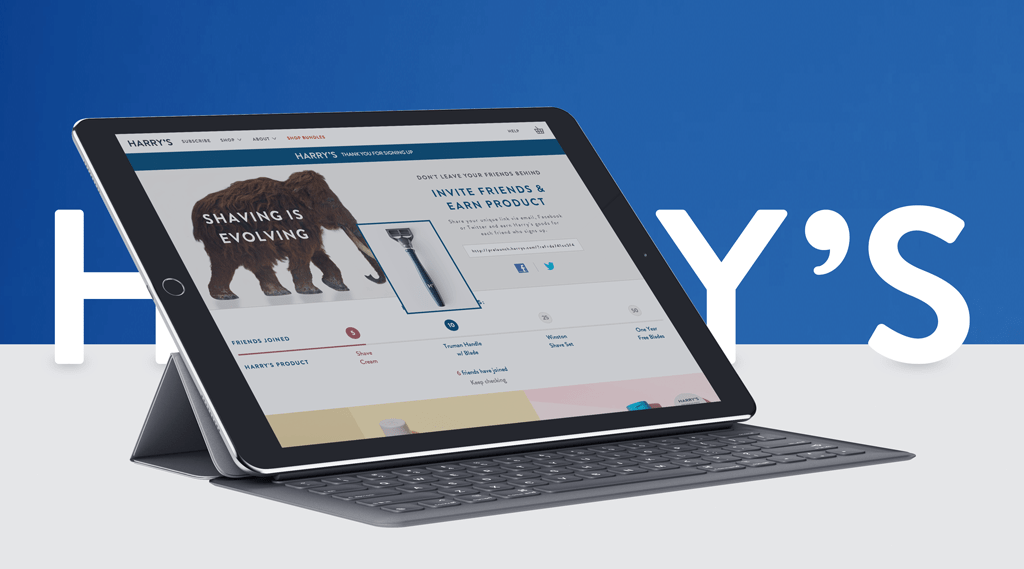
To accumulate buzz about their brand’s launch, Harry’s executed a week-long pre-launch referral program designed to collect the email addresses of as many potential qualified customers as possible. In this great example of a referral program that incorporates other elements of a digital marketing strategy, they offered incremental tangible rewards to those who were willing to refer their friends through email, Facebook or Twitter.
Referrer Rewards: Accumulating rewards: Refer five friends, earn free shave cream. Refer 10 friends, earn a free razor. Refer 25 friends, earn a free premium razor. Refer 50 friends, earn free shaving for a year.
Referee Rewards: 10% off their first purchase.
Results: As the week-long campaign wrapped up, the results surpassed all expectations. They generated 100,000 leads within the first week. Supported by a stellar referral program, Harry’s grew into a billion-dollar unicorn and became a household name. More recently, though, they’ve dialed back their referral program to a simple $5 credit each way, abandoning their more high reward program of old for a more stripped down version.

(Image source: Buyapowa)
What they did right: Harry’s being the only non-purchase-based reward referral program on the list, it wasn’t difficult to find internet cruisers who were willing to share the brand with their friends in exchange for free products. There’s also something to be said about tangible rewards; in Sujan Patel’s post he notes that “physical product rewards can provide an opportunity to create a concrete connection to your online experience”. While their latest referral program lacks the aggressiveness of that initial scheme; their venture into the world of referral was undoubtedly a fruitful one.
5. Evernote Rewards Program

(Image source: Buyapowa)
Evernote has come a long way since their launch in 2008. The note-taking app has collected over 100 million users worldwide and a $1 billion valuation with a modest $0 budget for user acquisition. Evernote’s focus has been on creating a great product that their customers love, knowing that word-of-mouth would be their greatest marketing asset. Without spending on SEO or advertising, Evernote’s referral program is primarily responsible for the company’s sizeable growth and financial success.
Evernote decided to close its referral program in 2021, so the information below relates to the period before its closure.
Referrer Rewards: Earn 10 points for your first three referrals – enough for three months of Premium or 3 GB of additional monthly upload, then whenever a referred friend buys Premium, earn 5 points.
Referee Rewards: A free month of Premium.
Results: Out of the 225 million users of Evernote, 13% were referred by other users.
What they did right: The freemium model, which we’ve talked about before, has been a big success factor for referral programs like Dropbox’s, Uber’s, and now Evernote’s. Their simply designed program also encourages customers to keep making referrals to sustain their free trial of Premium.
6. T-Mobile “Stock” Rewards (now T-Mobile Referral Program)

(Image source: Buyapowa)
Wireless uncarrier T-Mobile decided to break the referral program mold and offer actual shares in the company in return for referrals. While the program has been quietly discontinued since then, and T-Mobile has returned to offering a more standard $50 MasterCard, the stock reward program generated massive amounts of press for T-Mobile and presented an opportunity for their CEO to promote their referral program example as something truly differentiated and groundbreaking across the wireless industry. Referrers could earn up to 100 shares in T-Mobile. And customers who had been with T-Mobile for more than five years were offered two T-Mobile Shares for every successful referral.
Referrer Rewards: Earn one T-Mobile share for every successful newly activated T-Mobile Line.
Referee Rewards: One T-Mobile stock after being referred and staying with T-Mobile for at least 15 days.
Results: T-Mobile hasn’t shared the results, but the share price rose from US$40 range to over US$60 in early 2018, resulting in an added bonus for successful recipients of share rewards, making the program a win-win for T-Mobile and their referral program’s participants.
What they did right: The highly differentiated program generated millions of dollars worth in free marketing as a result of the extensive press coverage. And, by diversifying the rewards offered to include actual company stock, rather than a financial incentive, credit or discount; T-Mobile was able to offer something with more unique and special for their referrers and their friends.
7. Revolut Uses Limited-Time Offers to Boost FOMO

(Image source: Buyapowa)
Revolut is a London-based fintech that’s working towards being the world’s first truly all-in-one financial super-app. Today, they boast 15 million personal customers and 500K business customers worldwide, and the Revolut platform supports more than 35 countries and over 28 currencies and offers everything from bank accounts and debit cards to stock trading and cryptocurrency exchange. Revolut now joins a band of cutting-edge fintechs looking to disrupt the financial services industry with innovative, customer-centric solutions. Key to their continued success and growth is a need to reduce customer acquisition costs; enter their referral program.
Referrer rewards: Each campaign can offer different cash rewards for each referred-in friend that orders a physical card and makes 3 card payments — for example we have seen €45, £50, and US$10 being offered. Also, where the offer is more generous, the number of friends that a customer can refer is typically capped (e.g. 5 friends), and in each case, the referred friend must be eligible for a Revolut account and not already be a customer.
Referee rewards: As above, the conditions can change for each campaign, but often a cash reward is also given to each referred-in friend who orders a physical card and makes 3 card payments.
Results: Revolut has reported a reported 700% increase in the number of customers acquired through their referral program between 2018 and 2019, alone.
What they did right: Unique and vital to Revolut’s referral program success is how they trigger a FOMO response and create immediacy in the minds of their customers by making it a sporadic, limited-time offer and by sending regular email and in-app reminder messages that the customer only has a certain amount of time left to earn the rewards. By creating a situation in which potential referrers have a short window of opportunity to refer and collect a reward, customers are spurred into action, and potential issues surrounding customer apathy and lethargy are cleverly mitigated. And so as to reinforce the effect, at the end of a campaign, the offer no longer appears in the app.
In addition, by limiting the number of referrals a customer can make, Revolut creates a scarcity effect. In one example, the offer is limited to 5 referrals of new customers. Revolut tends to reduce the number of permitted referrals when the reward offered is higher.
And finally, to avoid paying out for low-value customers, referrals are only confirmed once the referred-in friend has made three payments. However, the Buyapowa team recently tested this referral program in action and noticed somethings which could be improved. As of the August 2023 iteration of the program, we noticed a lack of communication to the referred-in friend as to the steps that needed to be taken for the referral to be approved. Only the referrer can see the progress of referrals in his or her app and while the referrer could remind the friend, we think a simple message to the new customer to say ‘now you just need to make three payments before X date and your friend will get a reward’ would not go amiss.
Hear Michael Goodbody, former VP, Head of Marketing & Comms at Robinhood, explain how by offering a stock as a referral reward, Robinhood were able scale their referral program by making the rewards feel more valuable.
What Robinhood's Referral Program Got Right | Robinhood
Michael Goodbody: "There are a few sort of gold standard [referral] programs, but I think Robinhood was always the one that, when I was at competitors for a few years, we'd always be looking at trying to figure out 'ok why is that so successful?'"
"But I think they really understood one thing, that to me, is at the very core of all successful referral mechanisms, which is that the best way of getting people to see the financial benefit from a referral program is to take every dollar that you're putting into the program and, perceptually, make that as valuable as possible to the consumer."
"You can give someone 10 bucks to recommend a product, and that's great, but the more that you can do to make every single one of those 10 dollars potentially more valuable, really helps in terms of how you can get that scale out of the program."
"Because if you do it the right way, you can take a dollar and make it feel like 10. And, I think that's what Robinhood did a really good job of, and in Robinhood's case, the way they did it was they said 'hey, get a free stock.'"
See Full Video
8. Robinhood offers shares of variable value for successful referrals

(Image Source: Buyapowa)
Robinhood Markets is a US financial services company, best known for pioneering commission-free trades of stocks and exchange-traded funds via their innovative mobile app. So pioneering, in fact, that after announcing plans to offer commission-free cryptocurrency trading in early 2018, their waitlist exploded to more than 1.2 million customers within a single day. They already offer the ability to trade in Bitcoin, Ethereum, Dogecoin, and Litecoin and plan to offer full support for cryptocurrency wallets, allowing deposits and withdrawals. Today, the fintech, which recently completed an IPO on Nasdaq, boasts more than 31 million customers and has aggressive plans to acquire more with its referral program playing a key role due to its “lower direct expense rates as compared to other marketing methods.”
Referrer rewards: The referring customer receives a stock drawn from a pool of stock, which can have a value ranging from US$2.50 to US$225.
Referee rewards: Like the referrer, the referred-in friend also receives a stock drawn from a pool of stock, which can have a value ranging from US$2.50 to US$225.
Results: Even prior to Robinhood’s actual launch, their referral program brought in more than 1 million people who signed up to the waitlist. And due to the success of their referral program, they have increased investment in it compared to more traditional marketing channels, slashing their paid media budget to just 32% of their overall marketing costs, compared to 72% in 2019.
“20-30% of [Robinhood’s] early users came from referrals… and it’s still one of the leading ways [Robinhood] gets customers in”
Vlad Tenev, Co-Founder – Robinhood in the interview with Jason Calcanis in This Week in StartUps from timestamps 20.28-22.31
What they did right: Their referral program is fairly simple; both the referrer and the referred-in customer receive a stock drawn from a pool of stocks at random. As the value can be anywhere between US$2.50 to US$225, this adds a gamification aspect to the referral reward. But as the value of a stock can rise or fall over time, the value of that reward can also rise or fall, and a referrer or referred-in friend who receives a lower value stock may be tempted to hold that stock to see if the value rises over time. By stipulating that the stock may have a value up to US$225, even if only 2% of referral participants receive anything above a $10 valuation, Robinhood is framing the mind of the referrer to think what the reward could be, rather than what it actually will be.
Another interesting point is that by crediting the referral reward, i.e. the stock, to the customers’ Robinhood portfolios, they are encouraging use of the trading platform, as well as potentially making a customer aware of a stock that they were previously unaware of. This is a good example of using rewards to encourage use of their core product, rather than offering rewards that can draw the customer away from the platform, like a voucher or cash reward.
“I think they really understood one thing, that to me is at the core of all success referral mechanisms, which is that the best way of getting people to see the financial benefit from this, is to take every dollar that you’re putting into the program and perceptually make that as valuable as possible to the consumer….and in Robinhood’s case, the way they did was to say ‘hey get a free stock’.”
Michael Goodbody, former VP, Head of Marketing & Comms – Robinhood
9. Gousto perfectly matches brand marketing with referral

(Source: Gousto)
Gousto is a popular British meal kit retailer headquartered in London. The company delivers their subscribers with recipe kit boxes that include fresh, pre-portioned ingredients and easy-to-follow recipes for delicious meals. The rapidly growing company first got its start on the BBC’s Dragons’ Den in 2013 before going on to receive extensive investment from multiple venture firms, including Unilever Ventures and BGF Ventures. Despite their rapid growth and success in performance marketing, they eventually hit a ceiling and needed to find a broader brand-led approach to help them push past it, which included a transition from performance marketing into direct response and branded TV and, of course, their referral program.
Referrer rewards:
The referrer receives a one-time £15 credit per referred friend added automatically to their account.
Referee rewards:
The referred friend receives a 60% discount on their first Gousto box, and 30% of all other boxes ordered in their first month.
Results:
Gousto has seen enormous success from its investment in brand marketing tactics and, according to the company’s VP of Brand, Anna Greene, who recently discussed how when she first joined, performance marketing drove 80% of sign-ups. Whereas now the opposite is true, and a whopping 82% of acquisition comes organically and through referrals. The company’s CMO added in a recent interview:
“At Gousto, [the referral program] got bigger than we thought…trust me, it’s worth putting time into.”
What they did right:
Gousto’s referral program is relatively straightforward and easy to understand, offering credits and discounts as rewards and incentives that encourage those referred-in to give the service a go and encourage referrers to keep using Gousto’s service.
But what’s really impressive about their referral program, other than the results, is how they promote their program. Firstly, they regularly communicate about their referral program with their customer base, not just via email but also in their app and on their website. And, moreover, those messages are strategically timed to arrive when their customers are most likely to refer, such as after a good experience, having given a positive rating, or just after joining. And they also follow up with referred-in friends that hesitated on signing up to remind them of the benefits of their service and the introductory referral offer available.
And finally, Gousto also understands the power of limited-time offers to encourage action (or booster campaigns as we like to call them). In Gousto’s case, they double the offer from £15 to £30 for a short period, which creates a sense of urgency or FOMO (fear of missing out) to encourage potential referrers to act now rather than miss out.
10. SMARTY keeps it simple, straightforward, and honest

(Source: SMARTY)
SMARTY, a wholly-owned MVNO in the UK telecoms group Three, was launched in 2017 as a SIM-only, contract-free mobile network targeting a young, tech-savvy demographic. Pledging to remain simple, straightforward, and honest, they uniquely offered to ‘buy back’ any customer’s unused data at the end of every month. And, understanding that their target audience was both super connected and marketing adverse, far more likely to listen to real-world advocacy from trusted peers than to generic marketing messages, SMARTY wisely incorporated a referral program right from the beginning.
Referrer rewards:
One month of free service.
Referee rewards:
One month of free service.
Results:
SMARTY’s super impressive growth, fueled by its very successful referral program, continues to this day, with revenue growth of 154% reported in H1 2021, and with over 550,000 subscribers. Thanks to its digital-first and highly automated business model, it’s reportedly achieved this with just 40 employees, an incredible ratio of 13,750 subscribers per employee!
“Successfully launching a brand like SMARTY relies on getting the basics right. In today’s market, a first-rate referral program is one of those essential basics.” — Elin McLean, General Manager, SMARTY
What they did right:
Firstly, SMARTY perfectly aligned its value proposition with its target audience, and provided exceptional value and service for its customers, as seen from their Trustpilot rating of 4 out of 5, one of the highest NPS in the industry, and the fact that they have won multiple accolades, including Best PAYG Network and Best Value SIM-Only at the uSwitch Broadband and Mobile Awards.
Everything about SMARTY is lean, and the network itself went from concept to reality in just six months with its website and self-serve mobile platform being built by just four engineers. Staying true to this philosophy meant that their referral program also had to be simple, straightforward, and honest with easy native sharing straight from the mobile app, a referrer dashboard, and easy-to-understand rewards of free months of service. However, they don’t let their campaign become boring, and regularly freshen up their offering with booster campaigns with time-limited additional rewards to get customers referring again and again.
11. IG offers scaling rewards to match the value of their referred-in customers

(Source: Buyapowa)
IG is the world’s leading online spread betting and CFD provider, providing their clients with access to opportunities across more than 17,000 global financial markets. The company’s intuitive, user-friendly platforms and apps enable clients to trade on indices, forex, shares, commodities, and much more. With the explosion of fintechs offering investment, trading, and wealth management services, IG decided to build upon the passion of their existing clients by investing in a strategy with a great return on investment: Referral marketing.
Referrer rewards:
US$100 when the referee completes 5 qualifying trades within 3 months, with an opportunity to earn up to US$1,900 more based on spreads/commissions paid by the referee.
Referee rewards:
US$100 when they complete 5 qualifying trades within 3 months, with an opportunity of up to US$1,900 more based on spreads/commissions paid.
Results:
IG Group celebrated a 13.5% increase in revenue in Q3 of its 2022 financial year. The popular fintech singled out a record increase in the number of active clients (hitting 292,000 in the quarter, up 32.3% year-on-year) as a driver of the results.
“Today, we have more clients and a broader range of products to trade than ever before in our history. But we aren’t stopping here – a new IG is emerging, and we’re excited by the opportunities ahead of us, building on our strengths and track record of delivery.” – June Felix, Chief Executive, IG Group
What they did right:
IG Group is an excellent example of how referral can be used in a more complex and sophisticated business. While many referral programs opt for a one-time fixed reward, IG has intelligently designed dynamic rewards that scale based on the value of the spread/commission or trades placed by the referred-in friend. Their referral program allows referrers and their referred-in friends to earn up to $2,000 each when the friend places a spread/commission or trades worth $4,000 or more. And with a maximum of five successful referrals per customer, referrers can earn up to $10,000. Because IG is paying out such potentially large referral rewards, it was also vital to ensure that rewards were only paid out for genuine verified referrals.
IG has placed their referral program behind the login for My IG, meaning that only existing clients can refer. Once they log in, however, referrers can easily access their unique referral code and share it using native sharing options, including email, text, Facebook, and Twitter.
12. Google Workspace offers rewards that multiply with users

(Source: Google)
Google surely needs no introduction at this point, they’re the tech giant that everyone’s familiar with and most use on a daily basis, from their search engine to their suite of apps to streaming content to their smartphones and beyond. But one particular cloud-based solution that Google has been growing and supporting with the help of a referral program since 2014 is Google Workspace, formerly known as Google Apps and later G Suite. The collection of cloud computing, productivity and collaboration apps is popular among businesses and individuals alike and includes Gmail, Google Calendar, Google Drive, Google Docs, Sheets and Slides, Google Meet and Google Chat, to name just a few. Google’s referral program is a great example of both a customer and client acquisition referral program, as it’s designed to target both individual users and businesses alike.
Referrer rewards:
Up to US$23 per successful referral is directly deposited into the referrer’s bank account (note that this amount varies depending on the plan purchased by the referee and the country).
Referee rewards:
A 10% discount on their first year.
Results:
In October 2020, Google shared that Workspace had grown to more than 2.6 billion monthly active users, an increase from 2 billion in March of that year, and as of April 2020, they had over 6 million businesses using Workspace and another 120 million G Suite for Education users. Much of that growth is attributed to the transition to remote working during the pandemic which has helped boost business for cloud-based workplace productivity and collaboration tools.
What they did right:
One of the most notable aspects of Google’s Workspace referral program that’s helpful in boosting conversions is their offer of tiered rewards that multiply with the number of users referred in by a referrer. While a single user successfully referred in can bring in a US$23 reward, if the referrer is able to refer in a domain (i.e. a business or organization) that brings with them 10 users (i.e. employees), then they’ll receive up to US$230. And Google will reward these referrers for up to 100 users in a single referral (i.e. for a maximum single reward of $2,300), and they can refer up to 100 times in a single year.
Google have also laid out very clear instructions and guidelines on their referral homepage and has even included definitions, a step-by-step example of a successful referral, an interactive timeline, and testimonials from successful referrers to help reduce possible confusion and inspire confidence.
Finally, with a timeline that can take over 100 days to complete, Google ensures that referrers are kept up to date with regular status emails that can encourage them to chase referrals and nurture them, particularly those that are more lucrative. These emails include helpful information, as well as the number of In-trial Referrals who are currently completing the 14-day trial, the number of Potential Paid Referrals who have completed the trial but not the 90 days as a paying customer, and the number of Paid Referrals who have completed their 90 days as paying Google Workspace users who are now eligible for the reward. Users can also contact Google directly to know the number of users each referral has.
13. Vitality

Vitality, a leading provider of Health, Life, and Car insurance in the United Kingdom, has a shared value approach to insurance and uses rewards as a key part of its business model, and is a USP for prospects and customers.
In 2019 alone, its members saved £103m as a result of the Vitality healthy living program, which helps them to understand their health and then encourages them to get healthier through incentives and rewards. In addition to helping members directly via rewards. Vitality uses reward marketing in various parts of the business, however we’ll focus on their longest-running program; Health and Life.
Referrer rewards:
£100 Amazon or John Lewis Voucher.
Referee rewards:
£100 Amazon or John Lewis Voucher.
Results:
Vitality identified referral as a hugely economical acquisition channel with a low CPA and high ROI. Their program has seen a 98% engagement rate on the program and a 49% conversion rate for referred-in program visitors.
“We have always believed that Vitality has the power to generate immense advocacy from our loyal members. We needed a referral platform that could deliver on that promise.” – Ross Dowson, Director D2C Distribution, Vitality
What they did right:
The Vitality brand and by extension, their referral program, demonstrate the significance of rewarding to develop positive word-of-mouth and brand awareness. Their reward structure is crafted to match the value of the new customers with high-value rewards and a choice to make sure their customers are engaged.
The ongoing promotion of their campaign at key customer touchpoints ensures that customers are always reminded of the rewards on offer. The CTAs for the program surface at moments of joy for customers, and are always accessible in their account area. The program worked so well that Vitality has since rolled out to various other parts of the business and customers can now refer their friends to other product lines and policies, being rewarded differently depending on the value of the product.
You can read more about Vitality’s program here and learn why referral is perfect for insurance here.
14. Kaizen Gaming

Kaizen Gaming is one of the fastest-growing global gaming companies. Its two brands currently operate in Greece and Cyprus under the Stoiximan brand, and in ten further countries as Betano, including Germany, Romania, Portugal, Bulgaria, Brazil, Peru and Chile, among others. In 2022, it counted over 2.4m active players across all its markets, covering over 1m sporting events worldwide. Focusing on providing an excellent, user-friendly interface and an engaging customer experience through cutting-edge technology, its brands have continued to grow at a phenomenal rate.
Referrer rewards:
The reward proposition is different for each brand, typically an existing customer earns €10 (or the local equivalent) and it’s added to their account.
Referee rewards:
The reward proposition is different for each brand, typically a new customer earns €10 (or the local equivalent) and it’s added to their account.
Results:
Their ongoing success has been reflected in the illustrious list of GameTech industry awards the brand has amassed over the past year, including Operator of the Year and Sports Betting Operator of the Year at the global 2022 EGR Operator Awards and Sportsbook Operator of the Year award at the SBC 2022 Latinoamérica Awards. Their program has resulted in over 400% year-on-year growth for new customers acquired through the various programs and their biggest advocates are referring over 100 new customers each.
What they did right:
Kaizen Gaming understood the value of Reward Marketing as a supplement to launches in new territories. With new international opportunities opening up outside of the main established gaming territories, Kaizen Gaming looked to lead in these new markets by leveraging referral marketing. Since their referral campaign’s inception, Kaizen Gaming quickly went on to roll out high-performing referral programs across Brazil, Bulgaria, Chile, Portugal and Germany under the Betano brand, and in Greece and Cyprus under the Stoiximan brand. These will soon be joined by Peru, the Czech Republic and Canada. Their CRM Campaign Manager expresses the importance of referral in their rapid expansion:
“We knew we had to act fast to take advantage of these international expansion opportunities and that meant that we had no time to waste trying to build internally. We needed a best-in-class solution, and we needed it now.”
15. Kwiff

Founded in 2015, the dynamic sports betting platform Kwiff aims to stand out in the competitive United Kingdom sports betting market with a series of engaging and entertaining features such as their “Supercharged” odds, which can surprise users with boosted odds at any moment creating an ‘adrenaline rush’. And they’ve carried this mentality into their referral program which offers both the referrer and referred-in friend a free randomly generated bet worth £10 on any sport or any bet type. Winnings aren’t subject to any wager requirements and there is no reward limit on this program.
Referrer rewards:
For each successful referral, the referrer is given a randomly generated £10 bet across any sport or bet type.
Referee rewards:
The referred-in friend gets the same bet as the referrer
Results:
Unfortunately, we don’t yet have any publicly available results from Kwiff’s referral program, but we’ll keep our eyes open and update this blog as soon as we hear of any results or anecdotes.
What they did right:
We were intrigued by the Kwiff referral program, as in many ways it’s similar to the Robinhood example above. But whereas Robinhood offered a stock randomly drawn from a pool of stock with a value ranging between US$0.25 and US$225, Kwiff is offering a bet worth £10 randomly generated by its algorithm. In this manner, it achieves many of the same objectives as the Robinhood program. The bet, like the stock, may or may not have any value, but it encourages both the referrer and the referred-in friend to engage with and experience the platform. And by giving both the same bet, it further aligns the interest of the existing customer and the friend. They have also not imposed any limit on the number of referrals a customer can make.
As mentioned, we try to keep this blog up to date, and when we hear anything further about this program, we’ll update the entry.
16. Dropbox

One of the most iconic and successful referral programs has to be from the online storage unicorn Dropbox, given that Founder and CEO Drew Houston claimed in 2017 that fully 35% of all daily sign ups came from referrals. And interestingly, it was only after trying and failing with the classic marketing launch playbook of PR, performance and display marketing (where they reportedly spent US$200 on each new customer for a product that cost only US$99 a year – although Sean Ellis in Hacking Growth says that they were spending nearly double this at US$400), that they realized that the secret sauce was to accelerate positive word-of-mouth and drive viral growth by offering a “give and get storage space” referral program. A program that saw them jump from 100,000 users to 4 million in just 15 months. And as a testament to the validity of their approach, that program still runs today!
In the book Hacking Growth, Sean Ellis explained that, when they realized that Google Ads wouldn’t work, as no-one was searching for online storage, the first thing they did was conduct a simple survey asking users ‘How would you feel if you could no longer use Dropbox?’. Learning that 40% of respondents said that they would be ‘very disappointed’, they realized that they had very strong growth potential. Coupled with the discovery that fully one third of new users already came from referrals from current users of Dropbox, they knew that they were onto something very powerful. Admitting that they were inspired by Paypal’s referral program, which offered a US$10 deposit into the user’s account at that time, they realized that they could not afford to ‘buy’ users if they wanted to achieve the level of growth they wanted, so they looked for something that would have high value to referrers but little cost for them. For this reason, they settled on 250 megabytes of extra storage for the referrer and referred-in friend which, as Sean pointed out in the book, at that time was the equivalent of offering ‘a whole hard drive of storage for free’. Another reason for offering storage was that Sean mentioned was that ‘the downside of offering cash, even in the form of discounts, is that it’s very easy to calculate its value in relation to what you are asked to do to receive it, and this can make it hard to motivate people to act without larger sums to stir action.’ Whereas it’s hard for a potential user to set an actual value on 250 free megabytes of space which he wrote ‘feels highly valuable’.
The Dropbox team then ‘worked furiously for weeks to optimize every element of the program, from the messaging, to the specifics of the offer, to the email invites, to the user experience and interface elements’ so that ‘the company had grown from just 100,000 users at the time of [the program’s] launch to more than 4,000,000. All this in just 14 months, and all achieved with no traditional marketing spend, no banners ads, no paid promotions, no purchasing of email lists and, in fact, Dropbox didn’t even bring in a full-time marketer for another 9 months after [Sean] left at the end of [his] engagement.’
An interesting anecdote in the Hacking Growth book, is that the Dropbox team ‘were surprised to find, for example, that if invites to share a file also promoted the value proposition of online storage space, it actually hurt the conversion rate! When the page that greeted invitees instead emphasized how the service facilitated collaboration and file sharing, however, the conversion rate spiked up’. This was attributed to the fact that most users had yet to understand the value of online storage but understood ‘the beauty of being able to share files so easily with the people who referred them.’
Referrer Reward:
The heart of the Dropbox referral program lies in simplicity of its referrer rewards. To encourage existing users to become advocates, Dropbox offered a simple yet powerful reward: additional storage space. A reward where the referrer could instantly see the value being offered and immediately benefit from it by storing additional data. And because subscribing for extra data storage had a visible sticker price, available on the Dropbox website, a user could easily ascribe a dollar value to that benefit, even though the marginal cost to Dropbox was minimal.
Though there have been changes to the reward over time, the current reward is 500 MB of free storage per referral, up to 16 GB. Dropbox Plus users earn 1 GB of free storage per referral, up to 32 GB.
Referee Reward:
The second half of Dropbox’s winning formula was the reward for the referred-in friend: also additional free storage space. A key element of this incentive was that the referrer and the referee could both benefit, as the referrer could now share files and data with that friend in Dropbox (and vice versa) – as mentioned above, the comment from Sean Ellis, emphasizing the ability to share files with friends and colleagues was a more powerful message than extra storage space for the referred-in friend.
And importantly, as the incentive encouraged usage of the product itself, each referred-in friend would quickly learn the value of extra storage and be incentivized to earn more by referring friends. Thus, Dropbox effectively converted new users into an active part of their referral loop.
The current reward is 500 MB of free storage if a new customer is referred. Dropbox Plus customers earn 1 GB of free storage instead.
Results: A Remarkable 3900% Growth
The outcomes of Dropbox’s referral program were nothing short of astonishing. Between 2008 and 2010, they doubled their user growth every three months, reaching 4 million users and becoming the industry leader. Fast forward to 2020, and Dropbox had a remarkable 700 million registered users, 15.48 million of whom were paying customers. The Dropbox referral program wasn’t just a short-term success; it became a long-term ‘always on’ driver of growth.
What They Did Right:
Several strategic decisions made Dropbox’s referral program a resounding success:
- Product-Centric Rewards: Dropbox harnessed the power of rewarding users with additional storage space, aligning the incentive with usage of their core product. This strategy not only encouraged referrals but also improved user retention and satisfaction.
- Double-Sided Rewards: By rewarding both the referrer and the referee, Dropbox created a powerful motivation for referrals. This win-win approach fostered a viral loop, whereby each new subscriber would be incentivized to become an advocate.
- Seamless Onboarding Integration: Dropbox seamlessly integrated referral requests into their user onboarding process. And by making it an integral part of the user journey, they ensured users were aware of the referral program from the outset and throughout their entire use of the product.
- Efficient Referral Landing Pages: Dropbox’s referral landing pages were straightforward, efficient, and succinctly and powerfully emphasized the benefits of the referral in terms a subscriber could easily understand: more storage space! The clear calls to action made sharing easy and appealing.
- User-Friendly Dashboard: The inclusion of a referral dashboard allowed users to track the status of their referrals and rewards. Transparency and user engagement were priorities for Dropbox.
- Strategic Thank-You Emails: Every time a referral successfully signed up, Dropbox sent a thank-you email. These emails not only expressed appreciation but also acted as a platform for encouraging further referrals by reminding referrers that they could get more storage by referring again.
17. Google Pixel 8

Google’s storied history in the tech industry continues to evolve, this time with its latest smartphone lineup—the Pixel 8 series. In a strategic move to boost sales and brand loyalty, the US Google Store is launching an enticing referral program for the Pixel 8, Pixel 8 Pro, and Pixel 7a. This initiative rides on the back of significant discounts akin to Black Friday or holiday sales, making it a prime opportunity for Google enthusiasts and new customers alike.
Referrer Rewards: Participants in the referral program are rewarded with a $50 Google Store coupon code for each successful referral. This code can be used towards purchasing an array of accessories or products available on the Google Store, providing a tangible benefit for promoting the Pixel 8 series among friends and family.
Referee Rewards: Similarly, the referred individual, upon purchasing an unlocked/Fi Pixel 8, 8 Pro, or 7a using the provided referral code, also receives a $50 Google Store coupon. This dual-sided incentive scheme not only encourages the adoption of Google’s latest smartphones but also enhances the shopping experience on the Google Store by allowing the reward to be combined with other ongoing offers.
Results: While specific metrics are yet to be disclosed, the referral program is poised to replicate the success of previous promotions by leveraging the allure of direct financial incentives. The strategic timing, coinciding with discounted pricing on the Pixel series, aims to maximize participation and drive significant sales uplift.
What They Did Right: Google’s approach with the Pixel 8 referral program exemplifies a savvy marketing strategy by offering a straightforward yet compelling incentive. The ability to combine the referral reward with other discounts and promotions enhances the appeal, making it a win-win for both referrers and referees. Moreover, by limiting the promotion to one referral code per giver and user, Google ensures exclusivity and value for each transaction. The decision to email the coupon code after the purchase adds an element of anticipation and satisfaction, further solidifying customer loyalty and engagement with the brand. And lastly, of course offering google store coupons will maintain a self-contained flow of valuable customers.
18. Uber

Arguably one of the most successful referral programs in helping a business scale rapidly via word of mouth was the referral program launched by Uber in 2009. Ex-CEO Travis Kalanick famously claimed that “95% of all our riders have heard about Uber from other Uber riders” and reportedly for every 7 Uber rides, word-of-mouth generated a new user.
In an interesting recent article, Andrew Chen, who previously ran the Uber referral program, discussed that in order to generate virality, a brand needs more than a referral program, and also needs some effective top of the funnel sources that work to bring in new users who can then refer. In addition, Uber also had other viral loops that generated awareness and encouraged friends to download the app, such as fare sharing and sharing an expected time of arrival (ETA). This all worked with and augmented referrals.
“For a product like the Uber app — when I was there — it was something like 50% of first trips might be from paid marketing. Then 10-20% from referral programs, and the remainder from word of mouth, SEO, and so on. We’d buy activated mobile users, with broad base and untargeted advertising, for $10-20 and the math all worked. For other products, you might have a different acquisition mix depending on how aggressively you pushed paid versus SEO and so on. A high-intent product category like travel might have a lot more from SEO and referrals, since you need to be near transactions. Either way, you just need some set of top of funnel sources that work….
This was the case at Uber, which I saw first-hand. People were introduced to Uber in many ways. You had loops like the referral program or you could earn dollars by inviting friends and they would receive dollars too. But you also recruited users naturally simply because you would often invite friends IRL (in real life) to come take a ride in your Uber. Or engage in functionality like “Share ETA” that would expose friends to Uber, driving them to eventually download it…
That way you’re not asking people to invite over and over again but instead there’s a loop for inviting on your first session, then maybe a referral program that you introduce to them in session number two, then you might have some embedded functionality where they share some content or otherwise with friends in a later session and so on.”
Andrew Chen, General Partner – Andreessen Horowitz
However, while Uber withdrew its referral program for riders in 2020, at the time of writing Uber still runs a referral program for drivers and Uber Eats delivery riders. Interestingly, Andrew Chen, recently shed some light into why Uber withdrew its referral program for riders.
Andrew concluded that the users Uber got from the referral program for riders were much worse than those from organic sources and had ‘worse LTVs, worse conversion, [were] less engaged, and so on.’ And he continued that the program attracted ‘a different type of marginal user that wouldn’t have signed up earlier. They [were] less qualified, more discount seeking, and behave differently.’ And finally he added that this was more so ‘when the product has been out there for a while and the core market has mostly been saturated’ as users attempted to game the system by creating new accounts to gain an incentive etc.
Andrew also explained that, on the contrary, the driver referral program performed well and attracted very positively selected users and while this represented only 15% of driver sign ups it was ‘well over 30% of first trips’. Andrew attributed this to the fact that the referred-in drivers were money motivated. As we argued in this blog, we’re not surprised that the Uber rider’s program attracted discount seekers and people looking to game the system because they were offering something valuable and which had a cost to them (a credit for an Uber ride) for free. Instead, we always advocate not paying out any valuable rewards until you know that you have a fully verified and valuable conversion that brings you more value than the rewards you pay out. We think it’s no coincidence that the drivers programs continue to work well given that the referrer only earns a reward after the referred-in driver completes a certain number of trips and meets other conditions, and these conditions are made clear to referrers upfront.
Referrer Rewards:
The referral program for riders offered credits for free rides, valued at up to US$10 for each of the referrer and referee. The rewards were later increased to US$20 and US$30 but often varied by market. We understand that Uber used A/B testing to determine the right rewards for each market.
The reward for referrers who refer new drivers or delivery riders depends on the city where the referred-in driver works, and is only paid into the driver’s account once the referred-in friend completes a certain number of rides.
Referee Rewards
Before being closed, the rider referral program offered a credit for a free ride, which was typically the same as that offered to the referrer.
It appears that the driver and Uber Eats delivery referral programs currently offer nothing for the referred-in driver, although new drivers get a minimum earnings guarantee if they complete a specified number of rides. We understand that in the past a welcome bonus was offered which was reportedly could be as high as US$1,500.
What They Did Right:
The programs were designed to be app first and were easy to use and understand with native sharing straight from the phone via email, social media (Facebook, Twitter), SMS, or directly copying and pasting a unique referral code. The program also offered a reward that was valuable and easy to use almost immediately and allowed new users to try out the service for free or at a reduced price, thereby encouraging adoption. And by providing an account credit to the referrer this encouraged further use and loyalty (and future referrals).
While the two-sided referral program undeniably helped encourage adoption and Uber’s early growth, as explained above, the fact that they offered something of value for free can, in a large part, explain the problems they experienced with abusive behavior once the brand was established. As we highlighted, we think that they could have avoided many of these problems if they’d structured their riders’ referral program like the drivers’ referral program and only paid out valuable rewards when they were sure they’d received a valuable conversion.
19. Sky

It’s difficult to find someone who hasn’t heard of Sky, the entertainment and communication giant, now part of the Comcast Group, whose brand has become synonymous with premium TV, broadband, and mobile services across the UK and beyond. Founded in 1989, it has consistently led the market with innovative products and services, establishing itself as a household name and has consistently been at the forefront of technological advancement, from pioneering satellite television to offering comprehensive digital services. Now, Sky’s referral program is no exception.
Referrer Rewards:
One of the key features of Sky’s referral program is the reward structure which, despite its complex set of different rewards packages, is presented simply and in a manner that’s easy to understand for their customers. Sky’s headline is “Both get up to £125 in vouchers to spend at your favorite stores”. What that means in practice is a tiered reward system for each potential product the new customer is referred for. And if there is more than one product, the rewards will stack.
- Sky Glass and Sky Live: The referrer and referred-in friend will get a £125 voucher choice
- Sky Glass: It’s a £100 voucher choice
- Sky Stream: They’ll get a £75 voucher choice
- Sky Broadband, Full Fibre: It’s a £60 voucher choice
- Superfast Sky Broadband: It’s a £30 voucher choice
- For Sky Mobile, Sim + Device: A £25 voucher choice
- And for Sim only: It’s a £15 voucher choice
Referee Rewards:
The referred friend gets the same reward as the referrer depending on their product choice.
Results:
While specific metrics on the success of Sky’s referral program aren’t publicly available, Sky has identified referral as one of its key acquisition channels and has been continuously improving and expanding this offer.
Sky’s referral program stands out for several reasons. While we can put a pin on the stylish and clear UX, and seamless rewarding experience, the main attribute is the reward structure. Sky’s rewards are perfectly crafted to deliver maximum value with minimal overhead. By utilizing a tiered reward structure, Sky can assign specific reward values to the different products and product bundles they offer, effectively eliminating a common issue in referral programs: under-rewarding customers who bring the most value or over-rewarding low value customers. This approach ensures that they provide higher rewards for those buying their most profitable products. After all, it makes sense to appropriately reward the customers who contribute the most to your business’s growth and profitability.
Diving into the rewards themselves, Sky’s program hits all the right notes. In Buyapowa’s recent groundbreaking study into reward marketing, we found that: on average, customers are most likely to refer or transact when the reward is of equal value for both referrer and referred-in friend. Not only that but, on average, referrers and referred-in friends referrers expect a choice of at least 3 different reward types. Now back to Sky’s referral program. It offers a voucher of equal value to the referrer and referred-in customer and presents a reward choice from over 100 popular brands. By combining a generous reward value, stylish UX and the clear and thorough offer-explanation page, and they’ve got a winning proposition.
20. Wise

Known for disrupting the traditional banking industry, Wise (formerly TransferWise) has made a name—or, in this case, two—for itself by offering international money transfers at a fraction of the cost of using conventional banks. Launched in 2011, Wise quickly grew into a household name, achieving high customer satisfaction and securing a place on the FinTech50 list. Wise’s remarkable growth can largely be attributed to its transparent and customer-focused strategy.
Wise’s referral program, launched around 2012, encourages satisfied customers to spread the word about the brand and capitalizes on the peer-to-peer dynamic at the core of their business, which involves transferring money from one person to another.
Referrer Rewards: When three friends make their first transfer of more than $300 through the referral link, Wise rewards the referrer with up to $115.
Friend Rewards: Wise rewards newly referred customers by waiving their transfer fee (up to $500 of their first transfer).
Results:
While we aren’t privy to the specific results of the referral program, Wise has experienced rapid growth since its launch, attracting 8 million users worldwide and achieving a valuation of $3.5 billion. Today, Wise handles over $4 billion in transactions each month. It’s fair to assume that referrals have been a significant contributor to this stellar growth.
“Wise’s remarkable growth has been fueled by customer advocacy and word-of-mouth referrals. A key driver was building a referral program that aligned with how and why customers recommend Wise. As our product offerings expanded—from money transfers to travel cards, spending, receiving and holding money in multiple currencies—our referral program evolved to support this. Offering attractive rewards and discounts has been crucial to its success and our growth.” – Asya Kuznetsova, Senior Product Manager at Wise
What They Did Right:
- Protecting Their Margins: The program waives transfer fees for every referred customer making their first money transfer. However, by only offering a reward to the referring customer after three successful referrals, where at least $300 is transferred each time, Wise protects its margins while still appearing generous. This allows them to offer a $115 cash reward without excessive financial strain, ensuring they only pay out for valuable, genuine referrals.
- Product-Centric Rewarding: By waiving the transfer fee on up to $500 for new referred customers, Wise reinforces the product’s value and encourages new users to try the service. The reward’s monetary value is relatively low compared to the lifetime value of a new customer, making it a cost-effective strategy.
- Thoughtful UX: The Wise referral program excels in user experience (UX) by emphasizing simplicity, clarity, and value. It’s a straightforward landing page that clearly explains the referral process, detailing how they can earn money and how new users can save on fees. And personalized landing pages for those using a referral code highlight cost savings and transparency, minimizing friction during signup. This is important because ease of use and reaffirming the value of the product or service during the referral process are vital and often overlooked aspects of an effective referral program.
- Promotion: Wise features its referral program prominently on its website and app, making it easy for users to find and participate. Combining this with a push for website traffic from high-profile awareness campaigns like “Stop Hidden Fees” in the UK and “#nothing2hide” in New York City, results in a program that sees considerable engagement, and in turn, results. After all, marketing is the most influential success factor for a referral program, Buyapowa’s own Referral Codebreakers research found that customers expect to be told you have a referral program and be reminded about it, on average once every two month.
Hear from Asya Kuznetsova, Product & Growth at Wise as to how they achieved phenomenal growth through word of mouth:
Aysa Kuznetsova: "Referrals is actually one of the most powerful tools."
"We achieved phenomenal growth through Word of Mouth."
"There is nothing more powerful than growing advocacy among your current customer base."
"If there is one person who loves your product, they would recommend it to 10 people around
them."
"With referrals you could actually decide by yourself what is the acquisition cost that you would have. And usually it's lower than traditional marketing channels."
See Full Video
21. Admiral
Admiral Group has solidified its status as a leader in the UK car insurance market. Founded in 1993, Admiral distinguished itself early by pioneering a direct-to-consumer approach, avoiding traditional insurance intermediaries to offer competitive prices. This strategy quickly led to a significant market share. Beyond the UK, Admiral operates in seven countries, including Spain, Italy, France, and the United States, under various brand names. Admiral’s customer-centric approach and technology have fueled its growth, making it a significant player in global insurance.

Admiral’s new referral program launched in July 2024, upgrading from its previous program, aiming to leverage Admiral’s strong brand reputation and reward satisfied customers for helping expand its market reach.
Referrer Rewards: Referrer rewards are specific to each product that the new customer purchases through the referral, and increase with the value of the product.
- Travel Insurance: £20 in cash
- Landlord & Home Insurance: £30 in cash
- Car Insurance: £50 in cash
- Single Car Insurance: £60 in cash
- MultiCar & MultiCover Insurance: £75 in cash
Friend Rewards:
Due to legal restrictions, friends do not receive any direct rewards. Instead, they are directed to Admiral’s product landing page where they can sign up for any of Admiral’s services and products.
Results:
While the program is still in its early stages and specific results are not yet available, Admiral’s referral program is off to a promising start, showing potential for significant customer engagement and growth.
What They Did Right:
Admiral avoids the need to have many different programs by covering several insurance products all in one program. This not only allows the brand to promote the different policies it offers, but also lets referred-in customers choose the mix of products that are appropriate for them. And importantly, Admiral is able to protect its margins by paying out rewards in accordance with the business value obtained from each new referred-in customer. For example, higher cash incentives are offered for more valuable policies like MultiCar or MultiCover. A common mistake with referral programs is paying the same reward for all customers, thus over-rewarding some and under-rewarding others, and Admiral’s sleek referral program avoids this potential pitfall.
22. Wealthsimple
Wealthsimple, Canada’s largest fintech, has embedded referral marketing into its DNA, using it as a key driver for sustainable growth. With over three million clients, the company’s approach focuses on high-value customer acquisition, ensuring that incentives align with meaningful engagement.
“Referrals bring in some of our highest-quality users. They invest more early on and stay with us longer.” – Natasha Saviuk, Head of Growth Engagement & Lifecycle at Wealthsimple.

Referrer Rewards:
Referrers receive a minimum of $25 when their referred friend opens and funds an account. The reward scales up to $1,000 depending on the referred-in customer’s net deposit value within their first 30 days.
Referee Rewards:
The referred friend receives a minimum of $25, but like the referrer, their bonus increases based on the total amount deposited within the first 30 days.
Results:
Referral marketing has been a significant growth engine for Wealthsimple, driving 25% of new customer acquisition. Notably, referred-in customers invest more in their first 30 days and churn less than those acquired via traditional channels. “When a friend is the one recommending the product, it builds instant credibility,” Saviuk noted. “It’s a completely different level of trust compared to an ad or a cold marketing email”.
What They Did Right:
Tiered rewards that scale with value: Wealthsimple designed its referral program to reward both quality and quantity, ensuring the best customers bring in other high-value customers. Instead of a flat payout, their program scales rewards based on how much the referred-in friend deposits in their first 30 days. This encourages higher investment levels, rather than just quick signups. The result? More engaged customers who invest more from the start and stay longer, making the program cost-efficient while maximizing lifetime value.
Time-boxed referral promotions for urgency: Rather than keeping rewards static, Wealthsimple periodically boosts referral bonuses for a limited time, creating FOMO (fear of missing out) among users. These campaigns are short, sharp, and designed to drive immediate action. During these promo periods, the number of referral shares and clicks spikes dramatically, proving that urgency drives engagement. Wealthsimple runs these promos multiple times a year to keep referrals top-of-mind and reignite interest among users who might not have shared otherwise.
Embedded referral flows at key moments: Wealthsimple ensures customers see referral prompts at exactly the right time—not just as a static menu item but woven into their natural user journey. When a new user funds their account for the first time, completes a first trade, or hits a savings milestone, they’re reminded about the referral program. These moments feel intuitive and organic, reinforcing a positive first experience and making users far more likely to share. By surfacing the referral option at the moment of excitement, Wealthsimple taps into natural word-of-mouth behavior when users are most engaged and impressed.
A 30-day referral code grace period: Referral programs typically require new customers to use a referral link at sign-up, but Wealthsimple recognized a key gap—many people hear about the platform from friends but sign up organically without using a link. To capture these organic referrals, they introduced a 30-day grace period, allowing users to retroactively apply a referral code after signing up. This dramatically reduced customer complaints, increased tracked referrals, and ensured that offline word-of-mouth was properly rewarded.
By blending behavioral psychology, strategic timing, and customer-first thinking, Wealthsimple has built a referral engine that fuels sustained growth—one that attracts loyal, high-value investors while maintaining cost-efficiency and long-term retention.
Hear from Natasha Saviuk, Director of Growth at Wealthsimple as to the 4 Main Pillars she cares about for referral: incentives, awareness, shareability and referee onboarding
The 4 Key Pillars of Referral | Wealthsimple
Natasha Saviuk: "So when I think of referrals, there's really four main pillars that I care about."
"The first obviously being the incentive, that's what's going to motivate clients to take action, or not. On the incentive side we see two-sided incentives work really well."
"But then you also have awareness, as we've touched on, so how easy is it to discover the program in the app, and are we reminding clients that the program exists, or triggering them at moments that you know maybe they're more likely to refer."
"Then we have the actual shareability. So this is often overlooked, but just make it as easy as possible for
clients to share their referral link."
"And the last piece there would be around referee onboarding. As you can imagine, every additional step that you make a client do in onboarding reduces your total conversion rates."
"And by doing that, we can significantly increase the total referrals, in ways that don't add to the total cost of the program."
See Full Video
23. Monzo

Founded in 2015, Monzo has quickly become one of the UK’s leading digital challenger banks, known for its customer-centric design, transparency, and app-first approach. As part of its growth strategy, Monzo has actively used referral marketing to drive user acquisition, refining its approach through several distinct phases in both the UK and the United States.
United Kingdom (UK)
Monzo’s referral journey began in 2016 with its now-iconic “Golden Tickets” program, which allowed users to skip the waiting list and access a Monzo account early—there were no monetary rewards at this stage, only priority access (Monzo Blog).
By August 2018, Monzo began with a dual-sided cash referral program: both the referrer and referee received £5 once the new customer made a card payment (Monzo Community). Subsequently the brand switched between one-sided and two-sided rewards until when in March 2025, it unveiled a gamified “mystery reward” model. Under this structure, 94% of successful referrals result in a £10 bonus per person, 5% yield £20, and 1% net a £50 reward. This approach aimed to add a layer of excitement to the referral process.
United States (US)
Monzo’s US presence began with a beta program in 2019 via a partnership with Sutton Bank. Early referrals here also operated on a waitlist system—referrers could move up the queue by inviting others, but no cash was involved (Monzo US Blog).
By late 2022, Monzo launched a full cash referral program in the US. The reward was typically $20 to both the referrer and new user, contingent on the new user activating their debit card and spending at least $10 within 14 days. Earlier iterations offered smaller bonuses, with Monzo continually refining thresholds and amounts to optimize performance (Maximizing Money).
In April 2025, Monzo pivoted to a more engagement-focused model. The current US referral program now offers 10% cashback on purchases for 30 days (capped at $50 per user) for both the referrer and referee. This shift to an ongoing value-based reward aims to encourage regular use of Monzo cards rather than relying on one-off incentive redemptions (Monzo US Referral Info).
Monzo limits users to one cashback-earning referral every 30 days, creating a sense of exclusivity and preventing bonus abuse while also emphasizing active card usage over passive acquisition (Referral Terms – US).
Referrer Rewards:
UK (March 2025 – present):
- Randomised cash reward per referral:
- £10 (94% of referrals)
- £20 (5%)
- £50 (1%)
- Maximum of 100 high-value referrals before rewards taper Source: Monzo Terms and Conditions
US (April 2025 – present):
- 10% cashback on Monzo card purchases for 30 days, capped at $50
- Cashback applies only after referee spends ≥$10 within 14 days
- Only one referral per 30-day window Source: Monzo.com
Friend (Referee) Rewards:
UK:
- Same randomised cash reward as the referrer (£10, £20, or £50), applied after first card payment Source
US:
- 10% cashback for 30 days (up to $50), after activating the card and spending $10+ within 14 days Source: Monzo.com
Results:
Monzo’s referral programs have consistently delivered strong early-stage growth. The initial UK referral push in 2019 brought in hundreds of thousands of new users, while ongoing campaigns like “Golden Tickets” and recent gamified offers have helped Monzo maintain momentum in a cost-sensitive environment. In the US, the 2022–2023 $20/$20 referral campaigns showed strong uptake, while the new cashback-based approach is expected to boost card activity and retention by linking rewards directly to usage.
What they did right
Instead of offering a flat cash incentive, Monzo’s current UK referral program injects a dose of unpredictability: both the referrer and their friend receive a random cash reward of £10, £20, or £50. According to Monzo’s published odds, 94% receive £10, 5% get £20, and 1% receive £50.
While this might appear to be a clever way to control average cost-per-referral (which it is), it also taps into deeper psychological levers — specifically the variable-ratio reward schedule. This is the same behavioural principle behind lotteries and slot machines: intermittent and unpredictable rewards are more engaging and habit-forming than fixed, guaranteed ones. It’s not just about value — it’s about anticipation and excitement and the perceived value of the reward.
By making the reward a “moment of chance,” Monzo elevates the emotional impact of a referral. The customer isn’t just getting a few pounds — they’re opening a digital envelope to see what they’ve won. And becauseboth the referrer and the referred friend get something, Monzo also engages the psychology of reciprocity: you’re giving your friend something of value and being rewarded in return.
This structure doesn’t just make referrals appealing — it makes them memorable. It’s a tactic more marketers could borrow from.
Hear from Jacob Tice, Senior Marketing Specialist at Trupanion, why referred-in friends cost less to acquire, are more likely to covert and stay longer.
Jacob Tice: "When you're able to get that compelling first-hand testimonial and you're able to use, say, a referral link or something like that where your friend gives you a method to enroll, those memberships last longer. That trust is built much more quickly. Those are our stickier members who are going to stay with us a long time and they'll refer their own friends.
You know, it becomes this kind of chain of referrals that people build over time. In terms of tenure, lifetime value, they become advocates for the brand themselves. All of that is kind of heightened when they have been brought in by a friend or a loved one. Our cost per acquisition for a referral pet is significantly lower than we see in other channels.
And a part of that is because, a big bolstering for the program is simply the reliability, the quality, and the service that we provide. Once someone has kind of taken that step and followed their friend's referral link through to our quote page, we find that they are much more likely to complete the quote and much more likely to go on to enroll than someone who sort of stumbled across it in a Google search."
Robin Bresnark: "Good. So cheaper to get in, more likely to convert, stay longer. It's pretty good. This this all works."
See the full video here.
24. Trupanion
 Trupanion is a US- and Canada-based pet insurance provider, founded in Vancouver and now headquartered near Seattle. Operating across the United States, Canada, Australia, and Puerto Rico, their mission is simple but powerful: to help pet parents care for their animals with ease, trust, and compassion. Because caring for pets is an emotional, community-driven experience, Trupanion recognized early on that a referral program had huge potential.
They introduced their program 10 years ago to harness the passion of members who were already telling friends and family about their positive experiences. As Senior Marketing Specialist Jacob Tice explained, the company saw referral as a way to “formalize something that was already happening organically” — members sharing stories of how Trupanion helped save their pet’s life, or veterinarians recommending it during a puppy’s first check-up.
Referrer Rewards:
Trupanion members receive a $25 gift card for each successful referral once their friend progresses far enough in the quoting journey. Members can earn rewards for up to four referrals per rolling 12-month period. Powered by Buyapowa, Trupanion has access to thousands of choices—from major retailers to pet-themed options.
When you’re able to get that compelling first-hand testimonial and you’re able to use, say, a referral link or something like that where your friend gives you a method to enroll, those memberships last longer. That that trust is built much more quickly. Those are our stickier members who are going to stay with us a long time and they’ll refer their own friends….All of that is kind of heightened when they have been brought in by a friend or a loved one. Our cost per acquisition for a referral pet is significantly lower than we see in other channels.
Jacob Tice, Senior Marketing Specialist – Trupanion
Referee Rewards:
Due to regulatory restrictions in insurance, referred friends don’t receive a direct incentive. Instead, they benefit by becoming part of the Trupanion community.
Results:
The program has proven highly cost-effective. Referral acquisition costs are significantly lower than other marketing channels, while conversion rates from referral traffic are much higher. Importantly, referred-in members show stronger lifetime value, greater tenure, and are more likely to become advocates themselves. In short: referrals bring in “stickier” members who stay longer and refer others, creating a virtuous cycle of growth.
“In terms of tenure, lifetime value, they become advocates for the brand themselves… all of that is kind of heightened when they have been brought in by a friend or a loved one.”…“Our cost per acquisition for a referral pet is significantly lower than we see in other channels.”
— Jacob Tice, Senior Marketing Specialist, Trupanion
What They Did Right:
- Community at the Core: Trupanion leaned into the natural bonds of pet ownership. As Jacob Tice put it, “If your mom, if your aunt, if your best friend comes to you and says, ‘Trupanion saved my pet’s life,’ that is as compelling as anything you’ll see”. This is reinforced by hospital partners and veterinarians, whose trusted voices often spark enrollment: “If the doctor who’s been taking care of your pet for their entire life says, ‘You need to get Trupanion for this dog,’ that’s a voice you’re going to trust.”
- Inclusive Eligibility: Unlike many brands, Trupanion doesn’t limit referral strictly to active customers. “You could be between pets… our members maintain access to their referral pages even if they don’t have an active pet with us”. This ensures that valuable advocacy continues even after a pet has passed.
- Transparency: Instead of hiding rewards, Trupanion tells new customers upfront that their friend will benefit: “If you get this quote, Debbie’s gonna get a small thank you from us.” According to Tice, this taps into reciprocity: “We haven’t ever had anybody reach out and say, ‘Why didn’t I get this?’ It’s understood as a little honorarium, just a tip of the hat for bringing another pet into our pack.”
- Surprise & Delight: The $25 gift card is the program’s foundation, but Trupanion sometimes adds thoughtful extras. “We’ll reach into the cupboards and… give you a water dish with the Trupanion logo or bandanas with a fun pet-centric design. One campaign gave two bandanas so members could share one with the friend they referred.”
- Smart Use of Caps: Members can earn rewards for up to four referrals per year. Rather than discouraging, this motivates completion: “People that are on three get to four quicker than they get to the first one or the second… it’s like ‘I’ve got to catch all my referrals’.”
In an industry where upselling opportunities are limited, referral gives Trupanion a way to keep engaging members long after enrollment. As Tice explained, after a successful claim is the perfect moment to ask for referrals: “Their pet is feeling better, they’re feeling good about their interaction with us… that’s when we can say, therefore, refer your friends.” By fostering community, rewarding authentically, and embedding referral into emotional moments, Trupanion has built a program that is as much about strengthening trust as it is about driving growth.
25. Club Med

Founded in 1950 and headquartered in France, Club Med is a global resort‑and‑holiday brand operating dozens of all‑inclusive villages around the world. Its growth strategy includes turning loyal guests into advocates via a referral program built into its loyalty ecosystem.
Initially launched around 2015, Club Med’s referral program began with generous incentives — early UK versions offered roughly £160 to referrers and £80 to new guests. The pandemic paused many travel marketing efforts, but as bookings rebounded, Club Med relaunched and upgraded its referral initiative around 2021–2022, doubling the benefits and streamlining participation. The UK referral page now grants £200 to both parties plus 2,500 loyalty points, clearly signalling greater emphasis on referral-driven acquisition.
At the same time, Club Med integrated the referral feature into its broader Great Members loyalty program, where each referral earns 2,500 points toward status upgrades. This integration reflects a deliberate long-term strategy: combining advocacy and retention rather than treating referrals as short-term promotions. The consistent investment, enhanced rewards, and alignment with loyalty mechanics indicate Club Med’s commitment to referral-led growth across its major markets.
Their referral program, branded as “Referral Rewards” or “Refer‑a‑Friend” depending on market, is active in multiple countries including the United Kingdom, United States, Australia, Malaysia and Singapore.
Referrer Rewards
- <p”>UK: £200 credit toward a future booking + 2,500 loyalty points for the referrer.
- US: $200 credit toward a future booking for the referrer when the friend books their first stay.
- Canada: C$200 credit toward a future booking for the referrer.
- France: €200 credit toward a future booking + 2,500 loyalty points for the referrer.
Referee Rewards
- UK: £200 credit toward their first stay.
- US: $100 discount voucher for their first stay.
- Canada: C$100 credit toward their first stay.
- France: €200 credit toward their first stay.
Results
While Club Med does not publish specific figures on how many customers its referral program has acquired in the UK, US, or Canada, we have actually met the people behind the program and were suitably impressed by their operations and the large team that runs it. And given how the program is regularly promoted across official channels — this suggests Club Med’s confidence in its effectiveness.
What they got right
Club Med has designed its referral program to reward valuable business only, not simply clicks or sign‑ups. The program pays out only when the referred friend completes a valid booking and stays at a resort, which ensures that payouts align directly with real revenue‑generating actions. This limits wasted incentive cost and protects margins. In addition, by stipulating the reward only for a “first stay” by a new customer (in most markets), the program prioritises genuine new‑customer acquisition rather than merely shifting existing loyalty. It is the kind of acquisition model aligned with what marketers call “qualified referral” — highly efficient and high‑intent.
The headline reward values, for example, US $200 in the U.S. for both referrer and friend, are substantial in the context of travel‑industry marketing. The average cost of a Club Med holiday varies significantly, with a recent Club Med report stating the average spend for a week-long ski holiday is around $2,000 per person, which includes all-inclusive features like lift passes, lessons, and food. For beach resorts, prices can start from around $182 per adult per night (or $373 for flights included) at Cancun Yucatan, while packages including flights to Columbus Isle in the Bahamas can be around $1,799 per person, according to the Club Med US website.
Want to Learn More?
If you’re interested in launching your own referral program and supercharging your customer acquisition, reach out to one of our referral experts today.