

If a referral is about anything it’s all about trust.
Essentially, it’s where a trusted brand asks a person to refer it to others who trust them and their recommendations, and where the outcome of those recommendations, whether good or bad, can have an impact on the ongoing relationship of trust between the referrer and the referred-in friend.
So when the whole relationship is based on trust, it’s absolutely vital to maintain that bond of trust throughout the whole referral journey. And that’s from the very first solicitation to refer, to the actual sharing, and through to the post referral experience and rewarding. And it’s important not just for the referrer but also the referred-in friend, as anything that detracts from the authenticity and integrity of the brand experience is likely to cause people to pause and think and perhaps abandon the referral process.
In other words, anything that reduces trust, like the referral program being on a supplier’s URL with supplier’s logos and branding being prominently placed across the referral user journey, will likely reduce the number of referrals. That means that, in order to maximize the number of referrals, it’s vital that your referral program is completely on-brand and white-labeled.
What do we mean by white-labeled software?
Wikipedia defines white label as where a product or service is produced by one company (the ‘producer’) but rebranded by another company (the ‘marketer’) to make it appear as if the marketer had made it. This is common in the grocery business where many grocery stores offer lower cost ‘own brand’ products, such as coffee beans, that are made by a third party manufacturer but have the logo and colors of the grocery store on the packaging. However, the origin of the term actually comes from the music industry whereby record companies used to distribute vinyl records to radio stations in white sleeves to make it clear that these were not for resale.
In the context of software, white-labeling means being able to ‘skin’ third party software to make it appear as if it is produced and provided by the brand using it. A typical example is the shopping carts provided on many e-commerce websites, which are actually provided by a third party that specializes in taking secure payments but are made to look as if it’s fully part of the brand’s checkout journey.
Of course, there are various degrees of white-labeling in software, from simply adding a logo and choosing a background color on a supplier’s hosted site to full white-labeling that allows a brand to change almost every aspect of the software’s look and feel from logos, colors, text and tone of voice, the URLs on which it’s provided and including every communication sent by the software and, in some cases, being able to customize the software itself to better adapt to the needs of the brand. In other words it’s being able to fully embed your brand’s DNA into your customer’s user experience.
The advantages of white-labeling are to allow you to use best-in-class software that’s available immediately without the costs and time in involved in building software in-house while being able to achieve a consistent and authentic brand experience for your customers.
Hear from Buyapowa’s Referral Experts as to why allowing supplier branding on your referral program is one of the worst mistakes brands can make:
Referral marketing: Worst referral mistakes
Gideon Lask: "I'll let you guys into a secret. We are sadly nerdy about all things referral. And in our spare time we look at hundreds and hundreds of referral programs. I'd love to hear from you guys what you feel are some of the most common mistakes made by people with their referral programs what makes a referrer stop in their tracks or a friend say 'I'm not participating'?
Robin Bresnark: "Number one for me it doesn't look like a core thing the brand is doing. It's an afterthought. The worst case of this is when the program is hosted on a microsite with a different url. Maybe whoever is providing the software has got their brand all over it. Maybe that's the url that the referral might share with their friend. Maybe it's referral platform.com - that's awful."
Gideon Lask: "So it needs to be trustworthy, on-brand, integrated into the experience."
Robin Bresnark:"Yeah if I'm your friend and you want me to shop at this shop don't go telling me about some referral platform. That's horrible."
Gideon Lask: "Got it."
Peter Cunningham: "I agree with Robin. It's between the brand and the customer, so no one else should get in the way. I think the offer needs to be clear. It needs to be clear what you can get, what your friend can get and what you need to do. So that needs to be spelt out just really clear. Another thing you need to be clear about is what's happening with any data you're giving. That data is it going to be resold? Are you going to be hawked to any referral program out there. So it's very important that your supplier doesn't share that data with anyone they shouldn't."
Gideon Lask: "I know I'm asking the questions but I've got an answer as well. I hate it when they don't promote
the program because I need to be able to find the referral program if I'm looking to refer or if I'm minded to refer because I've just had a great experience, ask me to refer. Don't hide these things."
Robin Bresnark: "Yeah if someone comes to your website looking for your referral program you've got 10 seconds until they go and look at cat videos. So put it in the places they're gonna find it."
Peter Cunningham: "And give it a url that makes sense, so it's brand.com/referral."
Gideon Lask: "And rewards which are commensurate with the experience as well. If you're asking someone to join up, then offer them something good don't be tight about it. Thanks guys."
The importance of trust in referrals
As we’ve previously written, Nielsen’s Trust in Advertising in Study in 2021 surveyed 40,000 people across 56 countries and found that 88% of consumers said that they trusted recommendations from people they know, above all other forms of marketing messaging. This is unsurprisingly, given that recommendations from friends and family are not only made by people who actually know the person receiving the recommendation but also from people who actually care that the recommendation is a good one.
A key difference between referrals and affiliates and influencers is that referrals are normally made between people who know and trust each other, whereas affiliates and influencers may have a degree of trust with their audiences, being seen as experts or celebrities, but typically don’t actually know the people they are selling to. And one of the reasons referrals work so well, as highlighted by the Keller Center for Research at Baylor University, is due to active and passive matching in a referrer’s network, as well as social enrichment due to the fact that the referrer not only knows his or her friend really well but also knows the brand’s offerings and can make precise recommendations.
The fact that a referrer is vouching for a product or service to a friend, family member or colleague, the risk that the referral could turn out to be bad was highlighted in research by Yale and UC Berkeley as being a potential barrier to referrals. A barrier that they mentioned can be overcome by offering an attractive referral reward. And the desire of referrers to ensure that not only did their friends get a good experience from a referral but also a good deal was highlighted by research from Harvard into the role of friend incentives.
Clearly while a referral from a trusted friend is amongst the most powerful marketing messages, more likely to be read, trusted and acted upon than any other message, due to the relationship of trust between the referrer and the friend, maintaining the trust between the brand and the customer is the key to getting the referral in the first place. And this key element of trust is why referred in customers are more valuable than those required from any other channel, including affiliates, paid search or paid social.
“It’s between the brand and the customer, so no-one else should get in the way… Give it a URL that makes sense it should be brand.com/refer-a-friend’.”
Peter Cunningham, Director of Marketing – Buyapowa
How not to break the bonds of trust with your Referral Program
Here are the key steps in creating and maintaining trust through the referral process:
Asking for a referral
The first step is asking your customers (past customers or employees) to refer you. And because you’re asking them to vouch for you to their friends, you should do the asking on your website, mobile site, app and in your emails, newsletters and social channels. A third party brand shouldn’t be asking for you. Each time you ask, it should feel like a normal communication with your trusted brand.
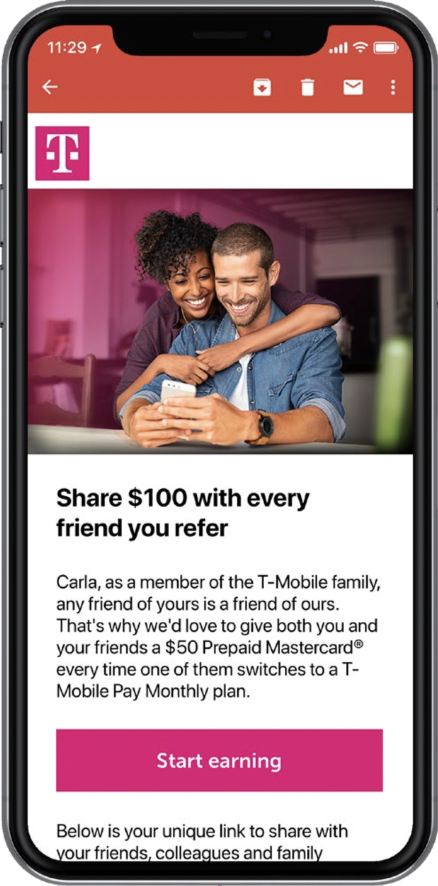
You should ask in your brand tone and language
When you’ve spent time creating a brand tone and voice that your customers appreciate, your entire referral program should be in that tone and language and each communication and part of your program should reflect that. Your software should let you change every word across the entire program to ensure that.
“The worst case is when the program is hosted on a microsite with a different URL, and maybe whoever is providing the software has got their brand all over it. Maybe it’s the URL that the referrer might share with their friend, maybe it’s referralplatform.com/brand. That’s awful’.”
Robin Bresnark, Director of Brand – Buyapowa
Hear from Katie Brooks, Product Owner at toob, why your referral program should be on brand and on your website:
Katie Brooks: "We know our customers and we know that they want things to be easy to find and accessible.
Which is why we put our refer friend scheme where we did on our website.
And also we not only wanted them to get to the page, but to stay on it.
And we did our research on how other people did their refer a friend schemes and it would [often] send you off to an external page or suddenly all the branding would look completely different.
And what we loved, was where we could put your embed on our page on our site. So people felt like they were still with toob and on toob's page and they didn't have to leave or go anywhere.
They're always on our website, a familiar place that they trust. So yeah, not only getting them to the site, but keeping them there because, like you say, people only have limited time. So if they don't think they're in the right place or they don't recognize it, they'll just click off.
Whereas our campaign, we can really make it feel like us, which is what people were on our site for in the first place."
See the full video here.
Your landing page should be fully on brand
Imagine clicking through to a referral program and seeing that the landing page looks nothing like the brand you know and love? Imagine it’s on a supplier’s URL and there are bold and prominent statements that this is ‘powered by [Supplier]’. As well as being jarring and creating dissonance with what you expected to see, you’re likely to stop and think if you’re in the right place. Maybe you wonder why the supplier’s logos are so prominently displayed, are you actually dealing with this unknown supplier rather than your beloved brand? Will the supplier gain rights to use your personal data and market other products to you? As highlighted by Steve Krug in his seminal publication Don’t Make Me Think, each time a customer stops and thinks, it’s a chance to exit the journey. So make sure your landing page is fully white-labeled and fully on-brand to encourage your audience to refer you.
“We put our refer friend scheme where we did on our website. We also not only wanted [our subscribers] to get to the page, but to stay on it. And we did our research on how other people did their refer a friend schemes and it would [often] send you off to an external page or suddenly all the branding would look completely different. And what we loved, was where we could put your embed on our page on our site. So people felt like they were still with toob and on toob’s page and they didn’t have to leave or go anywhere. They’re always on our website, a familiar place that they trust. [Because] if they don’t think they’re in the right place or they don’t recognize it, they’ll just click off.”
Katie Brooks, Product Owner – toob
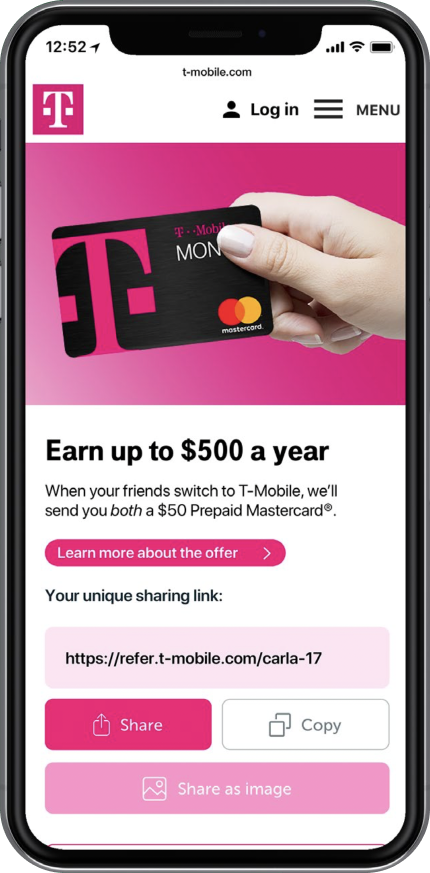
Sharing messages should be on-brand
If your customer’s going to recommend your brand to a friend, the customer is risking part of his or her reputation with that recommendation. So when making that recommendation the link should clearly be from the brand being recommended and not supplier.com/124613, which can look like phishing.
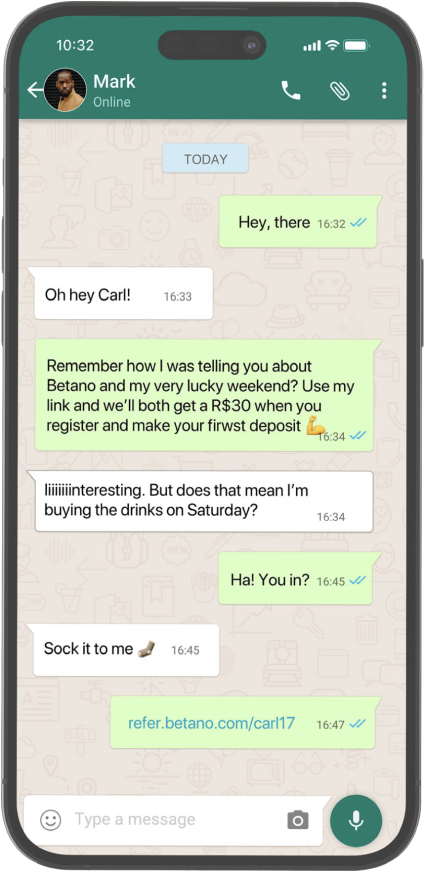
The landing page for the friend should be fully on-brand
Similar to the experience for your customer, the referred-in friend has received a recommendation from a friend about your brand. So if, on clicking through on the shared link, they see a supplier’s URL, supplier logos and prominent claims that the experience is ‘powered by supplier’, this is likely to be just as jarring as for your actual customer and will be less likely to lead to a conversion.
Subsequent communication
Once the referral process is underway, your customer has shared, the friend has clicked through and started to complete, each and every subsequent communication should be on-brand and white-labelled to maintain the intimacy and authenticity of the referral process. This should include the referral confirmation, reward payout and invitations to refer again.

Buyapowa: the 100% White Label Approach
For the reasons above, Buyapowa’s Reward Marketing Platform was designed from the ground up to be fully white labeled. Rather than trying to grab some free advertising at our clients’ expense, we realized that the authenticity of the connection between the brand and the referrer was paramount to success in referral marketing. And also that the experience for the referred-in friend has to be aligned with the recommendation made by the trusted friend in order to maximize the number of referrals.
We also understand that for both referrers and referred-in friends need to feel comfortable with the referral process, and be sure that their customer data will not be used by a supplier to market third party products and that the referral process is only between them and the recommended brand.
If you’d like to know more about how to maximize the potential of your referral program, please reach out.
Note: the images above are for illustration purposes only and are not actual images from the relevant programs