

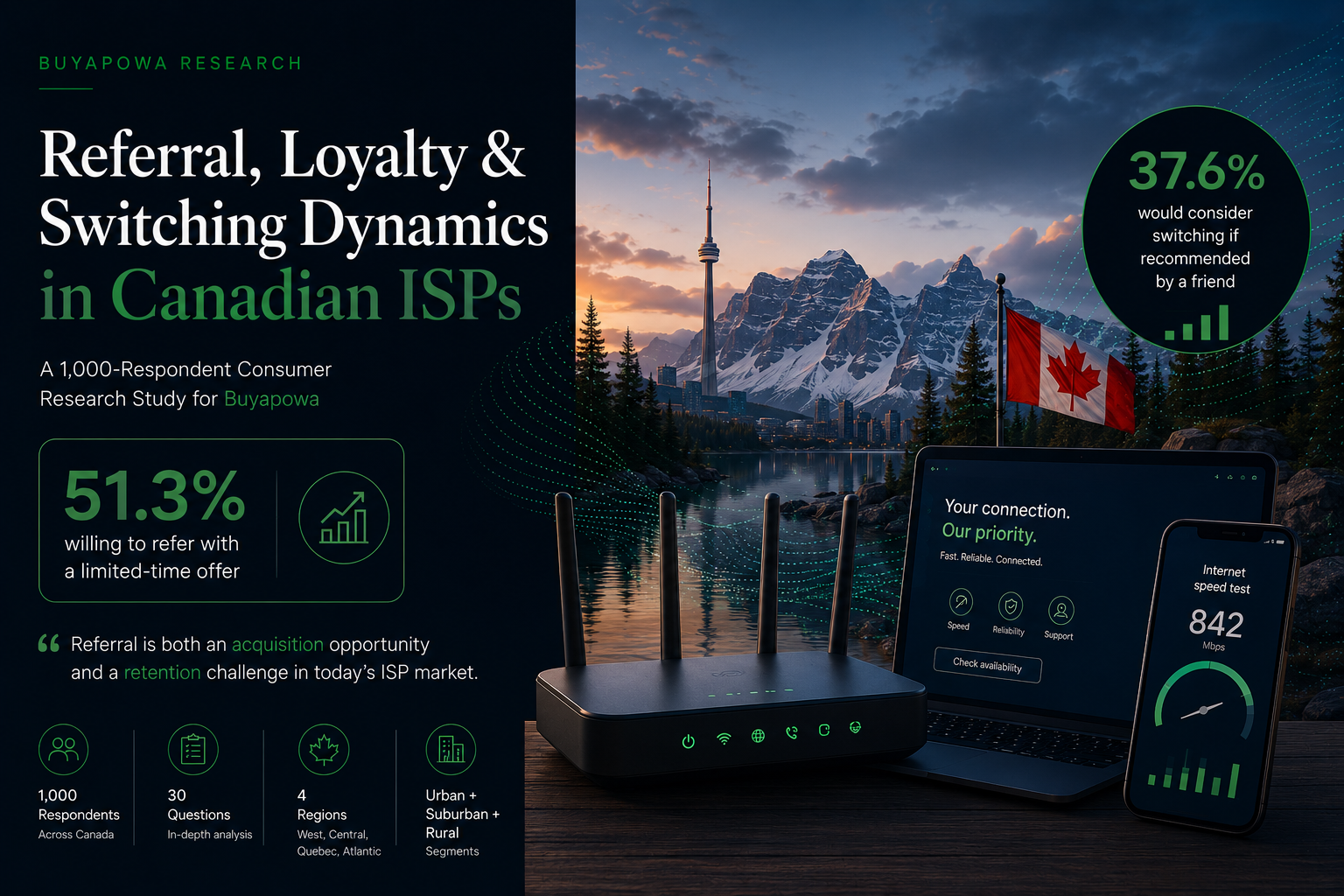
A 1,000-Respondent Consumer Research Study for Buyapowa
Executive Summary
Referral behaviour is already deeply embedded within the Canadian ISP market.
44.1% of customers say they have referred their current internet provider before, indicating that recommendation behaviour is already a normal and socially accepted part of the category.
Customers clearly discuss providers when:
- moving home
- comparing prices
- evaluating service quality
- upgrading speeds
- dealing with service issues
- helping friends and family choose a provider
Unlike many referral studies, however, the Canadian market reveals a different pattern.
Referral behaviour appears less dependent on incentives than expected.
47.9% of customers say they would refer a friend even without receiving a reward themselves.
When a limited-time referral offer is introduced, willingness rises to 51.3%.
This increase is meaningful, but relatively modest.
The implication is important.
Referral in Canadian telecoms appears to be driven more by trust and satisfaction than by promotional mechanics alone.
Customers are not waiting for incentives before recommending providers.
Many are already willing to advocate.
The challenge is converting goodwill into consistent action.
The study also highlights a second and potentially more important finding.
37.6% of customers say they would consider switching providers if recommended by a friend.
At the same time, only 7.0% say they are unlikely to leave their current provider.
This creates one of the most interesting contradictions in the research.
Customers are willing to recommend their providers, yet remain surprisingly open to leaving them.
Referral therefore becomes both:
- an acquisition opportunity
- and a retention challenge
The same recommendation behaviours that drive customer growth can also accelerate customer loss.
The regional findings reinforce this further.
Western Canada emerges as the country’s strongest referral market, combining:
- the highest historic referral activity
- the strongest program participation intent
- the highest levels of advocacy overall
Quebec displays a different behavioural profile, with lower referral penetration and lower participation intent, suggesting stronger barriers around activation and trust.
Atlantic Canada presents the highest switching vulnerability, indicating that referral programs should be viewed not only as growth mechanisms but also as protection against competitor word-of-mouth.
The strongest providers will therefore do more than simply launch referral programs.
They will integrate referral into broader customer experience, loyalty and retention strategies.
More broadly, the findings suggest referral is becoming increasingly important strategic infrastructure within Canadian telecoms.
Providers are no longer simply competing on:
- speed
- coverage
- pricing
They are increasingly competing for recommendation visibility inside the conversations where switching decisions are already taking shape.
1. Introduction & Market Context
Internet service providers occupy a unique position within referral marketing.
Unlike categories built around fashion, entertainment or lifestyle, internet services are fundamentally practical.
Customers rarely think about their ISP when everything is working properly.
And yet recommendation behaviour remains surprisingly influential.
People regularly ask friends, neighbors, colleagues and family members:
- Which provider are you with?
- Are your speeds reliable?
- Was installation straightforward?
- Is customer support any good?
- Are you paying a fair price?
- Would you recommend them?
These conversations become particularly common around:
- home moves
- contract renewals
- service disruptions
- pricing changes
- fiber upgrades
- switching decisions
This creates an important contradiction.
Internet providers are not highly social brands.
Yet recommendation behaviour still exerts significant influence over customer acquisition and retention.
Customers often hesitate to recommend providers because they worry:
- service quality may vary by location
- installation experiences may differ
- pricing may change over time
- customer service standards may deteriorate
Recommending an ISP creates a degree of personal accountability.
If the experience goes badly, the recommendation reflects on the person who made it.
At the same time, customers become highly willing to recommend providers when they believe:
- service is reliable
- pricing feels fair
- installation was handled well
- support can be trusted
- the recommendation genuinely helps someone
This means referral in Canadian telecoms operates across two connected behavioural systems:
- referral readiness and activation
- recommendation-driven switching and loyalty
The research explores both.
2. Methodology
This report explores referral behaviour, loyalty and switching dynamics within the Canadian ISP market, with particular focus on how these behaviours vary by region.
The objective is to help telecom providers better understand:
- when customers are willing to recommend
- what activates referral behaviour
- how incentives influence participation
- how recommendation affects switching behaviour
- how loyalty varies by region
- where referral programs are likely to generate the strongest returns
Sample
1,000 Canadian adults with home internet service.
Regions
- West
- Central
- Quebec
- Atlantic
Questionnaire Topics
The survey explored:
- historic referral behaviour
- willingness to refer
- response to incentives
- program participation intent
- switching risk
- loyalty indicators
- referral readiness
- behavioural responsiveness to referral programs
All results are presented as percentages.
3. Referral Readiness & Activation Gap
Referral behaviour is already established
44.1% of customers say they have referred their ISP previously.
That immediately changes the nature of the opportunity.
Referral in Canadian telecoms is not an emerging behaviour.
It is already established.
Customers are already discussing providers and already influencing one another’s decisions.
This means referral programs are primarily about capturing existing advocacy rather than creating it from scratch.
The strongest providers are not teaching customers how to recommend.
They are making it easier to do so.
The activation gap is smaller than expected
One of the most striking findings in the study is the relatively small gap between reward-free referral intent and incentive-driven referral intent.
47.9% say they would refer without a reward.
51.3% say they would refer when presented with a limited-time offer.
This differs from many other markets studied by Buyapowa.
In categories such as insurance, referral participation often rises dramatically once incentives are introduced.
Here, the increase is much smaller.
That suggests referral behaviour is being driven by something different.
Trust appears to be doing much of the heavy lifting already.
Customers are not primarily waiting for incentives.
Many are already willing to advocate if they believe:
- the service is reliable
- the recommendation is useful
- the process is straightforward
The challenge therefore appears less about motivation and more about activation.
Referral in Canada is trust-led rather than reward-led
This may be the single most important finding in the study.
The data suggests Canadian ISP referrals are driven primarily by confidence rather than compensation.
That does not mean rewards do not matter.
They clearly help.
But they appear to function as accelerators rather than foundations.
The strongest referral programs are therefore likely to focus on:
- trust
- simplicity
- transparency
- service confidence
before focusing on increasingly aggressive incentives.
Providers that attempt to compensate for poor customer experience with larger rewards are likely to struggle.
Providers that combine trust with simple incentives are likely to see much stronger results.
4. Referral Readiness Varies by Region
Western Canada – the country’s advocacy engine
The West stands out as the strongest referral market in the study.
49.2% of customers say they have referred their provider previously, significantly above the national average of 44.1%.
The region also records:
- the highest programparticipation intent (42.7%)
- strong reward-free referral willingness
- the highest overall advocacy levels
This combination is unusual.
In many markets, strong historic referral activity can indicate a degree of saturation.
That does not appear to be happening here.
Instead, referral behaviour appears both established and expandable.
Customers are already comfortable recommending providers and remain open to participating in formal programs.
The implication is straightforward.
Western Canada is likely to be the easiest place to scale referral activity quickly.
The challenge is not creating advocacy.
It is capturing more of the advocacy that already exists.
Central Canada – the operational benchmark
Central Canada sits remarkably close to national averages across almost every major measure.
Referral activity is healthy.
Program participation intent is strong.
Switching risk remains significant.
This creates a market that behaves very much like the overall Canadian ISP category.
For providers, Central Canada should probably function as the benchmark against which referral performance is measured.
The region may not generate the strongest headline figures.
But it provides the clearest picture of how a referral program is likely to perform at scale.
Quebec – advocacy exists but activation appears weaker
Quebec displays a noticeably different profile.
Only 38.0% of customers say they have referred previously, significantly below the national average.
Program participation intent is also the lowest of any region.
Importantly, however, switching risk is not materially lower.
This creates an interesting dynamic.
The challenge does not appear to be customer satisfaction alone.
Instead, it suggests that recommendation behaviour may be more cautious, selective or private.
Customers may simply require:
- greater confidence
- stronger trust signals
- clearer program communication
- more visible proof of value
before actively participating.
This is an important distinction.
A referral challenge caused by trust is solved differently from a referral challenge caused by apathy.
Quebec appears to be the former.
Atlantic Canada – high risk, high importance
Atlantic Canada produces one of the most strategically important findings in the study.
Historic referral activity is relatively low.
Program participation intent is relatively average.
But switching risk is the highest in the country.
40% say they would consider switching providers if recommended by a friend.
That makes recommendation influence particularly important.
In practical terms, providers operating in Atlantic Canada may have more to lose from inactive referral programs than operators elsewhere.
If positive customer advocacy is not being actively encouraged, competitor advocacy can quickly fill the gap.
This creates a region where referral should arguably be viewed as a defensive strategy as much as an acquisition strategy.
5. Referral Behaviour Appears Trust-Led Rather Than Reward-Led
One of the most interesting findings in the entire study is how little incentives appear to change behaviour.
In many industries, incentives create dramatic shifts in participation.
Insurance is a good example.
Without rewards, participation often drops sharply.
The Canadian ISP market behaves differently.
The gap between:
- reward-free referral intent (47.9%)
- incentive-driven referral intent (51.3%)
is relatively modest.
This suggests that referral behaviour is being driven by something deeper than promotional mechanics.
The most likely explanation is trust.
Customers appear willing to recommend providers when they feel confident the recommendation will genuinely help somebody.
The reward acts as reinforcement.
Not as the primary motivator.
This has important implications for program design.
The strongest programs are unlikely to win simply because they offer the largest incentive.
They are more likely to win because they combine:
- trusted service
- simple participation
- clear rewards
- confidence in the recommendation
Providers often focus heavily on reward size.
This research suggests trust may be a more important variable.
Recommendations are practical rather than emotional
The findings also suggest that ISP referrals are fundamentally practical.
Customers are rarely recommending providers because they feel emotionally attached to the brand.
Instead, they are recommending:
- reliable service
- fair pricing
- dependable support
- good installation experiences
- strong value for money
This distinction matters.
Practical recommendations behave differently from emotional recommendations.
Customers do not need to love their ISP.
They simply need to believe the recommendation will reflect well on them.
That creates a different referral environment from categories driven by:
- identity
- aspiration
- status
- lifestyle
The recommendation is less about self-expression and more about usefulness.
That helps explain why incentives play a supporting role rather than a dominant one.
The recommendation itself already carries value.
6. Switching Risk & Loyalty Vulnerability
Recommendation-driven switching remains significant
37.6% of customers say they would consider switching providers if recommended by a trusted friend.
This is strategically significant.
Many telecom operators still think of switching primarily through the lens of:
- price
- contract terms
- promotions
- network quality
The data suggests recommendation influence deserves equal attention.
Trusted recommendations reduce uncertainty.
Customers may hesitate to trust:
- advertising
- promotional claims
- comparison sites
But they often trust real experiences shared by people they know.
That makes referral one of the most powerful behavioural acquisition mechanisms in the category.
The same conversations drive acquisition and churn
This may be the most important strategic finding in the study.
The same conversations that create referrals also create switching.
Customers discuss:
- service quality
- pricing
- support experiences
- installation
- reliability
Those conversations can create:
- advocacy
- acquisition
- churn
depending on which provider occupies the recommendation space.
This changes how referral should be viewed.
Referral programs are not simply acquisition tools.
They are also competitive defence systems.
Every positive recommendation generated for your provider is one less recommendation available to a competitor.
Loyalty appears surprisingly fragile
Only 7% of customers say they are unlikely to leave their current provider.
This does not mean everyone is preparing to switch tomorrow.
It does suggest that loyalty is often conditional rather than absolute.
Many customers stay because:
- switching feels unnecessary
- alternatives are unclear
- current service is acceptable
rather than because they feel deeply committed to the provider.
That creates opportunity.
But it also creates vulnerability.
The providers most likely to succeed over time will be those that convert satisfaction into advocacy before competitors do.
7. Urbanicity Doesn’t Matter Here – And That Matters
One of the more surprising findings in the study is how consistent referral behaviour remains across regions.
In many categories, geography creates dramatic differences.
That is not what appears to be happening here.
Participation intent remains remarkably stable.
Referral willingness remains relatively stable.
Switching risk remains relatively stable.
This consistency suggests that the primary determinants of success are likely to be:
- program design
- service quality
- ease of participation
- referral visibility
rather than regional targeting alone.
This is useful because it means operators can focus on execution rather than over-segmentation.
The challenge is less about finding willing customers.
The challenge is making participation feel easy and worthwhile.
8. Strategic Implications for Growth
Several themes emerge consistently throughout the research.
The first is that referral already exists.
Customers are already recommending providers informally.
The opportunity is to formalize behaviour that is already happening.
The second is that trust matters more than incentives.
Incentives help.
But they appear to amplify existing goodwill rather than create it.
The third is that recommendation visibility itself matters.
Customers are already discussing providers.
The question is whether those conversations benefit your brand or someone else’s.
Finally, referral should increasingly be viewed as a primary acquisition channel rather than a secondary loyalty initiative.
The combination of:
- trust
- recommendation influence
- customer confidence
creates acquisition dynamics that many paid channels struggle to replicate.
9. Strategic Implications for Retention
Referral programs are often discussed as acquisition tools.
The findings suggest that perspective is incomplete.
The same social behaviours that create customer growth also create customer vulnerability.
Customers do not simply receive recommendations when they are actively shopping for a new provider.
Recommendations often influence how customers think about their existing provider as well.
A customer who repeatedly hears positive stories about competing providers may gradually become more receptive to switching, even if they were not actively considering it beforehand.
That is why referral increasingly sits at the intersection of:
- acquisition
- retention
- advocacy
- competitive defence
The providers most likely to succeed over the next few years are unlikely to be the ones spending the most on acquisition.
They are more likely to be the ones generating the most positive recommendation activity within their existing customer base.
Advocacy creates retention benefits
One of the most overlooked aspects of referral programs is their effect on the people doing the referring.
Referral is not only a customer acquisition event.
It is also a customer engagement event.
When customers recommend a provider, they are publicly validating a decision they have already made.
That creates a subtle but important psychological effect.
The customer becomes more invested in the relationship.
The recommendation reinforces:
- confidence
- commitment
- satisfaction
This helps explain why referred customers and referring customers often display:
- higher retention
- greater engagement
- stronger loyalty
- higher lifetime value
The strongest providers therefore view referral as something that strengthens both sides of the customer relationship.
Customer experience remains the foundation
The research repeatedly points back to one theme.
Trust.
Customers appear willing to advocate when they believe:
- service is dependable
- support is responsive
- pricing feels fair
- the recommendation will reflect well on them
This means customer experience is not simply a retention driver.
It is also an advocacy driver.
Every improvement in:
- installation quality
- issue resolution
- service reliability
- billing transparency
has the potential to increase referral participation as well.
The strongest referral programs are rarely built on incentives alone.
They are built on customer experiences worth recommending.
10. Recommended Program Design
The findings point towards a number of practical design principles.
The strongest ISP referral programs in Canada are likely to include:
- dual-sided rewards
- simple sharing journeys
- visible referral tracking
- limited-time activation campaigns
- mobile-first participation
- transparent terms
- customer-friendly reward timing
- strong onboarding integration
Most importantly, they should feel easy.
The data consistently suggests that simplicity is one of the most important drivers of participation.
Customers should not need to:
- search for the program
- remember complicated mechanics
- complete lengthy forms
- wait for unclear outcomes
The strongest programs reduce effort wherever possible.
Use urgency carefully
One of the more nuanced findings concerns limited-time offers.
They clearly work.
Referral willingness increases when urgency is introduced.
However, the uplift is relatively modest compared with many other industries.
This suggests urgency should be viewed as an amplifier rather than a primary strategy.
The strongest providers are likely to use:
- seasonal boosts
- campaign windows
- promotional periods
to accelerate behaviour that already exists rather than attempting to manufacture demand from scratch.
Keep the friend benefit visible
Nearly half of respondents say the friend’s reward is very important or essential.
This is not a secondary design consideration.
It is a core part of program performance.
Customers are significantly more comfortable recommending providers when they know:
- the friend benefits
- the value is clear
- the offer feels worthwhile
The strongest referral programs therefore make the friend’s reward highly visible rather than treating it as supporting information.
Design around confidence, not just incentives
The Canadian data consistently points towards confidence as the primary driver of referral behaviour.
Customers appear willing to advocate when they trust:
- the service
- the provider
- the recommendation
This means program design should focus heavily on:
- transparency
- simplicity
- trust-building
- ease of participation
alongside rewards.
The strongest programs are unlikely to be the ones offering the largest incentives.
They are more likely to be the ones making customers feel comfortable recommending.
11. What Canadian ISP Marketers Should Do Next
The findings suggest five immediate priorities.
1. Formalize existing advocacy
44.1% of customers have already referred.
The opportunity is not creating referral behaviour.
It is capturing more of the behaviour that already exists.
2. Make referral effortless
The majority of customers expect referral participation to feel extremely simple.
Reducing friction should be a primary optimization priority.
3. Treat referral as retention infrastructure
Recommendation influence affects acquisition and churn simultaneously.
Referral should sit alongside retention planning rather than outside it.
4. Focus on trust before rewards
The relatively small incentive uplift suggests confidence matters more than reward size.
Customer experience remains the foundation.
5. Use regional differences intelligently
Western Canada offers the strongest immediate scaling opportunity.
Atlantic Canada presents the strongest defensive need.
Quebec requires more emphasis on trust and clarity.
Program strategy should reflect those realities.
Conclusion
The Canadian ISP market presents a substantial referral opportunity.
Unlike many industries, recommendation behaviour is already deeply embedded within the category.
44.1% of customers have referred their provider previously.
That means providers are not trying to create advocacy from scratch.
They are trying to activate and capture advocacy that already exists.
The research reveals an important distinction.
Referral in Canadian telecoms appears less reward-driven than many other categories.
Customers are already willing to recommend providers when they feel confident doing so.
The challenge is making participation:
- visible
- simple
- worthwhile
- easy to trust
rather than relying solely on increasingly large incentives.
At the same time, recommendation influence creates meaningful switching pressure.
37.6% would consider switching providers if recommended by a friend.
Only 7% describe themselves as unlikely to leave.
This means referral increasingly influences both:
- customer acquisition
- customer retention
The same conversations that create growth can also create customer loss.
The providers that succeed will therefore be the ones that actively participate in those conversations rather than leaving them to chance.
The strongest programs will:
- reinforce trust
- reduce friction
- reward advocacy
- make participation effortless
- integrate referral into the broader customer experience
Most importantly, they will recognize that referral is no longer simply a marketing tactic.
It is becoming part of how telecom providers compete for:
- trust
- recommendation visibility
- customer growth
- long-term loyalty
In Canadian telecoms, referral is no longer an optional add-on.
It is increasingly becoming strategic infrastructure.