

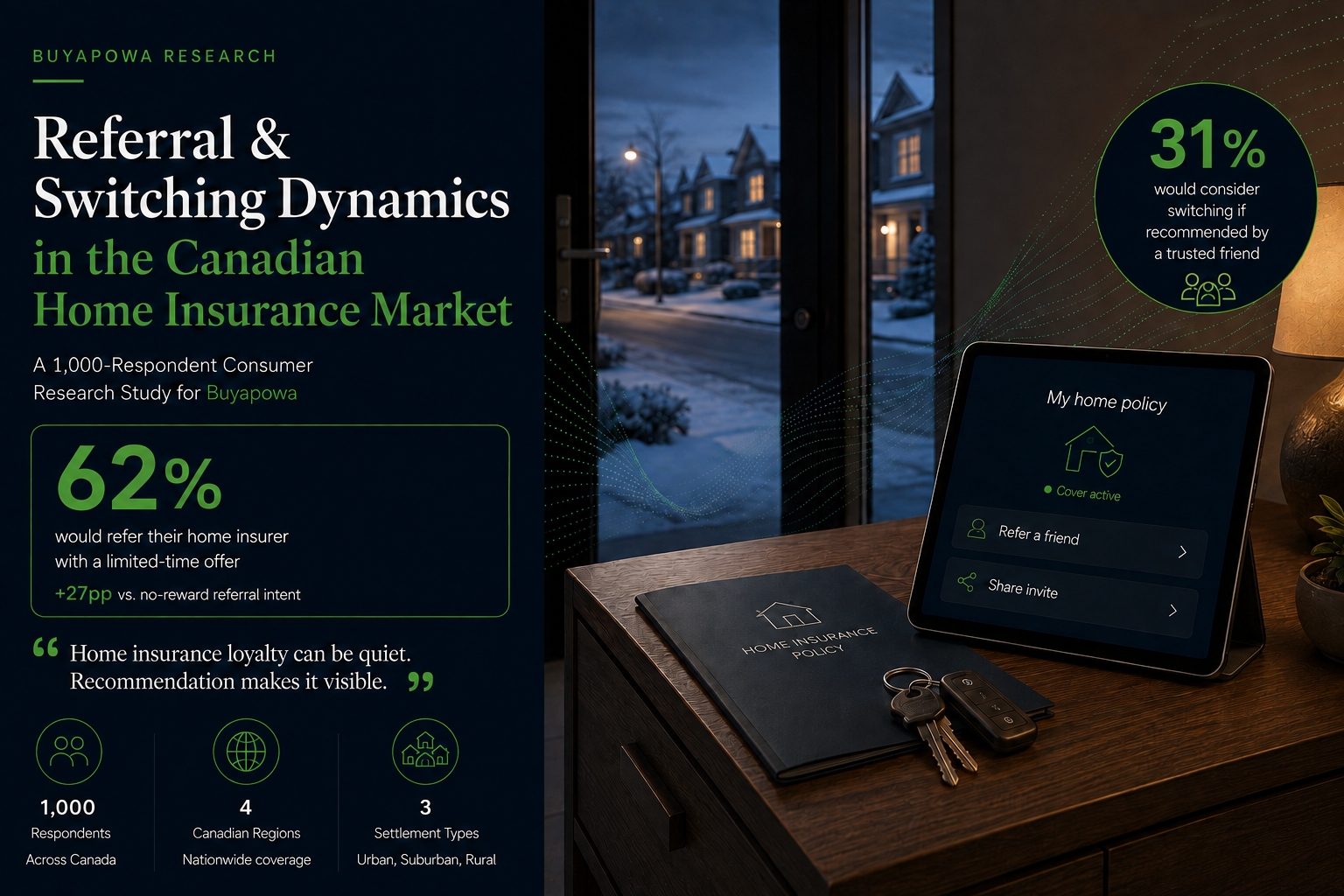
Research among 1,000 Canadian home insurance customers shows a market with solid satisfaction, substantial referral readiness and more switching exposure than loyalty figures alone suggest.
Home insurance is not a product most customers think about every day. It sits quietly in the background until renewal, a house move, a premium increase or, most importantly, a claim. That low frequency can make referral appear less natural than it is in banking, telecoms or retail. Yet the decision is intensely personal. When people do talk about home insurance, they are usually helping somebody protect their largest asset or make sense of a purchase that feels both necessary and difficult to judge.
That gives personal recommendation unusual weight. A friend cannot guarantee the premium another household will receive or predict how an insurer will handle a future claim, but they can lend confidence to a decision that otherwise depends heavily on price-comparison screens and policy wording. Our research among 1,000 Canadian home insurance customers shows that this influence is already active: 49.1% have recommended their provider before, including 18.5% who have done so more than once.
The opportunity is not simply to ask those customers to say something nice. Organic willingness is much narrower than historic behavior suggests. Only 35.0% say they would refer without a reward, while 38.0% have never referred but would consider it. The market therefore contains a sizable group of potential advocates who are neither unwilling nor fully activated. They need a timely reason to act, a proposition they feel comfortable putting their name behind and a journey simple enough to complete while the recommendation is still relevant.
There is also a defensive dimension. Although 66.8% are satisfied or very satisfied with their current insurer, 31.2% would consider switching if a friend recommended another provider. Home insurance loyalty may look stable when measured as present intention, but a trusted recommendation can introduce a credible alternative at exactly the moment renewal makes customers receptive. Referral is consequently both an acquisition opportunity and a measure of how exposed the existing book is to somebody else’s advocates.
Referral is already happening, but it needs a reason
The strongest signal in the research is the effect of a limited-time offer. Without a reward, 35.0% say they would refer their provider. With a time-limited incentive, likely referral rises to 62.0%, a 27-point increase. The uplift is too large to be explained as a marginal sweetener. It shows that much of the available advocacy is waiting for a prompt that turns “I probably would” into something worth doing now.
That distinction matters in a category where good intentions are easy to postpone. Customers may be perfectly content with their insurer, but they are unlikely to wake up thinking about whom they could refer. A limited-time offer creates a reason to notice the program and a reason to share it while the thought is fresh. The strongest programs will still be always available, but they will use concentrated bursts of value around moments when customers have recently been reminded of their cover: renewal, a successful service interaction, a policy update, a bundle saving or the resolution of a claim.
The response is broad rather than confined to one part of Canada. Likely referral with a limited-time offer reaches 59.7% in the West, 63.6% in Central Canada, 59.2% in Quebec and 70.0% in Atlantic Canada. Urban, suburban and rural customers all sit at roughly 62%. That consistency supports a national program with regional and audience-level adjustments, rather than a collection of different mechanics that becomes difficult to operate or understand.
Reward design can remain straightforward. Cash is the leading preference at 31.0%, followed by gift cards at 24.8%; both sit ahead of bill credits at 17.4% and premium discounts at 14.2%. Operational convenience should not be mistaken for customer appeal. Bill credit can be useful when the objective is to reinforce retention, but flexible, immediately understood value is more likely to attract attention when participation is the priority.
The more important principle is mutual value. A reward for both the customer and the friend is the most popular structure, chosen by 34.8%, and 69.1% say it matters that the person they refer also receives a reward or discount. That is particularly important in insurance, where the customer is not merely passing on a voucher. They are endorsing a provider that may one day be asked to respond when a home has been damaged or a family is under pressure. A two-sided offer helps the recommendation feel generous rather than self-serving.
Trust and convenience decide whether customers will put their name to it
An incentive can create attention, but it cannot carry the whole proposition. The largest hesitation is whether the friend will receive a good price, cited by 40.7% of customers. Concern about the claims experience follows at 31.0%, while 28.6% worry that the referral process may feel awkward. Others do not feel sufficiently informed about policy details or simply do not want to appear to be selling insurance to someone they know.
These are forms of social risk. A customer may be satisfied with their own premium and service yet remain cautious about recommending an outcome they cannot control. The friend may have a different property, location, claims history or coverage requirement. The referrer therefore needs confidence not that every quote will be cheapest, but that the friend will receive a worthwhile offer and a credible experience. The program language should make that benefit explicit without asking the customer to overclaim.
The conditions customers say they need before referring reinforce the point. Trust in the claims process leads at 38.2%, satisfaction with their own price follows at 36.9%, a simple referral process reaches 36.8% and confidence that the friend will receive a good offer stands at 36.0%. Referral performance will reflect the wider customer experience. A polished sharing journey cannot compensate for doubts about value or claims, but it can make strong customer confidence easier to act upon.
The journey itself needs to be almost effortless. A one-click link is preferred by 30.6%, while 26.5% favor a form that takes less than a minute. Together, 57.1% are asking for a very low-friction experience. Text message is the leading sharing route at 45.8%, followed by a referral link at 36.6% and email at 34.5%. Social media is much less important at 16.5%, which fits the category: home insurance recommendations usually happen privately between people who are already discussing a move, a renewal or a household expense.
The practical design is therefore mobile-first and private. Customers should be able to open the program from their account, understand the value for both parties immediately and send a pre-populated message through the channel they already use. The insurer can protect economics by paying once the friend buys a policy or remains active for a defined period; customers accept those timings. What matters is that eligibility, fulfillment and the friend’s benefit are visible before the link is shared.
The same recommendation that wins a customer can also move one away
Referral becomes more strategically important when viewed alongside switching. Some 39.2% say they have no plans to leave their current provider, yet 31.2% would consider switching after a friend’s recommendation. Those measures capture different states of mind. The first describes what customers expect to do without a new stimulus. The second introduces a trusted person, a credible alternative and, often, a reason to compare at renewal.
Price remains the most obvious trigger. Premium increases are selected by 48.2% as a reason to leave, with better offers elsewhere at 33.1%. Poor claims experience follows at 24.9% and poor service at 20.3%. This does not describe a market in which loyalty is absent. It describes loyalty that can be interrupted when a practical frustration meets a recommendation from somebody the customer trusts.
Atlantic Canada is the clearest example of opportunity and exposure arriving together. Seventy percent would refer with a limited-time offer and 54.0% are likely to join a program during the next six months, but 40.0% would also consider switching if a friend recommended another insurer. Central Canada combines the highest prior-referral rate among the regions, at 50.8%, with a 63.6% response to a limited-time offer and switching openness of 33.3%. These audiences justify strong acquisition activity, but they also need advocacy and value reminders before competitors reach them.
Rural customers offer a different balance. They have the highest historic referral level at 51.3% and the highest near-term program participation at 55.9%, while switching openness is lower at 25.7%. That makes them especially attractive advocates, provided the invitation feels useful and personal rather than like a broad promotion. Suburban customers have referred at a similar rate, 50.0%, but near-term participation drops to 45.0%, suggesting that the program needs a sharper reason to re-engage them now.
The operating model need not become complicated. A national, always-available referral journey can provide the common foundation: one clear two-sided proposition, mobile sharing, transparent fulfillment and consistent measurement. Limited-time campaigns can then increase attention in the regions or customer moments where the combination of referral readiness and switching exposure is greatest. Performance should be read across acquisition and retention, including conversion, cost per policy, reward fulfillment, renewal behavior and the quality of referred customers over time.
Canadian home insurers already have the raw material for a productive referral channel. Almost half of customers have referred before, more than half expect to participate in a program soon and a well-timed offer lifts referral willingness to 62.0%. The constraint is not a lack of goodwill. It is the distance between being satisfied and being willing to recommend a financial product whose future value will only become clear when something goes wrong.
Closing that distance requires more than a reward button. Customers need to believe the friend will receive fair value, feel confident that the insurer can be trusted when a claim matters and share without friction or embarrassment. Insurers that bring those elements together can turn quiet loyalty into visible advocacy. They will also be better placed to defend their own customers in a market where the same trusted recommendation can just as easily open the door to a competitor.