

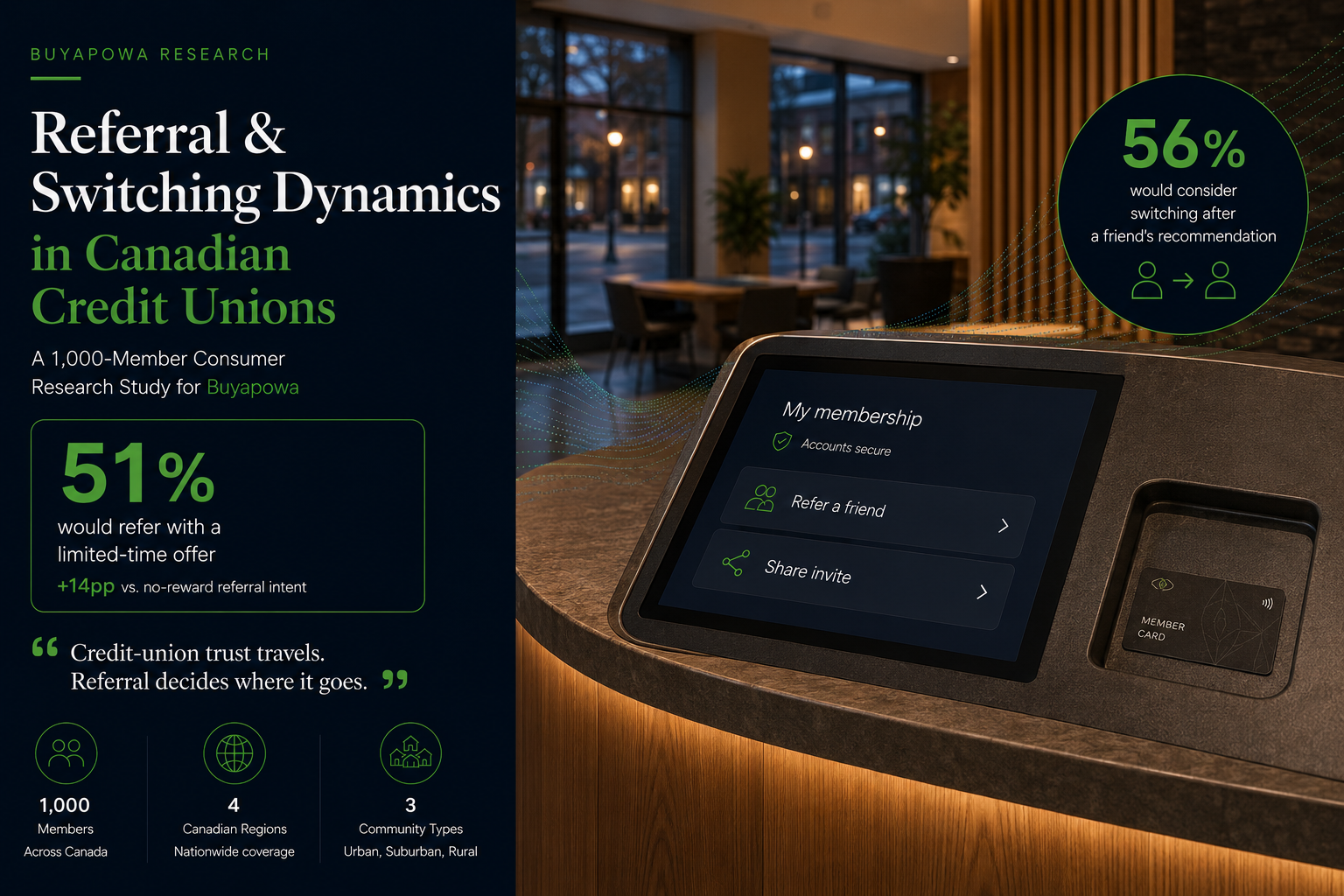
Research among 1,000 Canadian credit-union members shows that trust is both a growth advantage and a switching risk. The opportunity is to activate it without making referral feel like selling.
Credit unions have always grown through recommendation. Long before referral became a measurable acquisition channel, members introduced family, friends and colleagues because the relationship felt worth sharing. A useful rate, a supportive branch interaction or a piece of financial guidance did more than satisfy one member; it gave that member a story they could pass on.
That history creates an enviable advantage, but it can also encourage complacency. Informal advocacy is valuable precisely because it feels natural, yet what stays informal is difficult to prompt, track or scale. It is also available to competitors. The trust that makes a member willing to recommend their credit union can make the same person willing to listen when somebody they know recommends a better offer elsewhere.
Our research among 1,000 Canadian credit-union and caisse-populaire members across four regions and three community types exposes both sides of that equation. Some 45.8% have already referred, another 42.1% would consider it, and 54.8% are likely to join a referral program in the next six months. At the same time, 55.8% would consider switching after a friend recommended another provider with better benefits. The strategic question is no longer whether trust drives word of mouth. It is which institution gives that trust somewhere useful to go.
Trust needs a moment, not a slogan
The addressable audience is unusually broad. Combining members who have referred with those willing to consider it gives credit unions 87.9% of their base with some openness to advocacy. That is not an audience that needs to be persuaded that recommendations matter. It needs a relevant reason to act and a journey simple enough to preserve the natural quality of the recommendation.
Satisfaction creates the foundation but not the behavior. Two-thirds of members—66.9%—are satisfied or very satisfied with their credit union, while only 36.5% would refer without a reward. The distance between those figures is important. A member can feel positive about the institution and still have no obvious reason to introduce it into a conversation today. Waiting for satisfaction to become action on its own leaves much of the available advocacy dormant.
A limited-time offer closes part of that gap. Likely referral rises to 50.7%, a 14.2-point lift over no-reward intent. The response is consistent across regions, ranging from 50.0% in Quebec to 51.0% in both the West and Atlantic Canada. Rural and suburban members respond particularly well, at 53.3% and 53.9% respectively. Urgency is not replacing trust; it is making the opportunity to use that trust visible.
The best activation moments will therefore feel connected to the member relationship rather than pasted onto it. A successful onboarding, mortgage or loan approval, savings milestone, positive service interaction or community-linked initiative gives the invitation context. Seasonal and product-led campaigns can add urgency, but the underlying signal should remain the same: the credit union has delivered something worth sharing, and now there is a clear benefit in sharing it.
The friend benefit removes the social risk
Credit-union referral carries an emotional constraint that reward value alone cannot solve. The most common hesitation is not wanting to seem pushy, selected by 35.3% of members. Another 30.1% are not confident enough in the experience and 28.9% are unsure whether their friend would be eligible. Members are not simply asking whether participation pays; they are asking whether the recommendation could cost them social capital.
That is why the benefit for the friend matters so much. More than eight in ten members—81.3%—say it is important that the person they refer also receives a reward or benefit. A visible, relevant friend offer changes the meaning of the message. Instead of asking someone to help the member earn, it allows the member to share access to something useful. The program starts to feel like an extension of cooperative value rather than a sales commission.
Cash is the clearest headline reward, preferred by 41.7%, with gift cards at 27.5%. Together they account for 69.2% of first choices, well ahead of account credit or fee rebate at 11.9%. Yet account credits should not be dismissed: 66.0% say that one would make them more likely to refer. The distinction is one of role. Cash and gift cards provide immediate acquisition appeal; an account credit can reinforce membership value as a loyalty-oriented option or part of a choice-based reward menu.
Value and certainty matter as well. The most popular range is C$50–C$100 at 35.7%, followed by C$25–C$50 at 32.2%, putting 67.9% of members between C$25 and C$100. Almost two-thirds prefer a guaranteed reward or a mix of guaranteed and conditional value, while 66.9% expect payment immediately or within a month. A theoretically generous offer can still feel weak if eligibility is obscure, the friend benefit is buried or the reward appears too distant to trust.
The invitation should be asked only after the institution has earned it. A consistently good experience is a prerequisite for 84.3% of members and great customer service for 80.5%. Those figures turn referral into an operational discipline as much as a marketing one: the program should recognize the moments when confidence is high, suppress prompts after poor experiences and give the member enough clarity to recommend the institution without qualification.
Make private recommendations visible—and defensible
The channel evidence is remarkably clear. Text message is preferred by 63.7% of members, email by 54.2%, in-person referral by 44.8% and shareable links by 42.7%; social media is lower at 29.4%. Credit-union advocacy is primarily a direct exchange, not a public broadcast. The ideal experience should help a member send a natural message to one person, not turn them into a brand promoter in front of an audience.
Ease cannot be treated as a small usability improvement. Nearly half of members say the process must be very simple, and another 38.1% will accept only a few clicks. In total, 87.6% expect a near-frictionless journey. The strongest design is therefore link-led and mobile-friendly, with clear eligibility, prewritten copy that can be personalized, and no requirement for the member to collect information the friend could provide themselves.
Tracking then turns a private recommendation into a dependable program. In-app status is preferred by 34.8%, email notifications by 32.2% and a web portal by 20.3%. Members do not need an elaborate game; they need to know that the referral arrived, whether the friend completed the required action and when the reward will be paid. That visibility protects confidence in the program and makes a second recommendation more likely.
The retention implications are harder to ignore. Some 55.8% would consider switching following a friend’s recommendation, compared with only 36.2% who say they do not plan to leave. Better savings or loan rates are a switching driver for 42.8%, lower fees for 41.4% and better service for 36.0%. Members are not abandoning the value of trust; they are applying it to an alternative that appears economically or experientially stronger.
The exposure is broad, but some communities stand out. Atlantic members combine the highest referral history at 52.0% with the highest switching openness at 66.0%. Rural members are the strongest natural advocates, with 55.3% having referred, yet 60.5% would consider moving after a recommendation. Suburban members are the most likely to join a referral program at 58.9%. These differences call for different activation and retention emphasis, not separate theories of referral.
Canadian credit unions already own something most financial institutions spend heavily trying to build: a member relationship people are willing to put their name behind. But trust is transferable. A timely, double-sided program can make advocacy visible, give members a helpful reason to share and reinforce why the relationship is worth keeping. Leave that trust unmanaged, and another institution’s member may be the person who activates it first.