

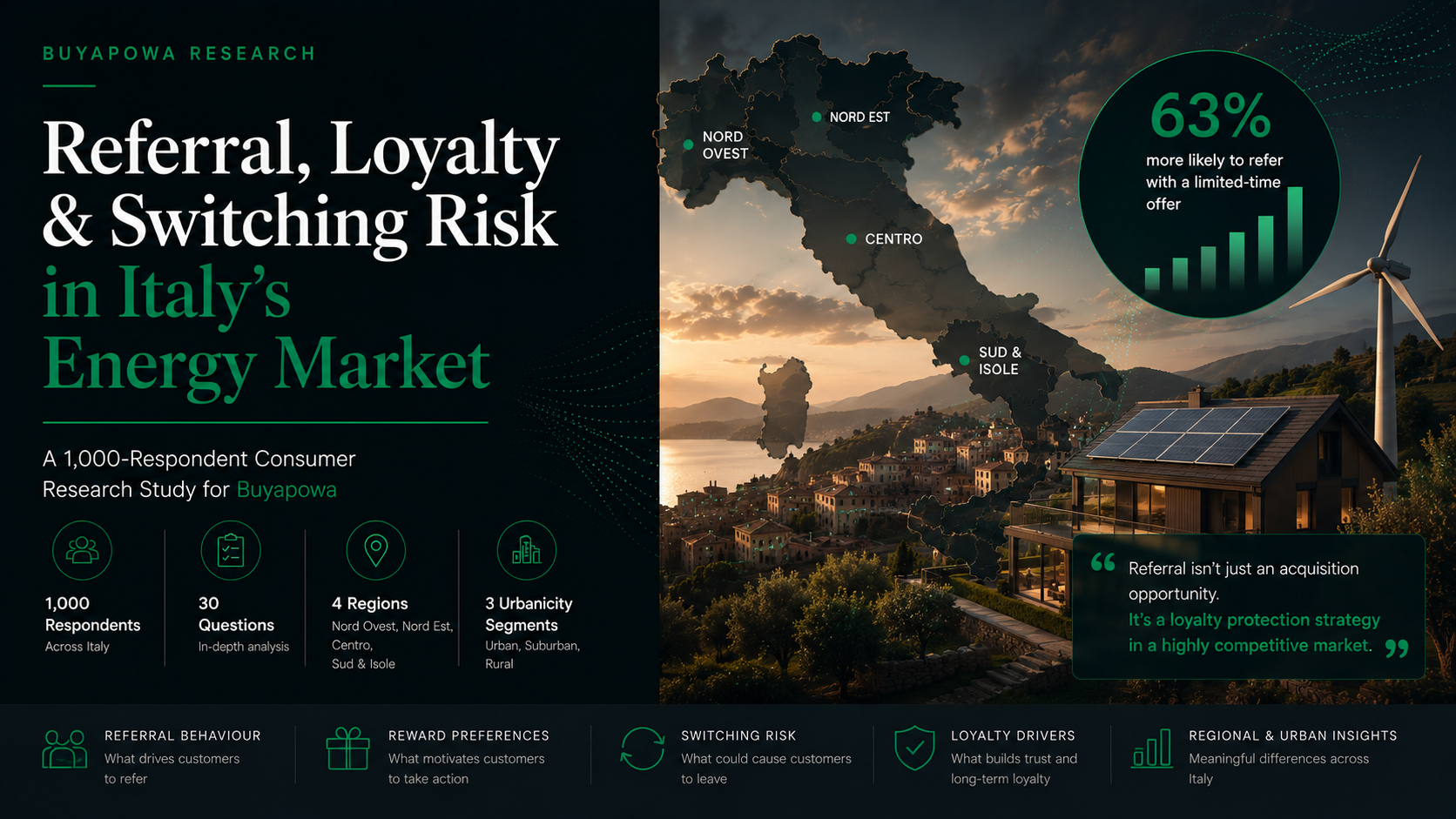
A 1,000-Respondent Consumer Research Study for Buyapowa
Executive Summary
Italy’s retail energy market shows a strong but underdeveloped referral opportunity.
Although energy supply is often treated as a low-engagement category, the research suggests customers are more willing to recommend providers than many suppliers may assume. Overall, 45% of customers say they have already referred their current energy supplier to someone they know.
That is a meaningful base of existing advocacy in a category often perceived as purely transactional.
Referral willingness extends further when future behavior is considered:
- 51% say they would recommend their supplier even without receiving a reward
- 63% say they would be more likely to refer with a limited-time offer
- 58% say they would likely participate in a referral program within the next six months
These findings suggest referral behavior in Italian energy is not purely incentive-led. Many customers already appear willing to recommend when they trust the supplier, believe the pricing is fair or think a friend could benefit from switching.
At the same time, urgency clearly matters. The uplift from 51% baseline willingness to 63% with a limited-time offer shows that promotional framing can move customers from passive goodwill to action.
Urban customers represent the strongest near-term activation audience. They lead across historic referrals, reward-free willingness, limited-time offer response and program participation intent:
- 49% have already referred
- 66% respond positively to limited-time offers
- 61% say they would likely join a program
Regionally, Nord Ovest appears especially strong. It combines the highest willingness to refer without incentives at 55%, strong historic referral behavior at 48%, and high program participation intent at 60%.
This suggests a market where both trust-led advocacy and campaign-led activation could perform particularly well.
But the research also shows that referral is not only an acquisition opportunity. It is also a defensive issue.
Overall:
- 52% of customers say they would likely switch supplier if a friend recommended another provider offering better value
- only 38% say they do not plan to leave their current supplier
This means customer loyalty remains relatively fragile, even where satisfaction levels are moderate.
The implication is increasingly clear: referral in Italian energy should be treated as both a growth mechanism and a loyalty-protection tool.
Suppliers that activate their own advocates can acquire customers more efficiently, but they can also occupy the recommendation space before competitors do.
The strongest programs are likely to combine:
- clear customer rewards
- visible friend benefits
- limited-time boosts
- simple sharing journeys
- strong reassurance around value, transparency and service reliability
1. Introduction & Method
This report explores what drives customer referrals and switching behavior in the Italian retail energy market, with particular focus on how these behaviors vary by region and urbanicity.
Energy is often described as a low-engagement category. Most customers do not think about their supplier every day. Engagement tends to happen around:
- bill reviews
- price increases
- switching comparisons
- service issues
- contract renewals
But low engagement does not mean low influence.
The research suggests Italian consumers are still willing to recommend suppliers when they believe the provider offers good value, reliable service and a fair customer experience. In a market where household energy costs remain highly visible, helping a friend reduce bills can be a strong motivation.
That makes referral more relevant than it may first appear.
Energy is not an impulse category. Customers are not recommending something entertaining or aspirational. They are recommending a supplier that affects household budgets, trust and everyday reliability.
That creates both opportunity and hesitation.
A customer may be willing to recommend a supplier if pricing feels competitive and the experience has been dependable. But they may also worry about whether the friend will receive the same value, whether prices may later rise, or whether recommending an energy provider feels overly promotional.
The study therefore explores referral through two connected lenses.
First:
- referral readiness
- willingness to recommend
- motivators and activation triggers
Second:
- switching vulnerability
- openness to friend recommendations
- competitive exposure
The findings suggest both forces are active simultaneously.
On the positive side:
- 45% have referred before
- 58% are likely to join a referral program soon
On the risk side:
- 52% say they would likely switch if a friend recommended another supplier offering better value
That creates a meaningful strategic opportunity for providers capable of mobilizing satisfied customers before competitors do.
Sample
1,000 Italian adults responsible for choosing or managing their household electricity or gas supplier.
Segments
Regions
- Nord Ovest
- Nord Est
- Centro
- Sud & Isole
Urbanicity
- Urban
- Suburban
- Rural
Questionnaire
30 questions covering:
- tenure and satisfaction with current supplier
- referral behavior and motivations
- reward preferences
- barriers to recommending a supplier
- switching triggers
- referral program design
- loyalty and retention signals
All results are presented as percentages. Questions that would normally allow multiple responses were simulated as single-choice primary responses to ensure totals equal 100% per column.
2. Referral Readiness and Likelihood
Referral behavior already exists at scale
The Italian energy market shows substantial untapped referral potential, with advocacy behavior already present among a large share of customers.
Overall, 45% of customers say they have already referred their current energy supplier to someone they know.
That is notable in a category where supplier relationships are often perceived as purely functional. It suggests customers do talk about providers, particularly when energy costs, service quality or switching decisions become relevant.
Referral willingness extends even further when customers are asked about future behavior. 51% say they would still recommend their supplier even if no reward were offered.
That is an important finding because it shows referral is not purely bought through incentives. Many customers appear willing to recommend because they feel the supplier offers fair value, reliable service or a better option for someone they know.
Promotions then increase participation. When customers are presented with a limited-time referral offer, referral likelihood rises to 63%.
This 12-point uplift matters because it shows many customers are not resistant to referral; they may simply need a prompt. A limited-time offer creates a reason to act now rather than leaving the recommendation to chance.
Looking ahead, 58% say they would likely participate in a referral program within the next six months.
Taken together, these findings suggest referral programs in Italian energy should not be viewed as attempts to manufacture advocacy from nothing. The underlying behavior already exists. The opportunity is to formalize it, measure it, reward it and make it easier to repeat.
Regional differences
Nord Ovest — strong intrinsic advocacy
Nord Ovest demonstrates some of the strongest referral signals in the study.
- 48% have already referred their supplier
- 55% would refer without incentives
- 65% respond positively to limited-time offers
- 60% would likely join a referral program within six months
This is one of the most attractive regional profiles in the research.
Nord Ovest combines strong organic advocacy with strong promotional responsiveness. Customers appear willing to recommend suppliers based on perceived value or trust, while also responding positively to campaign-led activation.
For suppliers, this is an important distinction. Some markets only respond when incentives are aggressive. Nord Ovest appears to offer both: underlying goodwill and strong campaign responsiveness.
Nord Est — highly responsive referral market
Nord Est also shows strong referral behavior.
- 46% have referred historically
- 53% would refer without incentives
- 64% respond positively to limited-time offers
- 59% would join a program in the near term
The region appears well suited to referral-led acquisition. Customers seem receptive to recommendation behavior, while also responding strongly to structured referral initiatives.
The relatively high willingness to refer without reward suggests trust and supplier confidence already exist within the customer base. The high response to limited-time promotions indicates that this trust can be converted into action when the program is visible and timely.
Centro — latent advocacy
Centro shows slightly lower historic referral activity, but strong future program interest.
- 44% have referred historically
- 51% would refer without incentives
- 62% respond positively to limited-time offers
- 57% would likely join a referral program
Centro looks like a market where referral potential already exists, but may not yet be fully activated.
The gap between historic referral behavior and future program participation suggests customers may be willing to refer but need clearer prompts, stronger visibility or more obvious referral offers.
That makes Centro a strong candidate for an always-on referral program supported by simple messaging and regular campaign boosts.
Sud & Isole — steady but more cautious
Sud & Isole displays slightly lower referral activity overall.
- 41% have referred historically
- 47% would refer without incentives
- 60% respond positively to limited-time offers
- 55% would join a program
While baseline advocacy is lower than in Nord Ovest and Nord Est, the opportunity remains substantial.
The strong response to limited-time offers suggests that clear and well-communicated referral programs could unlock additional participation. In this region, the value exchange may need to be especially visible, with simple terms and a clear benefit for both the customer and the friend.
Urban, suburban and rural patterns
Urban customers — active but exposed
Urban consumers show the strongest referral engagement.
- 49% have already referred their supplier
- 54% would refer without incentives
- 66% respond positively to limited-time referral offers
- 61% would join a program within six months
Urban markets therefore represent the strongest near-term opportunity for referral-driven growth.
This likely reflects higher exposure to digital comparison behavior, denser social networks, stronger switching awareness and faster sharing habits. Urban customers appear especially responsive to time-bound campaigns and simple digital sharing journeys.
However, as the switching data later shows, urban customers are also the most exposed to competitor recommendations. That makes them both valuable and vulnerable.
Suburban customers — balanced advocates
Suburban consumers present a balanced referral profile.
- 46% have referred historically
- 52% would refer without rewards
- 63% respond positively to limited-time offers
- 58% would join a program
Suburban areas combine solid referral willingness with meaningful program intent.
This makes them strong candidates for sustained program participation rather than just short-term campaign activity. They may not show quite the same intensity as urban audiences, but they remain commercially significant and should not be treated as secondary.
Rural customers — fewer referrals, but still reachable
Rural consumers show slightly lower historic referral activity.
- 37% have referred historically
- 45% would refer without incentives
- 57% respond positively to limited-time offers
- 51% would join a program
Although historic referral behavior is lower in rural areas, the data still points to meaningful opportunity.
A 51% program participation rate remains substantial. Rural customers may simply require different messaging, with greater emphasis on trust, clarity, local credibility and value for money rather than high-frequency promotional pressure.
3. Motivators and Preferred Rewards
Referral is driven by value, trust and social usefulness
Referrals in the energy sector are driven by a mix of financial incentives and the desire to help others reduce household costs.
That is important because energy is not an aspirational category. Customers are unlikely to recommend a supplier because the brand feels exciting. They recommend when they believe the supplier is fair, reliable or better value than the alternatives.
This gives energy referral a practical social purpose.
A customer recommending a supplier is often not saying: “you’ll love this brand.”
They are more likely saying: “this could save you money” or “they’ve been reliable for us.”
That makes credibility essential.
Referral programs in energy need to make the recommendation feel useful rather than overly promotional.
The fact that 51% would refer even without a reward reinforces this. Many customers appear motivated by confidence in the supplier rather than purely by personal gain.
Preferred reward types
When asked to choose their preferred referral reward:
- 36% selected cash
- 23% preferred gift cards
- 14% chose bill credits
Cash and gift cards therefore account for nearly 60% of preferred reward types, significantly outperforming bill credits.
This is notable because bill credits are extremely common in the energy sector. They are operationally simple and directly linked to the product.
But customers appear to prefer rewards that feel more immediate and flexible.
A bill credit reduces a future cost. Cash or a gift card feels more tangible.
That distinction matters when trying to encourage customers to share now rather than later.
Reward value and structure
Reward expectations appear relatively moderate.
Most respondents indicate that rewards between €20 and €60 would be sufficient to motivate referrals, while only a small minority expect significantly larger incentives.
That suggests providers do not necessarily need very high-value rewards to activate customers. The bigger issue is likely whether the reward feels:
- clear
- immediate
- worthwhile
- easy to understand
Customers also demonstrate a preference for certainty over complexity.
Many favor smaller guaranteed rewards rather than larger rewards tied to multiple conditions. This suggests referral programs should prioritize simplicity and reliability over elaborate mechanics.
That does not mean conditional rewards have no role. In energy, it may still make sense to link a larger reward to successful switching or minimum tenure. But the customer-facing proposition must remain easy to understand.
If the program feels complicated, participation is likely to drop quickly.
4. Barriers and Prerequisites
Social risk still holds referrals back
Despite strong referral willingness, several barriers continue to limit actual referral behavior.
One of the most common concerns is reputational risk.
Around 24% of customers say they worry that a friend might have a poor experience if they recommend their energy supplier. Another 22% say they do not feel confident enough in the consistency of the service to recommend it regularly.
These concerns are commercially important because they show referral hesitation is not simply about reward value.
Customers worry about putting their name behind a supplier. If billing becomes confusing, prices rise unexpectedly or the experience deteriorates, the referrer may feel responsible.
This makes energy referral socially sensitive in a different way from more discretionary consumer categories.
Customers need confidence before they recommend
Several conditions must be satisfied before customers feel comfortable recommending a supplier.
Key prerequisites include:
- confidence that the supplier offers good value for money
- assurance that service is reliable
- clear evidence that the friend will receive a genuine benefit
- a simple and transparent referral process
This reinforces a broader point: referral programs amplify the underlying customer experience.
A strong program can make advocacy easier and more measurable, but it cannot compensate for weak service, unclear pricing or poor customer confidence.
In energy, the friend benefit is especially important. Customers need to feel they are helping the friend, not pushing a supplier for personal gain.
That makes double-sided rewards particularly powerful. They reframe the recommendation as mutual value rather than one-sided incentive.
Simplicity is decisive
Ease of participation plays a decisive role in program success.
57% of customers say the referral process must be extremely or very easy. Only 17% say they would tolerate noticeable complexity, even if the reward were larger.
This is a clear warning against over-engineered referral journeys.
Energy customers are unlikely to work hard to recommend a supplier. The program needs to be quick, visible and easy to explain.
Customers should immediately understand:
- what they receive
- what the friend receives
- when rewards are paid
- whether the friend must switch successfully
- whether minimum tenure requirements apply
- how progress is tracked
Complexity is especially damaging in a category where customers may already be wary of tariff conditions, contract terms and pricing structures.
5. Size of the Potential Referral Network
When asked how many people they could realistically refer within a year:
- 34% say one person
- 42% say two to three people
- 16% say four to five people
- 8% say more than five
These results suggest referral scale will come primarily from broad participation across the customer base, rather than relying only on a small number of highly active advocates.
This is important for program design.
Energy referral is unlikely to be driven exclusively by super-referrers. Most customers are more likely to refer once or twice when the timing becomes relevant:
- a friend complains about bills
- someone moves home
- a family member compares suppliers
- prices rise
- switching becomes topical
That means the program should be designed for easy occasional participation.
The objective is not only to encourage a small number of customers to refer repeatedly. It is to make referral simple enough that a large number of satisfied customers can participate when the moment naturally arises.
That said, the 24% who say they could refer four or more people remain strategically valuable.
These customers may justify:
- tiered rewards
- milestone bonuses
- recognition mechanics
- loyalty-linked advocacy campaigns
The strongest strategy is therefore not broad participation or high-value advocates. It is both.
Broad participation creates scale. High-potential advocates create incremental lift.
6. Switching Risk and Loyalty
Trusted recommendations influence switching behavior
Switching behavior in the Italian energy market is strongly influenced by peer recommendations.
Overall, 52% of customers say they would likely switch supplier if a friend recommended another provider offering better value.
This is one of the most important findings in the study.
It shows that friend recommendations can materially influence supplier choice in a category often dominated by price comparisons, bill reviews and switching decisions.
The phrase “offering better value” is especially important.
Customers are not necessarily switching because a friend casually mentions another supplier. They are switching when the recommendation is paired with a credible value improvement.
That is exactly where referral programs become powerful. They combine social proof with a practical economic reason to act.
Urban customers are particularly exposed
Urban consumers show the highest recommendation-led switching risk.
- 55% of urban customers would switch following a friend’s recommendation
- compared with 51% in suburban areas
- and 46% in rural areas
Urban customers therefore represent both the strongest acquisition opportunity and the greatest retention risk.
This mirrors the referral-readiness data. Urban customers are:
- more likely to refer
- more responsive to limited-time offers
- more likely to join programs
- more likely to be influenced by recommendations from others
That makes them highly contestable.
Suppliers targeting urban customers need to think about referral both offensively and defensively. These customers may be easier to acquire through advocacy, but they may also be easier to lose if competitors activate advocacy first.
Loyalty remains relatively fragile
Despite moderate satisfaction levels, true loyalty remains limited.
Only 38% of customers say they do not plan to leave their current supplier. This means more than six in ten remain open to switching under the right circumstances.
Rural customers show the strongest inertia:
- 44% say they do not plan to leave
- compared with 38% in suburban areas
- and 35% in urban areas
Regionally:
- Nord Ovest: 36% say they do not plan to leave
- Nord Est: 37%
- Centro: 39%
- Sud & Isole: 41%
These figures indicate that loyalty in the energy sector remains relatively fragile.
Even where satisfaction is reasonable, customers appear willing to reconsider suppliers if a better-value recommendation is presented clearly and credibly.
7. Implications for Marketers
Formalize existing advocacy
With 45% of customers already referring suppliers informally, referral programs should focus on capturing and scaling behavior that already exists.
Customers may already be recommending providers during conversations about bills, switching, customer service or rising costs. Without a formal mechanism, much of that value is lost.
A structured program makes advocacy measurable, repeatable and easier to scale.
Use limited-time offers as accelerators
Limited-time promotions increase referral likelihood from 51% to 63%.
That makes urgency a powerful behavioral trigger.
The strongest approach is likely to combine always-on referral infrastructure with short promotional boosts around moments when energy decisions become more relevant:
- tariff reviews
- price changes
- moving home
- winter bill periods
- sustainability campaigns
Prioritize urban markets for early scale
Urban customers consistently show the strongest referral engagement and the highest program participation intent.
They are likely to provide the fastest route to early referral scale.
But because they also show the highest switching risk, urban referral should be framed as both growth and retention activity.
Make the friend benefit explicit
Energy referrals are more persuasive when the friend receives a genuine benefit.
Customers may feel uncomfortable appearing pushy about a utility provider. A visible friend reward reframes the recommendation as helpful rather than self-interested.
Lead with flexible rewards
Cash and gift cards outperform bill credits as preferred rewards.
That does not mean bill credits should disappear, but they should not automatically be assumed to be the strongest headline incentive simply because the category is energy.
Flexible rewards feel more immediate and emotionally motivating.
Keep the journey simple
The referral journey should be fast, transparent and easy to explain.
Customers should not need to understand complicated conditions before sharing. If the program feels difficult, many simply will not participate.
Treat referral as defensive infrastructure
With 52% willing to switch following a friend’s recommendation, referral programs can also protect against competitor word-of-mouth.
This is one of the most strategically important findings in the research.
If competitors are using referral to create trust and switching confidence, suppliers without strong advocacy programs are leaving themselves exposed.
Conclusion
Italy’s energy market combines strong referral readiness with relatively fragile customer loyalty.
That combination creates both a significant growth opportunity and a meaningful competitive risk.
On the positive side, 45% of customers say they have already referred their energy supplier. That shows advocacy already exists in the category, despite energy often being described as low engagement.
Customers are willing to recommend when they believe their supplier offers:
- fair value
- reliable service
- transparent pricing
- a better alternative than competitors
The opportunity becomes even stronger when future behavior is considered:
- 51% would recommend even without incentives
- 63% would be more likely to refer with a limited-time offer
- 58% would likely join a referral program within the next six months
These figures suggest referral has mainstream potential within Italian energy, not merely niche loyalty potential.
But the same research also highlights the fragility of customer relationships.
52% would consider switching following a friend’s recommendation if the alternative supplier offered better value. Only 38% say they do not plan to leave their current supplier.
Many customers may be reasonably satisfied, but they are not necessarily locked in.
This is the central tension running throughout the study.
The same peer influence that can help a supplier acquire customers can also help competitors take them away.
That makes referral strategically important. It should not be treated as a small promotional mechanic or customer perk. It should be viewed as part of how suppliers compete for:
- trust
- value perception
- recommendation visibility
- customer movement
Urban customers are the clearest example of this dynamic. They show the strongest referral engagement, the strongest response to limited-time offers, the highest program participation intent and the highest switching risk.
For suppliers, this makes urban markets both the fastest route to referral scale and the area most exposed to competitor advocacy.
Regionally, Nord Ovest appears particularly attractive because it combines high intrinsic advocacy with strong promotional responsiveness. Nord Est is also highly responsive, while Centro shows latent potential that could be unlocked with better visibility and activation cues. Sud & Isole is softer on historic referral behavior, but still responsive enough to justify structured referral investment.
The winning programs will be:
- simple
- clear
- value-led
- easy to share
- supported by limited-time boosts
- grounded in trust and reliability
They will use flexible rewards such as cash and gift cards, make the friend benefit obvious, and avoid unnecessary complexity.
More broadly, the findings suggest energy referral is not about making customers emotionally attached to a utility brand. It is about helping them recommend something practical:
- better value
- clearer pricing
- dependable service
- a supplier they trust more than the alternatives
That is a powerful position if suppliers act on it.
Providers that formalize advocacy early will be better positioned to acquire customers efficiently, defend against competitor recommendations and strengthen loyalty in a market where switching remains highly responsive to trusted peer influence.