

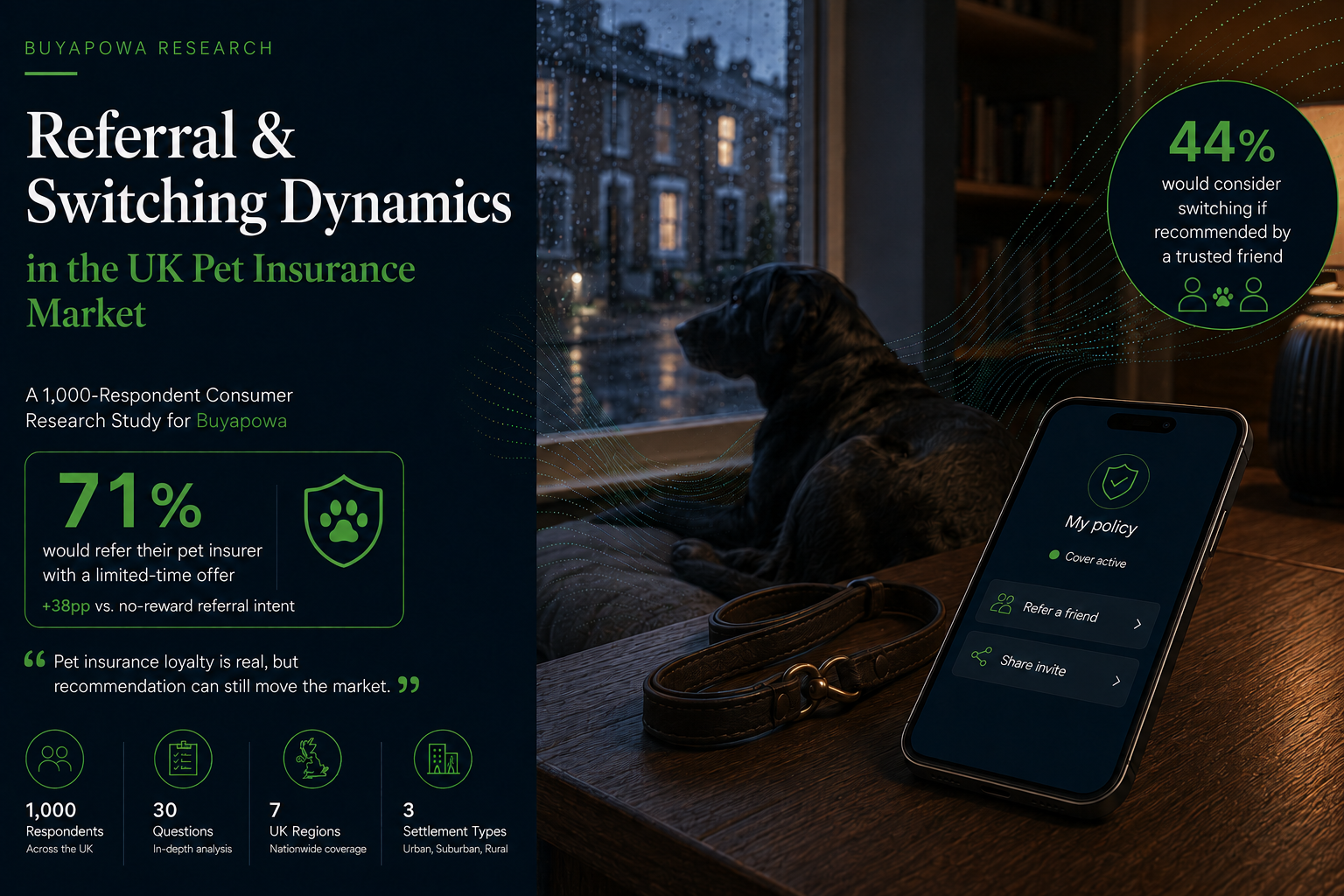
Research among 1,000 UK pet insurance customers shows that referral can protect a customer relationship or destabilise it. The strongest programs are designed to do both.
Pet insurance is bought with the head and experienced with the heart. Customers compare premiums, excesses and cover limits, but their strongest opinions are usually formed when a pet becomes ill, a claim is made or a renewal price arrives. Those experiences are also what people talk about with other pet owners.
A recommendation in this market rarely feels like an abstract product endorsement; it is advice from someone who understands how much the decision matters. That gives referral unusual commercial weight. It can introduce an insurer at precisely the moment a customer is reviewing their options, but it can also unsettle a relationship that appeared secure.
The loyalty paradox in five numbers
- 66% have no current plans to leave their insurer.
- 44% would consider switching if a friend recommended a competitor.
- 46% have already referred a pet insurance provider.
- 71% would advocate in response to a limited-time offer.
- 81% expect a straightforward, mobile-first referral experience with minimal steps.
Those figures are not contradictory. They show the difference between passive intention and an active reason to reconsider. A customer may be broadly content and have no plans to shop around until somebody they trust describes better cover, an easier claims experience or a more attractive price.
For pet insurers, referral therefore belongs on both sides of the customer equation: it can lower the cost of winning new policyholders and strengthen the advocacy that helps protect existing ones.
Referral changes the meaning of loyalty
Advocacy already exists
The starting point is encouraging. With 46% of customers having referred a pet insurance provider before, advocacy is already normal market behaviour. Insurers do not need to teach customers that pet cover can be recommended; they need to turn occasional, untracked conversations into a consistent and measurable source of growth.
That will not happen through goodwill alone. Only 33% are willing to advocate without a reward, but a limited-time offer lifts that figure to 71%. A further 62% express an intention to participate during the coming six months. The audience exists, and the uplift available from a well-timed proposition is substantial.
Referral is a retention issue too
The retention finding makes that opportunity more urgent. If 44% are open to switching following a trusted recommendation, every effective competitor program has two possible outcomes: it helps another insurer acquire a customer and it gives one of your policyholders a reason to look elsewhere.
Referral activity should therefore be monitored alongside renewal, retention and churn, not reported only as a source of new policies.
That does not mean rewarding customers simply to say something positive. A recommendation must still rest on an experience they are comfortable putting their name behind. Claims handling, clarity of cover, service and perceived value create the advocacy; the referral program gives it a visible route, an appropriate moment and a reason to act.
The commercial advantage comes from making satisfied customers easier to hear before a competitor’s advocates reach them first.
Where opportunity and switching risk are greatest
Urban and South East audiences
The national averages conceal a sharp difference between the audiences offering the fastest growth and those with the most dependable loyalty:
- Urban customers: Half have referred a provider before, 74% respond to a time-limited incentive and 66% express near-term participation intent. At the same time, 47% would consider switching after a friend’s recommendation, while only 62% say they have no plans to leave.
- South East England: 51% have already referred, 75% respond positively to a limited-time offer and 67% are likely to participate soon.
- East England: 49% have referred and 74% would be willing to do so with a time-limited incentive.
This makes urban markets attractive but exposed. They justify prominent acquisition campaigns, yet the same customers should also see advocacy prompts at positive moments in their existing relationship. A smooth claim, helpful service interaction or successful renewal can become an opportunity to reinforce the reasons for staying and invite a recommendation while confidence is fresh.
These regions offer strong conditions for scaling referral-led acquisition, provided performance is assessed beyond initial policy sales and includes the quality, retention and repeat advocacy of the customers acquired.
Rural, Scotland and Wales
Rural customers require a different tempo. Historic referral is lower at 39%, limited-time willingness is 66% and near-term participation is 56%. But loyalty is stronger: 73% have no plans to leave and switching openness falls to 36%.
Scotland and Wales show a similar pattern, with 72% planning to stay and 36% open to switching. These audiences may respond better to quieter, trust-led invitations and relevant value than to a constant sequence of urgent promotions.
The implication is not that every region needs a different platform or a completely separate program. The core journey, reward controls and measurement can remain consistent. What should change is the intensity and timing: higher-visibility acquisition and retention activity in fluid urban markets, with a steadier cadence in communities where relationships are more stable and reputation carries more weight.
What customers want from the offer
Customers are equally clear about the proposition itself. Their preferences point towards tangible rewards that are immediately understood, rather than elaborate mechanics whose value depends on multiple conditions:
- 32% choose cash, the most popular reward.
- 24% prefer Amazon gift cards.
- 19% prefer pet retailer vouchers.
- £21–£40 is the leading reward value band, selected by 36%.
Fair to both sides
Fairness matters too. More than three-quarters, 76%, prefer both the referrer and the friend to receive a reward, while 57% favour a guaranteed benefit for every successful referral over a larger conditional reward.
A two-sided, dependable offer helps the invitation feel like a genuine benefit being shared rather than a customer profiting privately from somebody else’s purchase.
Mobile-first and easy
The journey then has to match the simplicity of the promise. Some 81% expect a straightforward, mobile-first experience with minimal steps, and WhatsApp is the most popular sharing channel at 34%.
The largest barriers are ordinary rather than ideological:
- 23% forget to refer.
- 21% do not know a program exists.
- 18% feel the reward is too small.
- 15% find the process too complicated.
These are all problems that good timing, visible placement and clear communication can solve.
What pet insurers should do next
- Keep referral always available. The program should be easy to find at renewal and in the customer account.
- Prompt after positive customer moments. Surface the program after positive service and claims experiences, when customers have a recent reason to recommend.
- Use limited-time campaigns selectively. Create additional attention in high-opportunity urban and South East audiences without making the proposition feel permanently promotional.
- Measure acquisition and retention together. Track which experiences produce advocacy, whether referred customers stay longer, how quickly rewards are fulfilled and whether active advocates show stronger renewal behaviour.
Alongside shares, conversions and cost per acquired policy, this gives the business a clearer view of referral as a customer relationship system, not merely a discounted acquisition channel.
The UK pet insurance market does not lack loyalty, but neither is that loyalty immune to influence.
Customers will recommend when the experience deserves it and the program makes doing so worthwhile. They will also listen when another pet owner offers credible advice. Insurers that make advocacy easy, fair and timely can use the same force to win new customers, reinforce existing relationships and become the provider people are most comfortable putting their name behind.