

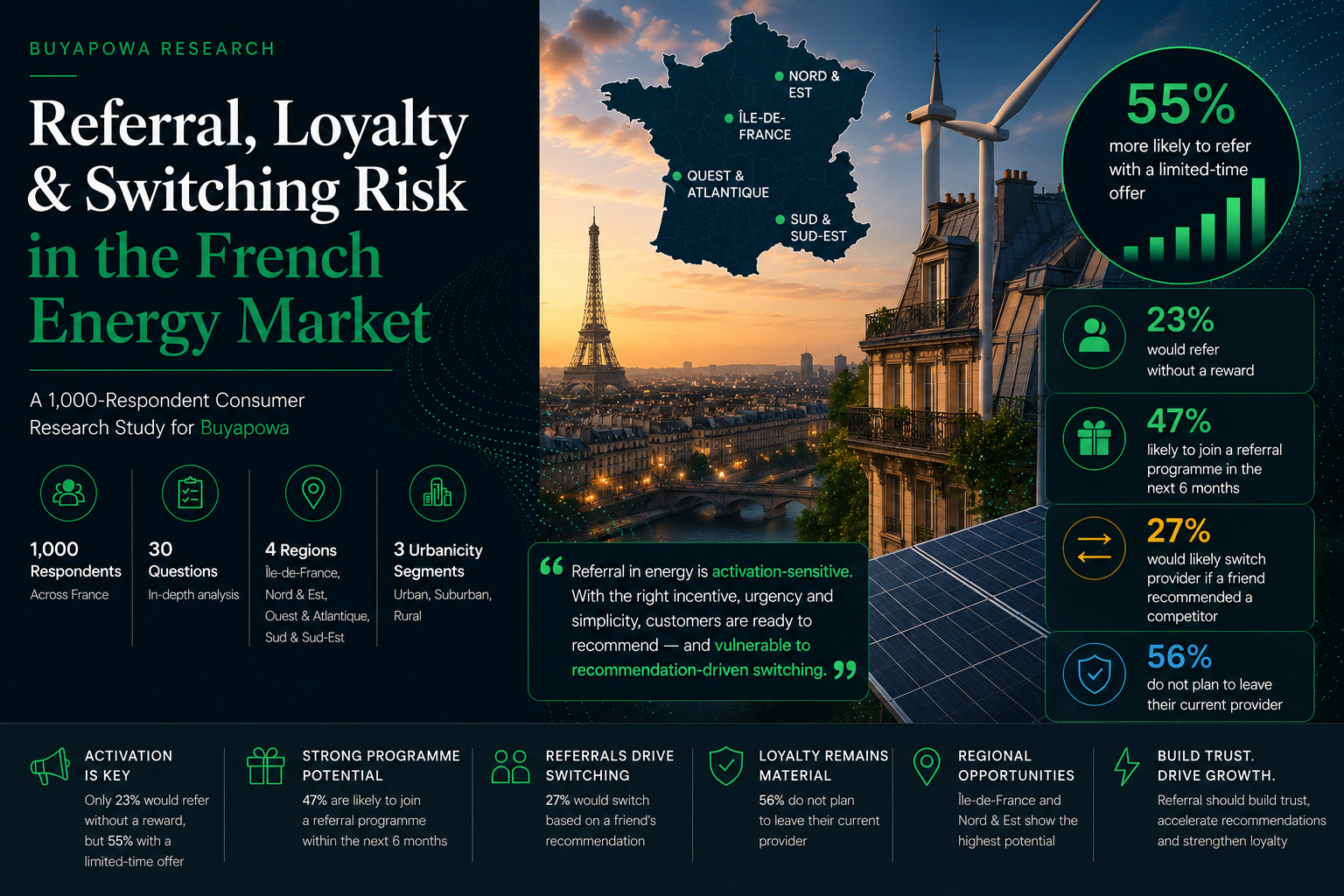
A 1,000-Respondent Consumer Research Study for Buyapowa
Executive Summary
France’s energy market presents a meaningful but structurally under-activated referral opportunity.
At first glance, the category appears difficult for referral-led growth. Energy providers operate in a low-engagement environment where most customers interact meaningfully only during:
- bill reviews
- tariff changes
- switching comparisons
- customer service issues
- periods of price volatility
Customers do not naturally wake up wanting to discuss their electricity or gas provider socially.
And yet the research reveals something important.
47% of customers say they have already referred their current energy provider to someone they know. That is a substantial level of existing advocacy in a category often viewed as highly functional and price-driven.
However, only 23% say they would refer without any reward.
This creates one of the clearest behavioural tensions in the study.
Referral behaviour clearly exists, but it is not naturally self-sustaining. Customers appear willing to recommend providers under the right conditions, but relatively unlikely to do so proactively without:
- prompting
- urgency
- visible value exchange
- stronger activation mechanics
That becomes especially obvious once incentives are introduced.
When a limited-time referral offer is presented, willingness to refer rises sharply to 55%, more than doubling the baseline level of non-incentivized referral intent.
This is not a marginal uplift.
It is a behavioural transformation.
The findings suggest referral in French energy is highly:
- friction-sensitive
- activation-responsive
- urgency-dependent
Small changes in perceived value, timing and simplicity create disproportionately large changes in participation behaviour.
The research also reveals a critical asymmetry between advocacy generation and recommendation influence.
While only 23% would refer organically without incentives, 27% say they would likely switch provider if a trusted friend recommended a competitor.
This creates a category where customers are more influenced by recommendations than naturally inclined to generate them.
That distinction is strategically important.
Referral in French energy is not simply an acquisition opportunity.
It is also a defensive necessity.
Providers that fail to activate advocacy risk leaving themselves exposed to competitors who occupy the recommendation space more effectively.
The segmentation patterns are equally revealing.
Île-de-France combines:
- strong historic referral behaviour
- meaningful program participation potential
- elevated recommendation responsiveness
Urban audiences display the highest switching openness and strongest referral activity, while rural audiences appear:
- more stable
- more loyal
- less naturally activation-driven
- but still highly receptive once programs become clear and trustworthy
More broadly, the findings suggest energy referral in France behaves differently from categories such as broadband or telecoms.
Customers are not recommending aspirational brands or identity-driven products.
They are recommending:
- savings
- predictability
- trust
- pricing fairness
- provider stability
That practicality is exactly what makes recommendation influence powerful.
In periods of rising household costs and tariff uncertainty, trusted peer recommendations can carry unusually high emotional and financial credibility.
The strongest referral programs are therefore likely to combine:
- meaningful financial rewards
- visible friend benefits
- low-friction participation
- mobile-first sharing
- time-bound activation
- transparent mechanics
- trust-led positioning
Providers that formalize advocacy effectively will be better positioned to:
- acquire customers efficiently
- strengthen customer trust
- reduce switching vulnerability
- reinforce long-term loyalty
- occupy the recommendation space before competitors do
1. Introduction & Market Context
The energy category occupies a unique behavioural position.
On one level, customers think about energy providers pragmatically. Electricity and gas are essential household services rather than emotionally expressive products. Engagement tends to happen only when:
- bills rise
- contracts renew
- switching opportunities appear
- customer service issues emerge
- household costs become more sensitive
This creates relatively low natural referral momentum.
Customers may remain with the same provider for years while barely discussing them socially.
And yet recommendation behaviour still matters.
People regularly talk about:
- rising energy prices
- unfair tariffs
- provider trustworthiness
- customer service experiences
- switching savings
- sustainability claims
- billing transparency
particularly during periods of economic pressure or market instability.
That creates an important contradiction within the category.
Energy may be operationally functional, but it is financially and emotionally relevant.
Customers may hesitate to recommend providers because they worry:
- the friend may not receive the same value
- prices may rise unexpectedly later
- service quality may deteriorate
- recommending an energy company feels overly transactional
At the same time, customers are willing to recommend providers when they believe:
- savings are meaningful
- pricing feels fair
- billing is transparent
- customer service is dependable
- the recommendation could genuinely help someone reduce household costs
This means referral in energy operates across two connected behavioural dynamics:
- referral readiness and activation
- recommendation-driven switching and retention vulnerability
The research explores both.
2. Methodology
This report explores referral behaviour, switching risk and advocacy dynamics within the French energy market, with particular focus on how these behaviours vary by region and urbanicity.
The objective is to help providers better understand:
- when customers are willing to recommend
- what activates referral behaviour
- what suppresses participation
- how incentives influence advocacy
- how referral intersects with switching behaviour and loyalty
Sample
1,000 French adults with a home electricity or gas provider.
Segments
Regions
- Île-de-France
- Nord & Est
- Ouest & Atlantique
- Sud & Sud-Est
Urbanicity
- Urban
- Suburban
- Rural
Questionnaire
30 questions covering:
- satisfaction
- referral behaviour
- reward preferences
- barriers
- switching triggers
- referral program design
- loyalty dynamics
The report examines referral readiness, motivations, barriers, referral network size and switching behaviour before exploring strategic implications for energy marketers.
3. Referral Readiness and Likelihood
Referral behaviour already exists, but activation remains weak
The French energy market shows moderate baseline advocacy with significant headroom for growth through structured referral programs.
47% of customers say they have already referred their current provider to someone they know.
That is notable in a category often perceived as highly functional and price-led. Customers clearly do discuss providers when:
- bills become topical
- switching opportunities arise
- savings conversations emerge
- service experiences stand out positively or negatively
However, only 23% say they would refer without a reward.
This is one of the clearest behavioural constraints in the study.
Unlike broadband or telecoms, referral in French energy appears less naturally advocacy-led and more dependent on behavioural prompting.
Customers may feel satisfied, but still require:
- visible incentives
- stronger prompts
- clearer value exchange
- urgency
before taking action.
That becomes especially visible once limited-time offers are introduced.
When a time-bound referral incentive is presented, willingness to refer rises sharply to 55%.
This more-than-doubles baseline organic referral intent.
That scale of uplift strongly suggests energy referral in France is:
- highly activation-sensitive
- highly friction-sensitive
- strongly responsive to urgency and reward visibility
rather than intrinsically social.
Looking ahead, 47% say they are likely to join a referral program within the next six months.
Taken together, these findings suggest referral programs in French energy should not focus primarily on “creating advocacy.”
The opportunity is to:
- activate existing goodwill
- formalize informal recommendation behaviour
- reduce hesitation
- increase visibility
- create more consistent participation
Referral in energy is practical rather than emotional
One of the clearest behavioural themes in the study is that referral in energy appears fundamentally practical.
Customers are not recommending providers because they feel emotionally attached to an energy brand.
They are recommending:
- lower bills
- provider fairness
- tariff transparency
- dependable service
- financial reassurance
That distinction matters because it changes how referral programs should be positioned.
The strongest referral programs in French energy are unlikely to succeed through:
- brand fandom
- status mechanics
- ambassador-style positioning
Instead, they are more likely to succeed when they feel:
- useful
- financially relevant
- easy to explain
- mutually beneficial
This is particularly important in periods of economic pressure, where energy costs become emotionally sensitive household issues rather than abstract utilities.
4. Regional Dynamics and Market Segmentation
Île-de-France — high-scale activation opportunity
Île-de-France combines:
- strong historic referral behaviour
- meaningful incentive responsiveness
- large-scale program participation potential
- 49% have already referred
- 26% would refer without reward
- 55% respond positively to limited-time offers
- 48% are likely to join a referral program
This creates one of the most commercially important regional opportunities in the study.
The region appears highly responsive to structured referral activation, particularly where:
- incentives feel financially meaningful
- participation is simple
- the program feels trustworthy and visible
Strategic implication
Referral programs in Île-de-France likely need:
- strong activation mechanics
- cleaner UX
- visible financial value
- stronger urgency cues
rather than passive always-on visibility alone.
Nord & Est — steady, trust-led behaviour
Nord & Est displays comparatively stable referral behaviour:
- 45% historic referrals
- 23% willing to refer without reward
- 50% incentive responsiveness
- 45% program participation intent
Customers here appear slightly less activation-sensitive than Île-de-France, but still commercially valuable.
Referral behaviour may depend more heavily on:
- provider trust
- pricing fairness
- reliability
- confidence in customer experience
than aggressive campaign mechanics.
Ouest & Atlantique — balanced advocates
Ouest & Atlantique combines:
- balanced historic advocacy
- moderate activation responsiveness
- stable program participation
This creates one of the healthiest long-term referral profiles in the study.
Strategic implication
The region appears especially well suited to:
- always-on referral infrastructure
- long-term advocacy cultivation
- value-led referral positioning
- sustained participation strategies
rather than purely short-term promotional bursts.
Sud & Sud-Est — urgency-responsive audiences
Sud & Sud-Est shows comparatively strong responsiveness to incentives:
- 55% respond positively to limited-time offers
This suggests urgency and visibility may play disproportionately important roles within the region.
Strategic implication
Referral campaigns around:
- seasonal bill pressure
- switching windows
- pricing comparisons
- household savings moments
are likely to perform particularly well.
5. Urbanicity and Behavioural Differences
Urban customers — strongest activation and switching pressure
Urban customers show:
- the highest historic referral activity
- the strongest recommendation-driven switching
- elevated program responsiveness
Urban audiences appear especially commercially attractive because of:
- denser recommendation networks
- stronger digital engagement
- higher switching awareness
- greater exposure to comparison behaviour
But these same audiences also show the highest vulnerability to competitor recommendations.
That makes urban referral both:
- a growth opportunity
- and a defensive necessity
Strategic implication
Urban referral programs should be:
- mobile-first
- financially visible
- urgency-led
- frictionless
- designed for fast participation
Referral in urban segments should be treated as both acquisition infrastructure and active churn defence.
Rural audiences — stronger loyalty, quieter advocacy
Rural customers display:
- lower referral activity
- lower switching openness
- but stronger loyalty and stability
This suggests rural referral behaviour is:
- more trust-led
- less campaign-driven
- more dependent on simplicity and credibility
Strategic implication
Rural programs should focus heavily on:
- transparency
- trust
- straightforward mechanics
- visible value exchange
rather than highly aggressive promotional structures.
Suburban customers — commercially stable middle ground
Suburban audiences provide:
- balanced referral participation
- moderate switching exposure
- stable advocacy potential
Strategic implication
Suburban customers are especially well suited to:
- always-on participation models
- long-term value-led referral strategies
- household savings messaging
This may represent the most stable long-term referral segment.
6. Motivators and Preferred Rewards
Referral is driven by savings and fairness
The strongest referral motivators are financially practical:
- helping a friend save money
- receiving a cash reward
- reducing household costs
- visible bill savings
This reinforces that energy referral is primarily about:
- usefulness
- fairness
- mutual value
rather than emotional brand advocacy.
The strongest positioning is therefore likely to be:
“help someone reduce their energy costs and both benefit”
rather than:
“become an energy advocate.”
Financial rewards dominate
Preferred reward types show a clear hierarchy:
- Cash: 37%
- Gift cards: 32%
- Bill credits: 20%
Cash clearly leads, but bill credits remain behaviourally relevant because they directly offset household expenses.
This distinction matters.
Customers may emotionally prefer cash, but bill credits still feel operationally useful within the category.
The strongest programs are therefore likely to combine:
- flexible financial rewards
- energy-linked savings
- visible household value
rather than abstract perks or loyalty mechanics.
Moderate rewards outperform extreme incentives
Most motivating reward bands:
- €20–€50: 38%
- €10–€20: 29%
- €50+: 16%
This suggests providers do not necessarily need extremely high-value incentives.
The bigger issue is whether the reward feels:
- immediate
- worthwhile
- visible
- easy to understand
The friend benefit matters heavily
More than half of customers say it is very or extremely important that the friend also receives a reward.
This is strategically important.
Energy referrals appear strongly dependent on:
- fairness
- mutual benefit
- visible shared value
Customers want the recommendation to feel helpful rather than self-serving.
That makes dual-sided rewards especially important within the category.
7. Barriers and Prerequisites
Emotional neutrality suppresses referral participation
The biggest referral barrier is not complexity.
It is emotional neutrality.
31% say they are simply not enthusiastic enough about their provider to recommend them.
This is one of the most important findings in the study because it highlights the structural challenge of low-engagement categories.
Customers may not dislike their provider.
But neutrality rarely creates proactive advocacy.
Other barriers include:
- uncertainty about whether others would benefit
- low perceived reward value
- discomfort promoting companies socially
- confusion around referral mechanics
Taken together, these findings reinforce that energy referral requires:
- stronger prompts
- clearer value exchange
- higher visibility
- active behavioural activation
rather than passive program availability alone.
Customers need confidence before recommending
Key prerequisites include:
- confidence the provider offers good pricing
- trust in reliability
- an easy referral process
- worthwhile rewards
This reinforces a broader principle:
referral programs amplify customer experience.
They do not replace it.
Customers will only consistently recommend providers when they believe:
- pricing is genuinely competitive
- service feels dependable
- the friend will benefit meaningfully
- the recommendation reflects positively on them
Simplicity remains critical
Customers consistently favour:
- low-friction participation
- transparent mechanics
- simple rewards
- easy sharing
Complexity creates disproportionate behavioural drop-off in low-engagement categories.
The strongest journeys are therefore likely to feel:
- lightweight
- mobile-first
- operationally transparent
- easy to complete quickly
8. Size of the Potential Referral Network
Referral scale in French energy appears likely to come from broad participation rather than small groups of highly active referrers.
- 28% say they could refer no one
- 30% say one person
- 29% say two to three people
- 9% say four to five people
- 4% say more than five
This is structurally important.
Energy referral appears highly situational.
Customers are most likely to recommend providers when:
- bills rise
- switching becomes topical
- friends compare providers
- household savings discussions emerge
- pricing volatility increases
This means participation is likely to be:
- occasional
- context-driven
- highly prompt-sensitive
rather than continuous.
The program therefore needs to make participation easy precisely when recommendation intent naturally appears.
9. Switching Risk and Loyalty
Recommendation-driven switching is meaningful, but loyalty remains stronger than in broadband
27% say they are likely to switch if a trusted friend recommends a competitor.
48% say they are unlikely to switch even then.
This creates a more balanced dynamic than categories such as broadband or telecoms.
Recommendation influence clearly matters, but inertia and loyalty remain materially stronger.
By urbanicity:
- Urban: 30% likely to switch
- Suburban: 26%
- Rural: 22%
Urban audiences therefore remain:
- the most commercially attractive
- but also the most vulnerable to recommendation-driven churn
Loyalty remains meaningful but conditional
56% say they do not plan to leave their current provider.
This is materially stronger loyalty than seen in several other categories in the research series.
However, it should not be mistaken for permanent lock-in.
Customers still remain open to switching when:
- meaningful savings appear
- trusted recommendations emerge
- pricing changes
- providers lose trust credibility
Overall observations
The switching data changes the strategic role of referral.
Referral programs in French energy should not operate purely as aggressive acquisition systems.
Instead, they are likely to function most effectively as:
- trust-reinforcement systems
- recommendation accelerators
- retention-support infrastructure
- customer-confidence mechanisms
This is a category where advocacy and loyalty interact more gradually than in broadband or telecoms.
10. Strategic Implications for Growth
The findings support a clear strategic conclusion:
referral should be treated as a meaningful growth channel rather than a secondary marketing initiative.
By activating even part of the 55% responsive to incentives, providers can generate:
- high-trust acquisition
- lower-cost customer growth
- recommendation-led conversion
- stronger long-term customer value
This matters because referred customers often enter with:
- higher trust
- reduced uncertainty
- stronger confidence in provider credibility
11. Strategic Implications for Retention
Referral programs also create important retention effects.
Customers who advocate for a provider often become:
- more psychologically invested
- less price-sensitive
- less vulnerable to competitor messaging
This creates reinforcing behavioural loops where customers become:
- more likely to stay
- more likely to recommend
- more likely to reinforce trust socially
That effect becomes strategically important in categories where switching pressure remains recommendation-sensitive.
12. Recommended Program Design
The strongest referral programs in French energy are likely to include:
- clear financial incentives
- dual-sided rewards
- mobile-first journeys
- WhatsApp and SMS sharing
- transparent tracking
- limited-time urgency
- low-friction onboarding
Most importantly, the program should feel:
- practical
- financially worthwhile
- trustworthy
- operationally simple
Customers are not recommending an aspirational lifestyle brand.
They are recommending:
- savings
- reliability
- fairness
- predictability
The referral program therefore needs to reinforce confidence rather than simply reward behaviour.
Conclusion
The French energy market presents a meaningful but structurally activation-sensitive referral opportunity.
Advocacy already exists. 47% of customers say they have referred their provider before, demonstrating that recommendation behaviour is already embedded within the category.
But the same customers are far less likely to recommend providers proactively without prompting. Only 23% would refer without incentives.
This is one of the clearest …behavioural tensions in the study.
Referral in French energy is not absent.
It is latent.
Customers require:
- activation
- urgency
- clearer value exchange
- visible incentives
- simpler participation
before advocacy converts into action.
The behavioural response to incentives reinforces this strongly.
When a limited-time referral offer is introduced, willingness to refer rises sharply to 55%, more than doubling baseline non-incentivized referral intent.
That scale of uplift strongly suggests referral in French energy is:
- highly activation-sensitive
- highly friction-sensitive
- strongly influenced by urgency and reward visibility
rather than intrinsically advocacy-led.
This distinction matters strategically.
Customers are not naturally enthusiastic enough about energy providers to recommend them proactively in the same way they may recommend restaurants, consumer brands or entertainment services.
Instead, recommendation behaviour appears fundamentally practical.
Customers are recommending:
- lower bills
- pricing fairness
- provider reliability
- predictable customer service
- financial reassurance
That practicality is precisely what makes recommendation influence powerful.
In periods of rising household costs, tariff uncertainty and economic pressure, trusted peer recommendations can carry unusually high emotional and financial credibility.
At the same time, the switching data fundamentally changes the role of referral.
27% of customers say they would likely switch provider if a trusted friend recommended a competitor.
While this switching pressure is lower than in broadband or telecoms, it remains strategically meaningful in a category where customer relationships are heavily value-driven.
This creates an important asymmetry:
- customers are relatively reluctant to recommend providers organically
- but meaningfully influenced when recommendations come from others
That means providers without active advocacy strategies leave themselves exposed to competitors who are better at activating recommendation behaviour.
The regional and urbanicity patterns reinforce this further.
Île-de-France combines scale with strong activation responsiveness, making it a critical market for referral-led growth. Nord & Est behaves more steadily and trust-led, while Sud & Sud-Est appears especially responsive to urgency and incentive visibility.
Urban customers provide the strongest recommendation density and the highest switching openness, making them commercially attractive but also competitively vulnerable. Rural audiences appear more loyal and less naturally referral-active, but still highly receptive once programs feel trustworthy and easy to engage with.
The broader implication is increasingly clear:
referral programs in French energy should not be treated as simple promotional mechanics.
They are becoming part of how providers:
- reinforce customer trust
- compete for recommendation visibility
- reduce switching vulnerability
- strengthen long-term customer confidence
The strongest programs will therefore feel:
- simple
- transparent
- financially worthwhile
- easy to share
- operationally trustworthy
They will avoid unnecessary complexity, make the friend benefit highly visible and use limited-time activation intelligently to convert passive goodwill into action.
Reward structure matters too.
The findings suggest customers respond most strongly to:
- cash rewards
- visible bill savings
- straightforward value exchange
- dual-sided incentives
- fast fulfilment
- clear conditions
But perhaps most importantly, the program itself cannot compensate for weak fundamentals.
Referral amplifies customer experience.
It does not replace it.
Customers will only consistently recommend providers when they genuinely believe:
- pricing is fair
- service is dependable
- switching feels worthwhile
- the recommendation will reflect positively on them
More broadly, the findings suggest French energy referral is not about creating emotional attachment to utility brands.
It is about helping customers recommend something useful:
- lower household costs
- provider stability
- transparent pricing
- reliable service
- financial predictability
That usefulness is what gives recommendation behaviour its influence.
Providers that formalize and scale advocacy early will be better positioned to:
- acquire customers efficiently
- reinforce trust
- strengthen retention
- reduce exposure to competitor recommendations
- occupy the recommendation space before competitors do
In the French energy market, referral is no longer simply an acquisition tactic.
It is becoming strategic infrastructure.