

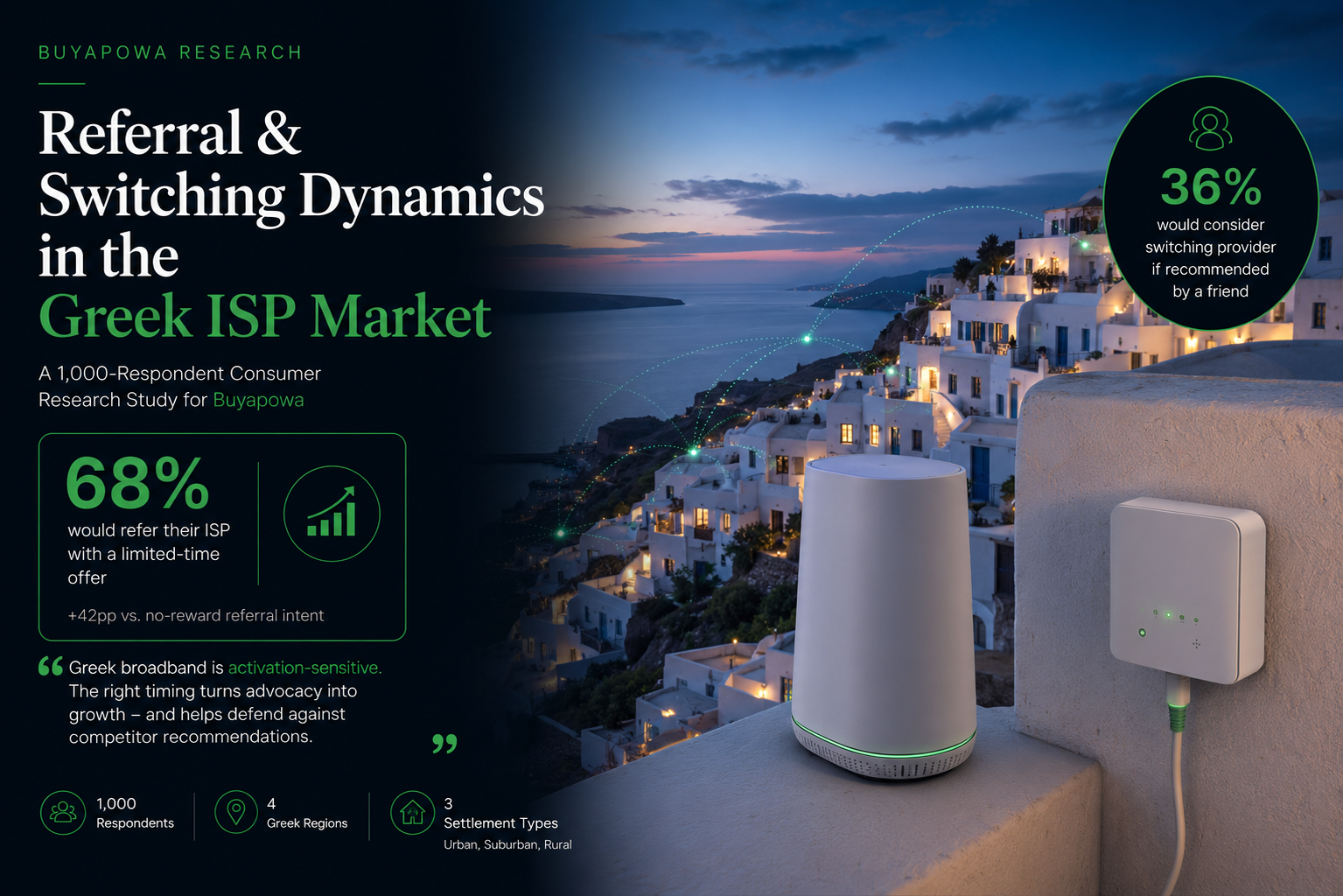
Research with 1,000 Greek broadband customers shows that limited-time offers can lift referral intent from 26% to 68%, while trusted recommendations also create a measurable switching threat.
Broadband is a quiet category until something changes. A house move, an outage, a price increase or an underwhelming speed test can suddenly turn an internet provider into the subject of a very practical conversation. At that point, customers do not only compare tariffs and coverage. They ask friends and family who is reliable, who made installation easy and whether switching was worth the effort.
That makes referral unusually important for internet providers. Recommendation is not simply a way to acquire another household; it is one of the forces that can decide which provider enters a customer’s consideration set in the first place. Our research suggests Greek ISPs have a large audience willing to advocate, but that advocacy is highly sensitive to timing. It also shows that the same social influence capable of bringing a customer in can persuade an existing customer to leave.
We surveyed 1,000 ISP customers across Attica, Northern Greece, Central and Western Mainland, and South and Islands, with results also examined across urban, suburban and rural communities. The clearest conclusion is that a national referral program can create significant growth, but only if operators stop treating it as a passive, uniform benefit.
The market does not lack advocates. It lacks a trigger.
Some 45% of Greek ISP customers have already referred a provider. That is meaningful evidence of established behavior: nearly half the market has been willing to put its own reputation behind an internet service. Yet only 26% say they would refer without a reward. Historic advocacy exists, but it does not automatically translate into a reliable flow of future referrals.
The picture changes sharply when timing and incentive are introduced. With a limited-time referral offer, willingness rises to 68%, a 42 percentage-point increase. In addition, 52% say they are likely to join a referral program within the next six months. The commercial issue is therefore not whether Greek customers understand referral or are fundamentally opposed to it. The issue is whether an operator gives them a clear enough reason to act now.
That distinction should shape the operating model. An always-available program provides somewhere for natural recommendation to go, but an invisible link in an account menu will not capture the full opportunity. Operators need planned moments of activation: after a successful installation, following a positive service milestone, around relevant contract events, or through short promotional windows that make the value and deadline unmistakable. The base program provides continuity; the campaigns create movement.
Urgency should not mean complexity. The gap in the research is between no reward and a clear limited-time proposition, not between a simple offer and an elaborate one. Customers should be able to understand what both people receive, what the friend must do and when the reward will arrive without navigating layers of conditions. A time limit can focus attention, but only a low-friction journey will convert that attention into a completed referral.
The biggest acquisition markets are also the easiest to lose.
Referral becomes more strategically important when switching is considered alongside advocacy. Across Greece, 36% say they would be likely to switch ISP if a friend recommended another provider, while 40% say they would be unlikely to switch. That is a narrow defensive margin. A competitor with an active customer base and a well-timed referral offer is not merely generating leads; it is influencing households that already have another provider.
Attica and urban-core customers show the tension most clearly. In each segment, 48% have referred before, 70% would refer with a limited-time offer and 55% are likely to join a program soon. They are the strongest near-term audiences for referral-led acquisition. They are also the most exposed to competitor advocacy: 39% say they are likely to switch following a friend’s recommendation, compared with 37% who are unlikely to do so.
This is why referral should not sit only inside an acquisition plan. In the most fluid markets, activating satisfied customers is also a way to maintain recommendation visibility while competitors are trying to create it. The objective is not to stop customers hearing other opinions; it is to ensure the operator has a strong, measurable body of advocacy of its own, supported by a proposition that customers are comfortable sharing.
It also changes how performance should be judged. New connections and cost per acquisition remain essential, but operators should also track who refers, when they do it, whether advocates remain engaged and where competitor recommendations are most likely to affect switching. Referral data can reveal not only where growth is coming from, but where customer relationships are most vulnerable to social influence.
One national program needs two operating tempos.
Outside Attica and the urban core, the opportunity remains substantial but more measured. Northern Greece, Central and Western Mainland, South and Islands, and suburban customers all show limited-time referral willingness in the 66-67% range. Near-term program interest sits at 49-51%, while switching likelihood is around 34-35%. These are not secondary markets; they are dependable audiences for an always-on program supported by selective, well-planned campaign peaks.
Rural customers require a different interpretation. They have the lowest historic referral level at 39% and lower near-term join intent at 44%, but their intrinsic willingness to refer without a reward is the highest of any settlement type at 31%. They are also more defensible: 30% are likely to switch following a friend’s recommendation, while 46% are unlikely to switch. The rural opportunity is therefore less about frequent promotional pressure and more about trust, clarity and making occasional invitations easy to act on.
The most practical model is a common national foundation with two tempos. Attica and urban audiences justify high-visibility, time-boxed campaigns, mobile-friendly prompts and rapid follow-up. Balanced regional and suburban markets suit a steadier cadence with periodic boosts. Rural customers should see fewer but clearer invitations, built around confidence in the service and a straightforward value exchange. The technology and core program can remain consistent while the timing, message and intensity change.
The first useful test is therefore not three completely different referral schemes. It is the same core program operated in different ways: a strong limited-time campaign in Attica or an urban segment, a steadier activation rhythm in a balanced region, and a trust-led version for rural customers. Operators can then compare participation, referral conversion, time to reward, repeat advocacy and customer retention rather than relying on one national average that conceals how differently these audiences behave.
Greek broadband customers are neither passive advocates nor permanently loyal ones. They are ready to recommend when given a clear reason, and many are ready to listen when a friend recommends somebody else. That makes referral more than a promotion. Properly designed, it becomes a competitive system for creating demand, defending customer relationships and turning everyday broadband conversations into measurable growth.