

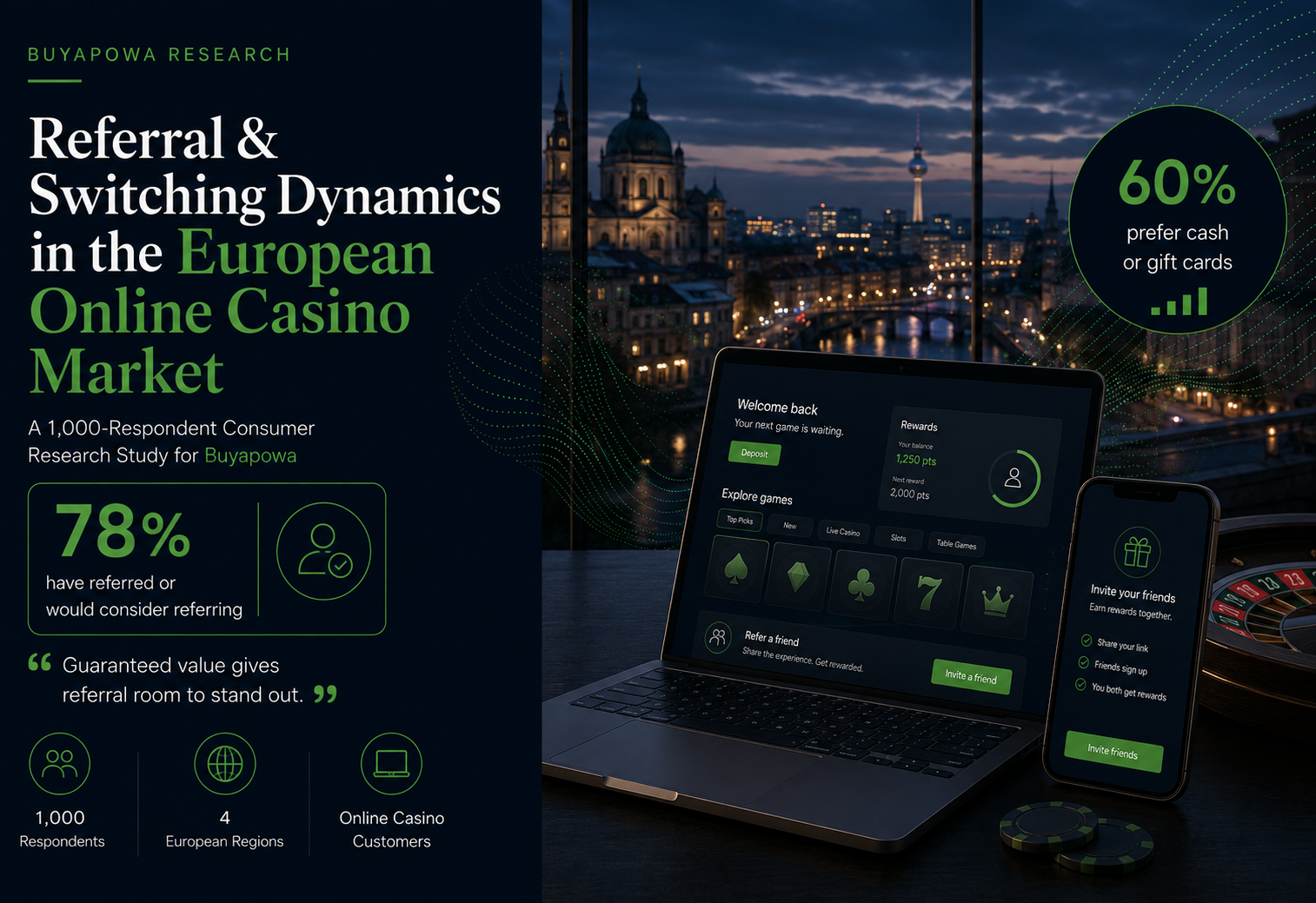
New research with 1,000 European online casino customers suggests guaranteed rewards could give referral the distinction that familiar gaming promotions no longer provide.
Online casino marketing is not short of offers. Free spins, deposit matches, bonus credit and cashback are everywhere, which makes them familiar to customers but increasingly difficult for any one operator to own. That presents an interesting problem for referral marketing. A familiar gaming reward may generate a response, but if every competitor is offering something similar, it does little to make the program itself memorable or distinctive.
Our research among 1,000 online casino customers across Northern, Eastern, Southern and Western Europe suggests there is an alternative. Customers are open to referring friends, but the strongest proposition may be one built around guaranteed value, a meaningful reward for the friend and an experience that respects the trust involved.
Referral is already happening
Nearly half of those surveyed, 47.6%, had already referred someone to their primary online casino. A further 30% had not done so but said they would consider it, giving operators an addressable referral audience of 77.6%. That matters because it shows referral is not an unfamiliar behavior that operators first need to create. Many customers are already talking about the casinos they use, and a well-designed program can give that existing advocacy a clearer and more measurable route.
Rewards still make a difference, of course. While 46.2% said they would refer their primary casino without an incentive, that rose to 59.4% when a limited-time offer was introduced, an increase of 13.2 percentage points. The useful lesson is not simply that customers like being rewarded. It is that an incentive can amplify advocacy which is already present, particularly when it gives people a timely and credible reason to act.
There is a competitive dimension too. Some 46.1% said they would be likely to try or switch to another online casino following a friend’s recommendation if it came with better benefits, although 38.9% said they did not currently plan to leave their main provider.
Those findings are not contradictory. Customers may have a preferred casino without being entirely exclusive to it; among respondents able to give a definite answer, 73.3% had used at least two online casinos. Referral can therefore support both acquisition and competitive defense, reaching people through a source they trust before another operator does.
The case for guaranteed value
The category’s usual promotional mechanics remain relevant, but they are not necessarily the rewards customers find most appealing in a referral program. Cash was the first choice for 33.9% of respondents and gift cards for 25.9%, meaning 59.8% preferred one of those two forms of guaranteed value. By comparison, 12.5% selected free spins, 8.1% chose cashback and 5.2% preferred a deposit match or bonus credit. Gaming-related rewards clearly retain an audience, but they were markedly less popular than cash or gift cards when customers were asked to choose.
The contrast became even clearer when we asked people to consider certainty against potential size. Just over half, 51.9%, preferred a smaller guaranteed cash or gift-card reward, while only 15.7% favored a larger gaming reward dependent on wagering or other conditions. Another 23.9% preferred a hybrid containing both guaranteed value and a gaming benefit. Taken together, that means 75.8% wanted some guaranteed value within the proposition, even if it was accompanied by something more closely connected to play.
This does not mean operators need to abandon free spins or other established mechanics. It means those rewards may work better as one part of the proposition than as its sole point of difference. A hybrid model could preserve the relevance of a casino-specific benefit while adding something more immediate and certain. For example, a modest gift card alongside free spins gives the customer a recognizable gaming reward without asking them to accept that all of the value depends on what happens next.
The preferred reward levels also provide a sensible starting point for testing. The most motivating range was €25–€49, selected by 34.4%, followed by €10–€24 at 28.1%, so 62.5% chose a value somewhere between €10 and €49. That should not be treated as a universal price list across every European market. Economics, regulation and customer value vary, but the result does suggest that a useful referral reward does not need to become extravagant in order to feel worthwhile.
Limited-time campaigns can add urgency when required. The 13.2-point uplift associated with a time-bound offer suggests that occasional bursts around relevant moments may prompt action more effectively than allowing the program to disappear into the background as another permanent promotion.
Trust matters more than novelty
A casino referral is not simply a promotional transaction. It asks a customer to put a personal relationship behind a recommendation, and that changes how the offer is judged. The research makes that responsibility visible. The most common concern, cited by 31.8%, was that the friend might lose money, while 25.5% worried about being held responsible for a bad experience and 24.9% did not want to encourage someone to gamble.
These are material barriers, not objections to be brushed aside by adding a larger bonus. Casino referral runs on borrowed trust, so the program has to help customers feel comfortable with what they are sharing and with the experience their friend will receive. The friend’s reward is central to that reassurance. Some 71.5% said it was important that the friend should benefit, which makes a genuinely two-sided proposition more than a matter of generosity.
A reward for the friend gives the advocate a more comfortable reason to share and makes the invitation feel less self-serving. It also allows the communication to focus on mutual value rather than on encouraging more play. The language around the program needs the same care. Clear eligibility, transparent conditions and straightforward explanations of the reward will do more for confidence than breathless claims about winning or oversized promotional language.
Responsible gambling considerations should also be part of the design rather than added as a disclaimer at the end. Customers need control over whether, when and with whom they share, and the program should never create pressure to make indiscriminate invitations.
A simpler program design
Customers’ preferred sharing methods were private, familiar and mobile. WhatsApp or another messaging service was chosen by 52.2%, followed by a shareable link at 44.4% and sharing through the operator’s app or website at 41.1%. That points toward a discreet customer-led experience rather than one built around public broadcasting. The most natural journey is likely to let someone generate a link, choose their own private channel and add a personal message if they wish.
Speed matters just as much. Some 62.9% expected the sharing process to take less than a minute, including those who wanted it to happen in a single click. Every extra screen, field or unexplained condition risks losing an advocate who was willing to recommend the brand moments earlier. Mobile optimization, a persistent referral entry point and a clear view of reward status are therefore core parts of the proposition, not finishing touches.
Operators still need to protect program economics and reward genuine new-customer activity. Respondents were most comfortable with the reward being triggered after a qualifying game, selected by 28.8%, or after the friend’s first deposit, chosen by 22.9%; together, those options accounted for 51.7%. Either trigger can provide a reasonable quality threshold without forcing both people to wait through a long sequence of wagering conditions. The right choice will depend on the market and the operator, but the governing principle should be simple: protect against abuse without making a legitimate referral feel doubtful or unrewarding.
The strongest initial test would therefore be fairly focused. Operators could compare a familiar gaming-led offer with a guaranteed cash or gift-card alternative, then test a hybrid version that combines the two. Each version should reward the friend as well as the advocate, use a clear qualifying event and be easy to share privately in under a minute. Beyond conversion, the evaluation should consider whether referred customers are valuable, whether the proposition attracts abuse and whether participants understand exactly what they will receive.
Final thoughts
The opportunity for online casino referral is not hypothetical. Customers already recommend their preferred operators, a further group is willing to consider doing so, and almost half say a friend’s recommendation with better benefits could persuade them to try or switch provider. The more important question is whether the program gives them something credible and distinctive to share. Our findings suggest that guaranteed value, a meaningful benefit for the friend and a simple private journey may do more than another familiar gaming promotion on its own.
Free spins can still have a role, particularly within a hybrid proposition. But when everyone offers free spins, free spins are no longer a strategy by themselves.