

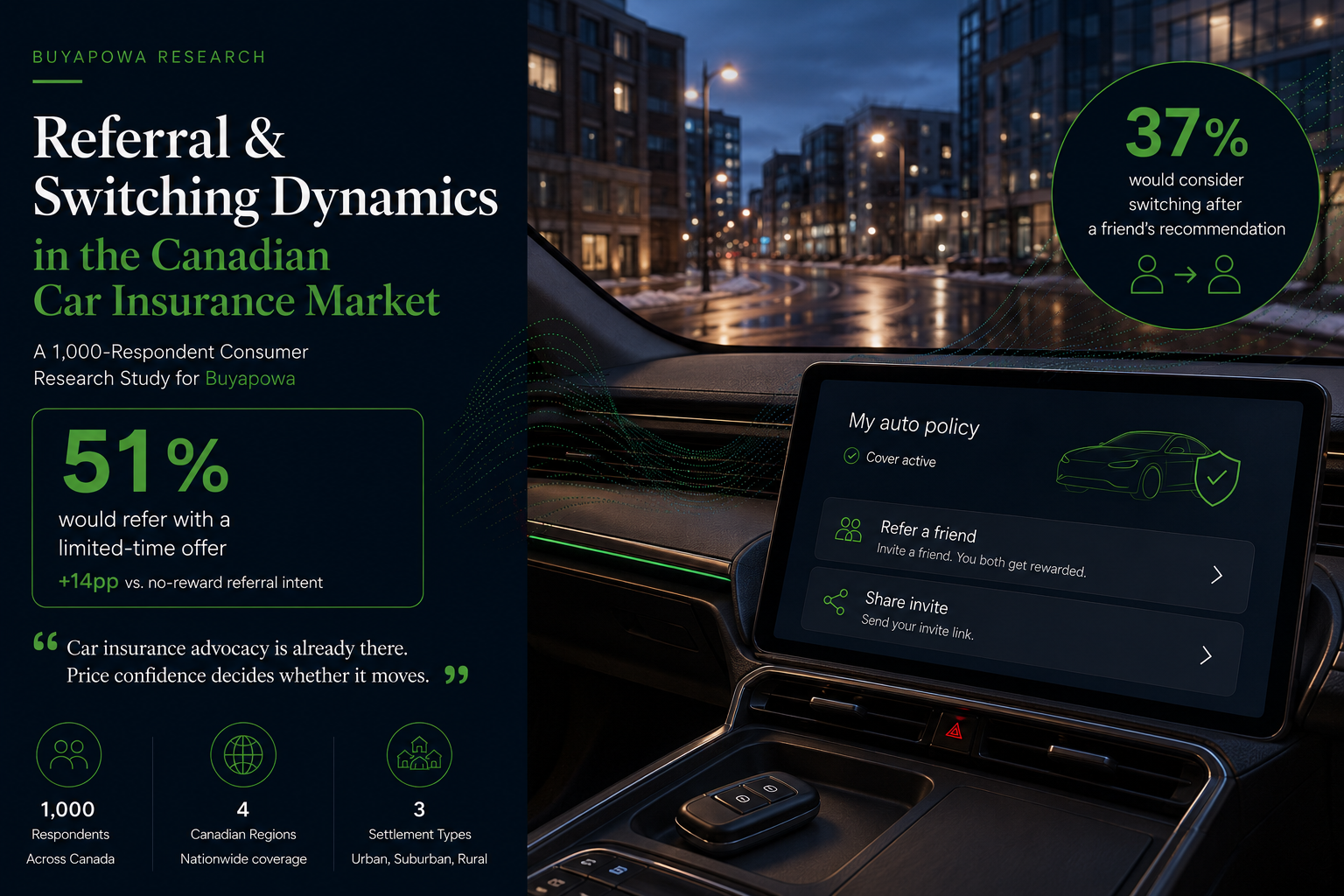
Research among 1,000 Canadian customers shows that referrals can unlock acquisition and defend retention—but only when the offer gives both people confidence in the value.
Car insurance rarely occupies much mental space until something changes. A renewal notice arrives, a premium rises, a vehicle is replaced or a friend mentions a better deal. In those moments, a category that usually sits quietly in the background becomes highly contestable. The customer may not have planned to shop around, but the combination of a price trigger and a trusted recommendation can quickly put another provider into consideration.
That makes referral unusually powerful in Canadian car insurance. A recommendation does more than create awareness: it helps a complex, consequential switch feel safer. Yet the same effect works in both directions. A satisfied customer can introduce a new policyholder to your brand, while another insurer’s advocate can make your own customer question the value of staying. Referral therefore belongs in the same conversation as renewal, pricing and retention—not on the edge of the marketing plan as a standalone promotion.
Our research among 1,000 Canadian car insurance customers across four regions and three settlement types shows a market rich in potential advocacy. Almost 45% have already referred their insurer, another 40% would consider doing so, and more than half say they are likely to take part in a referral program in the next six months. The opportunity is not to manufacture goodwill. It is to turn existing goodwill into a recommendation at the moment when the customer and their friend can both see genuine value.
Advocacy is already there; action is not
The starting point is stronger than many insurers might assume. Overall, 44.8% of customers have recommended their provider before: 17.4% more than once and 27.4% once. A further 40.1% have not yet referred but would consider it. Together, that means 84.9% of the market has either acted as an advocate or is open to doing so. This is not a niche behavior awaiting education; it is a familiar behavior with a substantial inactive audience.
Satisfaction provides a sound base, although not an automatic one. Some 64.4% are satisfied or very satisfied with their current provider, but just 36.8% say they would refer without a reward. The gap matters. Customers can feel perfectly content with their own policy and still lack a reason to bring insurance into a conversation with someone else. Goodwill is a prerequisite for referral, but it is rarely the trigger.
Urgency supplies part of what is missing. When customers are shown a limited-time referral offer, likely participation rises to 50.8%—a 14-point lift over no-reward referral intent. The effect is strikingly consistent across the country: willingness reaches 51.7% in the West, 50.0% in Central Canada, 50.8% in Quebec and 51.0% in Atlantic Canada. Rural customers are particularly responsive at 53.3%, while urban customers reach 52.5%. The exact numbers vary, but the behavioral lesson does not: a clear reason to act now moves referral out of the realm of vague intention.
This is why an always-on referral program should not feel passive. It needs visible moments of activation around renewal, a favorable service interaction, a bundle conversation, a new-vehicle change or a successful claims outcome. A limited-time layer can add momentum without turning the whole proposition into a perpetual discount. The objective is to meet a satisfied customer when the value of their relationship is already salient, then make the invitation timely enough to deserve attention.
The recommendation has to work for the friend
The biggest obstacle is not embarrassment, effort or a lack of interest. It is uncertainty about what the friend will receive. Some 45.8% say they would hesitate because they are not confident the person they refer would get a good price—the strongest barrier in the study. That concern is rational. Premiums vary with location, vehicle, driving history, coverage and claims record, so customers cannot assume that their own experience will translate into an equally attractive quote for someone else.
This price-confidence problem changes how the offer should be framed. A reward for the advocate is useful, but it does not remove the social risk of recommending a poor deal. Nearly seven in ten customers—69.5%—say it is important that the friend also receives a reward or discount. The most preferred structure is a benefit for both people, chosen by 33.4%, ahead of a larger reward only if the friend buys at 23.1% and a smaller guaranteed reward at 19.8%. The customer wants to share an advantage, not look as though they are earning a commission from someone else’s insurance decision.
Reward preference reinforces that need for clarity. Cash leads at 32.4% and gift cards follow at 26.4%, both ahead of bill credits at 15.3% and premium discounts at 13.5%. That does not make bill credits ineffective: 58.7% say one would make them at least somewhat more likely to refer. But flexible rewards are easier to value at a glance, while a visible friend benefit gives the invitation a more generous purpose. For the largest group of respondents, C$50–C$99 is enough to motivate a referral; a further 31.9% look for C$100 or more. The design challenge is not simply to spend more, but to make the exchange feel fair and immediately understandable.
Confidence also depends on what sits behind the incentive. Claims experience is a concern for 31.4%, and 37.1% say they would need to trust the claims process before referring. In car insurance, a customer is implicitly endorsing how the provider may behave after an accident, not just the price on the quote screen. Effective referral messaging should therefore combine the offer with credible proof: a clear quote journey, transparent coverage, recognizable claims support and no ambiguity about when either reward is earned.
The mechanics then need to disappear into the conversation. A one-click link is preferred by 29.4% and a form taking under a minute by 28.0%, meaning 57.4% want a near-frictionless process. Text message is the leading sharing route at 52.3%, followed by a personal referral link at 39.3% and email at 30.7%; social media is much lower at 16.8%. Car insurance recommendations are usually private exchanges between people who already trust each other. The strongest journey is mobile-first, easy to explain in one message and explicit about what happens next.
Every referral program is also a retention program
The commercial case becomes more urgent when referral is viewed from the other side of the relationship. Overall, 37.4% of customers would consider switching if a friend recommended another car insurer. Only 35.2% say they do not plan to leave their current provider. Customers may be inert for much of the year, but that should not be confused with deep loyalty. A credible recommendation can create a reason to review the market before the insurer sees any formal sign of churn.
Price is the ignition point. Lower premium is the leading reason customers would switch, selected by 59.5%, far ahead of better claims reputation at 32.7%, better coverage at 32.6% and better customer service at 31.6%. The same pattern appears in reasons for leaving: 51.1% cite a premium increase and 33.8% a better offer elsewhere. Renewal is therefore a particularly exposed moment. If the new price weakens the perceived value of staying, a friend’s recommendation can supply both an alternative and the confidence to explore it.
Risk is not evenly distributed, but it is broad. Atlantic customers are the most open to switching after a recommendation at 44.0%, followed by Quebec at 39.6%. Urban customers reach 39.3%, while even the lowest figure—32.2% among rural customers—still represents nearly one in three. That suggests different emphases rather than entirely different strategies: stronger renewal-value and claims messages in higher-risk groups, sharper program visibility in segments with latent advocacy, and regionally appropriate proof that the referred customer will receive a fair offer.
Connecting referral and retention changes the customer journey. Instead of waiting until someone is actively comparing quotes, the insurer can invite advocacy when satisfaction is fresh, reinforce the value of the relationship and make both the customer and their friend an offer that is easy to assess. That creates acquisition from an existing relationship while giving the advocate another reason to notice what they value about staying. The same program can therefore generate new business and strengthen the customer book it came from.
Canadian car insurance does not have an advocacy shortage. It has a recommendation gap between people who are willing to speak and the conditions that make speaking worthwhile. Close that gap with timely activation, a two-sided benefit, price confidence and a private, low-friction sharing journey, and referral becomes more than a campaign. It becomes part of how the insurer competes at renewal—mobilizing trusted relationships before somebody else does.