

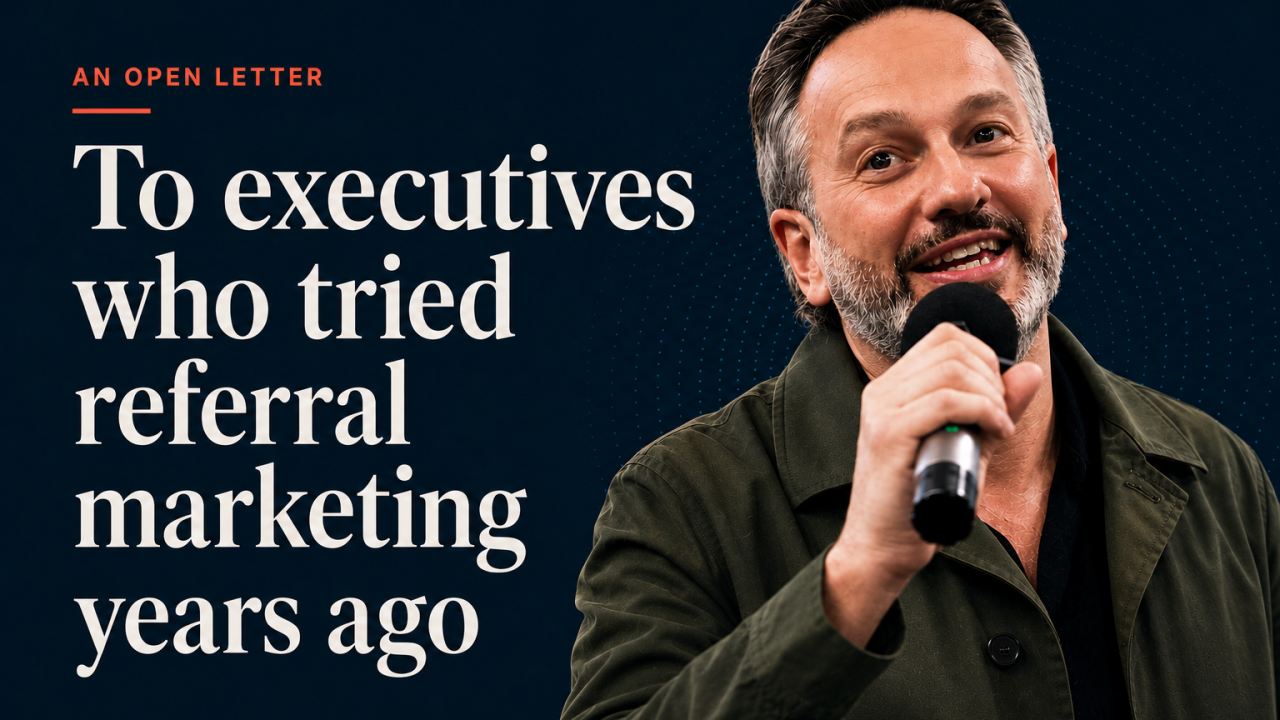
Dear Executives ,
A weird thing happens whenever referral marketing comes up in conversation.
Nobody would dream of saying, “We looked at social media in 2012.” Nobody dismisses CRM because they tried it ten years ago. Nobody decides SEO isn’t worth considering because they had a go at it back when people were still arguing about whether Facebook would catch on.
And yet referral marketing seems to occupy a strange place in people’s minds. All too often I meet someone who tells me they looked at referral years ago, as though the entire discipline packed up its bags sometime around 2015 and collectively agreed there wasn’t much point changing ever again.
Which would be an extraordinary achievement.
After all, almost everything else has evolved. The phone in your pocket has evolved. The car on your driveway has evolved. Television evolved into streaming, which somehow evolved into paying for seven different streaming subscriptions while reminiscing about how much cheaper cable used to be.
Marketing certainly hasn’t stood still. Search became a science. Social media became a profession. Affiliate marketing became a discipline in its own right. Loyalty programs became sophisticated. Customer experience became boardroom strategy. Entire industries emerged around understanding these channels, measuring them, optimising them and extracting every last ounce of performance from them.
Nobody assumes those disciplines stopped learning. Nobody assumes they stopped improving. Nobody assumes that what worked fifteen years ago is still best practice today.
So why would referral marketing be any different?
The reality is that referral marketing today bears little resemblance to what most people think of when they picture it. Many still imagine a simple program that gives existing customers a voucher for referring a friend. That still exists, in much the same way that putting a classified advert in a newspaper still exists. It’s just no longer the full story.
Over the last decade, referral marketing has matured into a proper marketing discipline. It has accumulated expertise. It has developed best practices. It has produced benchmarks, methodologies and specialist knowledge. There are now entire careers dedicated to understanding what drives advocacy, what influences sharing behaviour, which incentives work best, how programs should be structured, how they should be promoted and how they should evolve over time.
We’ve learned which rewards drive action and which simply give away margin. We’ve learned how program fatigue develops and how to prevent it. We’ve learned why some programs grow year after year while others plateau. We’ve learned that timing often matters more than reward value and that recognition can sometimes outperform discounting entirely.
Probably the biggest change, however, is that referral marketing escaped the narrow little box it was originally placed in. For years, referral marketing largely meant one thing: customers referring friends.
Today that remains important, but it is only one application of a much broader set of principles. Employees refer. Installers refer. Engineers refer. Partners refer. Affiliates refer. Community organizations refer. Influencers refer. Existing customers can refer, renew, upgrade, recover after poor service experiences or advocate for additional products. The same underlying mechanics now appear across acquisition, retention, engagement and loyalty strategies.
The most successful brands have stopped asking whether referral marketing works. They accepted that years ago. The more interesting question has become where else those same principles can be applied.
That shift is important because customer acquisition has become significantly harder than it was a decade ago. Competition has increased. Attention has fragmented. Advertising costs have risen. Consumers trust brands less than they trust people they know. Against that backdrop, it should not be surprising that businesses are placing greater value on advocacy, recommendation and trust.
What is perhaps more surprising is how effective these programs have become when executed well. Across many of the industries we work in, referral and reward-led programs now account for somewhere between 10% and 25% of all customer acquisition. In many cases, they acquire customers at around half the cost of traditional acquisition channels. Not because human beings suddenly became more likely to recommend products and services. We’ve always done that. The difference is that businesses have become dramatically better at recognising, encouraging and scaling those behaviours.
That is what mature marketing disciplines do. They learn. They improve. They accumulate expertise. They discover new applications. They get better results than they used to.
Referral marketing has done exactly the same.
So if your view of referral marketing was formed five or ten years ago, perhaps it’s worth taking another look. Not because people have changed. People still trust people. But almost everything else around them has.
Gideon
P.S.
If your boss’s understanding of referral marketing begins and ends with “Didn’t we try that years ago?”, here are six things worth mentioning before the next meeting:
The discipline matured.
The expertise matured.
The technology matured.
The use cases expanded.
Customer acquisition got a lot more expensive.
Case studies and proof points are everywhere.
Which is why so many businesses now treat referral as a core acquisition channel rather than a marketing experiment.