

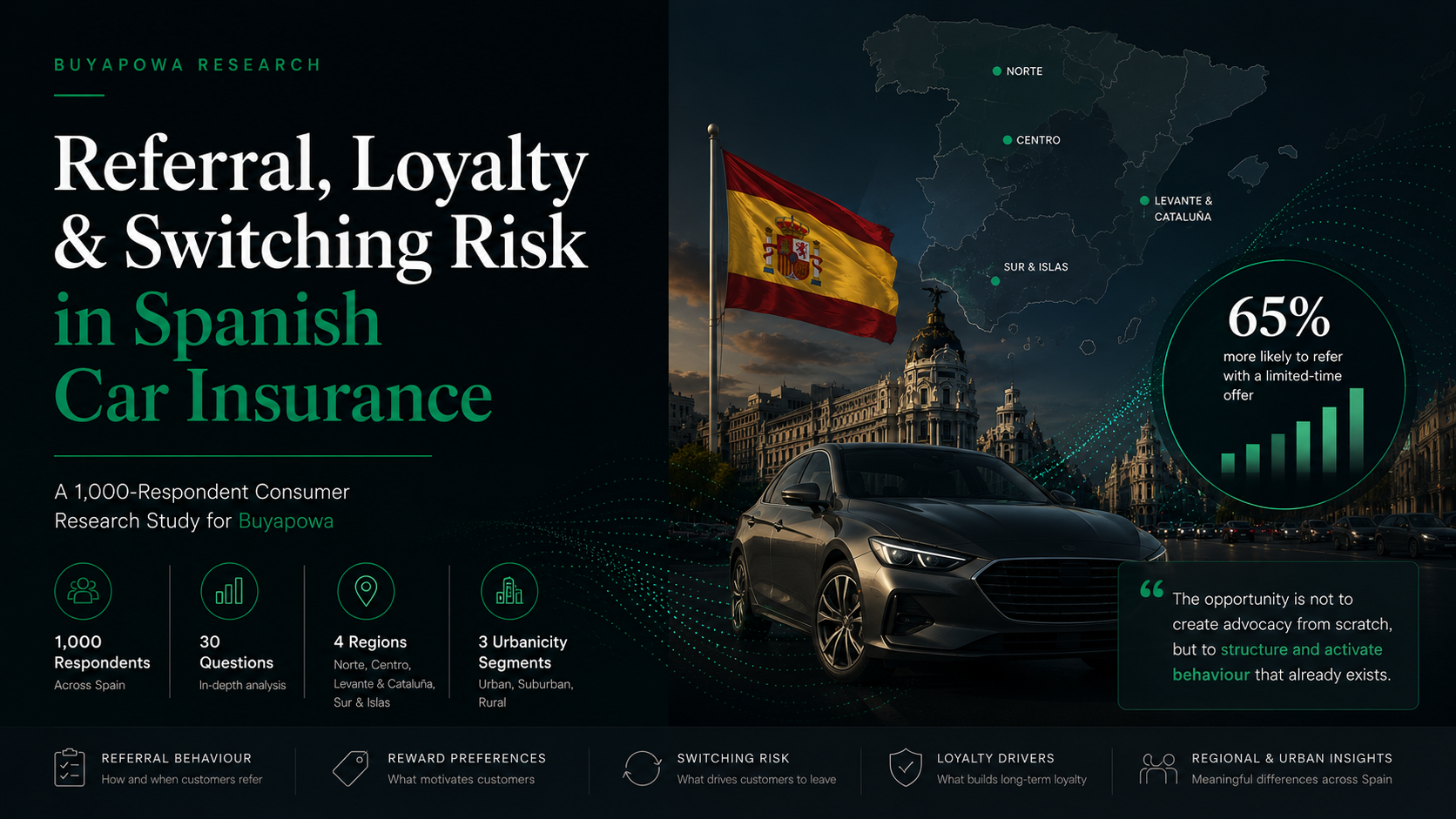
A 1,000-Respondent Consumer Research Study for Buyapowa
Executive Summary
Referral behaviour is already deeply embedded within the Spanish car insurance market, but much of it remains informal, inconsistent and commercially underutilized.
Half of Spanish car insurance customers say they have already recommended their insurer to someone they know, while almost half say they are likely to join a formal referral progran within the next six months. The opportunity is therefore not to create advocacy from scratch, but to structure and activate behaviour that already exists.
The research also shows that urgency materially increases participation. While 40% would refer without receiving a reward, this rises to 65% when a limited-time offer is introduced. Well-timed promotional windows and seasonal boosts therefore have the potential to dramatically increase program activity.
Rewards matter, but trust matters more. Customers are most motivated to refer when they feel confident in pricing, service quality and claims handling. The strongest referral programs will therefore combine compelling incentives with confidence-building customer experiences.
The market also shows meaningful switching vulnerability. Nearly one-third of customers say they would be likely to switch insurer if a friend recommended a competitor, reinforcing the idea that referral should be viewed as both an acquisition and retention channel.
Several important regional differences emerge throughout the study:
- Levante & Cataluña combines the highest referral activity with the highest switching risk.
- Centro shows the strongest future program participation potential.
- Norte appears more trust-led and less promotion-sensitive.
- Urban customers respond strongly to campaign activation, while suburban customers display elevated switching risk.
For insurers operating in Spain, the conclusion is increasingly clear: customer advocacy is already influencing acquisition and retention outcomes. The insurers that formalize and scale that advocacy earliest are likely to be better positioned to grow efficiently and defend their customer base over time.
1. Introduction & Method
This report explores referral behaviour, switching risk and customer advocacy within the Spanish car insurance market, with particular focus on how attitudes differ by region and urbanicity.
The objective is to help insurers better understand:
- when customers are willing to recommend their provider
- what incentives are most effective
- what barriers suppress referral behaviour
- how referral programs can support both growth and retention
The report examines referral readiness, reward preferences, program expectations, switching dynamics and loyalty indicators before exploring the practical implications for insurers operating in Spain.
While referral programs are now well established across sectors such as telecoms, retail and financial services, the insurance category remains comparatively underdeveloped. Yet insurance products are often highly discussion-driven. Customers regularly compare prices, discuss claims experiences and share switching recommendations with friends and family, particularly around renewal periods.
That creates an interesting tension within the category. Advocacy already exists, but much of it remains unmanaged, unmeasured and disconnected from formal referral infrastructure.
Sample
1,000 Spanish adults with a current or recent car insurance policy.
Segments
Regions
- Norte
- Centro
- Levante & Cataluña
- Sur & Islas
Urbanicity
- Urban
- Suburban
- Rural
Questionnaire
30 questions covering:
- satisfaction
- referral behaviour
- motivators
- reward preferences
- switching triggers
- loyalty
- referral program expectations
- sharing behaviour
- trust and confidence indicators
2. Referral Readiness and Likelihood
Referral behaviour is already mainstream
The Spanish car insurance market already displays strong underlying advocacy behaviour, creating clear headroom for structured referral programs.
Existing advocacy is common
50% of customers say they have already referred their current insurer to someone they know.
This is an important finding because it shows that referrals are already culturally normalized within the category. Car insurance may be a considered financial product, but customers are still willing to recommend providers when they feel confident in price, service or claims handling.
Informal advocacy is stronger than proactive advocacy
40% say they would refer without receiving a reward.
The gap between historic referral behaviour and proactive willingness suggests many recommendations happen reactively during conversations rather than through deliberate advocacy behaviour. Customers may recommend when asked, but not necessarily go out of their way to actively promote their insurer without an additional reason to act.
Referral programs therefore have an opportunity to create new activation moments rather than relying purely on existing enthusiasm.
Urgency materially increases participation
When a limited-time referral offer is introduced, referral readiness rises to 65%.
This 25-point uplift is one of the clearest patterns in the study. It indicates that urgency and promotional framing significantly increase referral participation, even in categories where advocacy already exists organically.
Importantly, this also suggests referral behaviour in insurance may be more responsive to campaign mechanics than many providers currently assume.
Near-term program participation potential is strong
46% say they are likely to join a referral program within the next six months.
This points to meaningful commercial headroom for insurers willing to invest in structured referral participation. The opportunity appears less about convincing customers referral is worthwhile, and more about making programs visible, easy and rewarding enough to join.
Regional differences
Levante & Cataluña — highest referral intensity
- 54% have already referred
- 42% would refer without a reward
- 69% become more likely to refer with a limited-time offer
- 43% are likely to join a program in the next six months
Levante & Cataluña emerges as the most referral-active region in the study. It combines strong existing advocacy with the strongest response to promotional urgency, making it particularly attractive for campaign-led referral activity.
The region appears highly socially responsive. Customers are already comfortable discussing and recommending providers, while also reacting strongly to limited-time incentives and promotional framing.
Centro — strongest program adoption potential
- 46% have already referred
- 40% would refer without a reward
- 65% become more likely to refer with a limited-time offer
- 53% are likely to join a program in the next six months
Centro displays lower historic referral behaviour than Levante & Cataluña, but the highest future program participation intent.
That combination is strategically important. It suggests latent demand exists even where referral behaviour is not yet fully activated. Customers here may not currently participate in informal advocacy at the same rate, but appear highly open to structured programs with clear mechanics and visible rewards.
Sur & Islas — active but reward-sensitive
- 52% have already referred
- 33% would refer without a reward
- 64% become more likely to refer with a limited-time offer
- 43% are likely to join a program
Sur & Islas shows strong existing referral activity, but lower willingness to refer without an incentive. Referral participation here appears more commercially dependent on visible customer value.
That does not necessarily imply weaker advocacy behaviour overall. Rather, it suggests customers may expect a clearer value exchange before actively promoting providers within their network.
Norte — more trust-led and less promotion-sensitive
- 47% have already referred
- 45% would refer without a reward
- 60% become more likely to refer with a limited-time offer
- 45% are likely to join a program
Norte stands out as the region least influenced by promotional urgency and one of the most organically referral-friendly areas in the study.
Customers here appear more willing to recommend insurers based on confidence, reliability and personal satisfaction than purely commercial incentives. This makes the region particularly interesting from a customer experience perspective.
Urban, suburban and rural patterns
Urban — strongest activation audience
- 51% have already referred
- 40% would refer without a reward
- 67% become more likely to refer with a limited-time offer
- 46% are likely to join a program
Urban customers appear particularly responsive to urgency-led referral activity. Higher exposure to digital channels, denser social connectivity and faster sharing behaviour likely all contribute to stronger campaign responsiveness in urban environments.
This makes urban audiences especially attractive for short-term promotional boosts, limited-time incentives and mobile-first sharing mechanics.
Suburban — strategically important retention audience
- 49% have already referred
- 41% would refer without a reward
- 63% become more likely to refer with a limited-time offer
- 45% are likely to join a program
Suburban customers sit close to the national average across most referral indicators, but become increasingly important once switching vulnerability is considered later in the report.
While referral readiness is healthy, this audience also appears comparatively open to competitor influence through trusted recommendations.
Rural — quieter but still commercially viable
- 46% have already referred
- 37% would refer without a reward
- 61% become more likely to refer with a limited-time offer
- 45% are likely to join a program
Rural customers display slightly lower referral intensity overall, but still represent a meaningful opportunity.
The findings suggest participation is less likely to be driven by aggressive campaign activity and more likely to respond to trust, clarity and simplicity.
Overall observations
Several broad themes emerge from the referral readiness data.
First, referral behaviour is already mainstream within Spanish car insurance. Advocacy is not hypothetical or emerging — it is already occurring at scale.
Second, urgency and promotional framing materially increase participation. Referral intent rises sharply when limited-time offers are introduced, suggesting insurers may be underutilising campaign-led referral activation.
Finally, the category appears highly segment-sensitive. Different regions and audience types respond differently to incentives, urgency and trust-based messaging, reinforcing the importance of targeted program positioning rather than a purely uniform national approach.
3. Motivators and Preferred Rewards
Referral behaviour is driven by confidence as much as incentives
Customers refer insurers primarily when they feel confident recommending the experience to others.
Main referral motivators
- 23% cite a positive personal experience
- 21% cite competitive pricing
- 18% want to help friends or family
- 14% cite a good claims experience
- 13% are motivated primarily by receiving a reward
- 7% cite brand reputation
- 4% cite ease of sharing
One of the more important findings here is that rewards are not the dominant referral driver. Customers appear motivated first by confidence in the provider itself.
This matters because it challenges the idea that referral performance can simply be “bought” through incentives alone. Insurance recommendations carry a degree of reputational risk. Customers need to feel they are recommending something genuinely worthwhile.
Claims handling is particularly significant because it represents the moment when insurance value becomes tangible and emotionally memorable.
Preferred reward types
A clear reward hierarchy emerges:
- Cash: 32%
- Gift cards: 24%
- Premium discount or bill credit: 18%
- Fuel voucher: 15%
- Charity donation: 5%
- No reward needed: 6%
Cash and gift cards together account for 56% of preferred reward types, making them the strongest overall incentive category.
The findings suggest flexible, immediate rewards are likely to outperform delayed or less tangible benefits such as renewal credits. This is particularly relevant in insurance, where some providers still rely heavily on future bill reductions or renewal discounts as the primary referral mechanic.
Reward value and timing expectations
Most motivating reward values
- Less than €10: 8%
- €10–€24: 28%
- €25–€49: 34%
- €50–€74: 17%
- €75 or more: 8%
The strongest reward band is €25–€49, with a further 28% motivated by €10–€24.
This suggests practical, achievable rewards may perform more efficiently than aggressively high-value offers. Customers appear to value immediacy and relevance more than extreme reward size.
Reward timing expectations are demanding
- 18% expect rewards immediately
- 31% expect rewards within a few days
- 24% expect rewards within two weeks
- 15% expect rewards within one month
- 9% accept delayed rewards after policy retention
73% expect rewards within two weeks or sooner.
Operationally, this is highly significant. Long fulfilment windows may materially weaken referral momentum, particularly where customers expect near-immediate recognition after making a successful recommendation.
Guaranteed versus conditional rewards
- 44% prefer a smaller guaranteed reward
- 35% prefer a larger reward if the friend purchases
- 21% have no strong preference
These findings create a compelling case for dual-stage reward structures.
Customers appear receptive to receiving a smaller initial reward for generating a qualified lead or quote, followed by a larger reward once the referred customer converts and remains active.
That structure potentially balances customer certainty with insurer risk management more effectively than purely outcome-based rewards.
Overall observations
The reward data reinforces a broader pattern seen throughout the study: referral behaviour in insurance is driven by reassurance as much as financial motivation.
Customers are willing to advocate when they feel confident in the provider, the reward feels fair and the process appears transparent. The strongest programs are therefore unlikely to rely purely on reward value alone, but instead combine compelling incentives with strong customer experience fundamentals.
4. Barriers and Prerequisites
Customers perceive social and reputational risk when referring insurers
The biggest referral barriers are confidence-based rather than purely financial.
Main hesitations
- 22% worry the friend may have a poor claims experience
- 18% do not want responsibility if the friend has a bad experience
- 16% are not fully confident in the provider
- 14% do not find the reward attractive enough
- 11% believe the process may be too complicated
- 9% rarely discuss insurance socially
- 6% have privacy concerns
The findings reinforce that referral programs cannot compensate for weak customer confidence.
Unlike some lower-consideration consumer products, insurance recommendations carry perceived reputational consequences. Customers worry about being blamed if the referred experience goes badly, particularly around claims or service quality.
Prerequisites for referral
Before recommending their insurer, customers say:
- 24% need to feel very satisfied personally
- 19% need confidence in pricing
- 18% need confidence in claims handling
- 15% need the friend to receive a strong introductory offer
- 12% need referral terms to be clear
- 8% need the journey to feel fast and simple
Referral therefore sits downstream from customer experience quality. Poor claims confidence, unclear pricing or complicated terms are likely to suppress advocacy behaviour even when incentives are attractive.
Importantly, this also means referral performance can become a useful signal of broader customer health and trust.
Simplicity expectations are extremely high
- 39% expect the process to be one-click
- 34% expect it to take less than one minute
- 18% would accept a few simple steps
The modern expectation for referral participation is increasingly frictionless.
Customers do not appear willing to tolerate complex forms, lengthy onboarding or unclear sharing mechanics, particularly on mobile devices. Referral journeys that feel cumbersome are likely to lose momentum quickly.
This places significant importance on:
- mobile-first design
- pre-filled sharing journeys
- embedded referral flows
- low-friction friend experiences
Customers expect visible referral tracking
Preferred tracking methods include:
- Email updates: 31%
- Mobile app tracking: 27%
- Online dashboard: 19%
- SMS updates: 14%
Insurance purchase cycles can be longer than many consumer categories, increasing the importance of visibility and transparency after the referral has been made.
Customers want reassurance that:
- the referral was received
- the friend engaged
- progress is being tracked
- reward qualification is progressing correctly
The emotional gap between sharing and reward fulfilment appears particularly important in insurance compared with faster-moving consumer sectors.
Overall observations
The barriers section highlights a consistent pattern throughout the study: referral performance is heavily linked to trust and customer confidence.
The strongest referral programs are therefore unlikely to succeed through incentives alone. Simplicity, transparency, claims confidence and visible tracking all appear critical to sustained participation.
5. Size of Potential Referral Network
Most customers appear to be light advocates rather than high-volume referrers.
Estimated annual referral potential
- 16% say none
- 29% say one person
- 35% say two to three people
- 13% say four to five people
- 7% say more than five people
64% believe they could realistically refer between one and three people annually.
This is strategically important because it suggests scale is more likely to come from broad participation than relying exclusively on a relatively small group of “super referrers”.
That dynamic is often overlooked in referral strategy. Many programs over-optimize for highly active advocates, when in reality sustainable scale may depend more heavily on making occasional referral behaviour easy and repeatable across a large customer base.
At the same time, around one-fifth of customers appear capable of referring four or more people annually, creating a viable audience for:
- tiered rewards
- milestone bonuses
- recognition mechanics
- gamified referral structures
Switching history and referral behaviour appear connected
- 43% have used one insurer in the past five years
- 38% have used two insurers
- 14% have used three insurers
- 5% have used four or more
Customers with recent switching experience may be especially valuable advocacy audiences.
They are more likely to compare providers actively, discuss pricing socially and understand differences between insurers, making them potentially influential recommendation sources within their networks.
Overall observations
The referral network findings suggest insurers should think about advocacy breadth as much as advocacy intensity.
Most customers are unlikely to refer dozens of people. But many appear capable of referring one or two people if the process feels timely, relevant and easy enough to participate in.
That creates a strong case for referral strategies designed around participation frequency and simplicity rather than purely maximising high-volume advocacy behaviour.
6. Switching Risk and Loyalty
Trusted recommendations materially influence switching behaviour
31% of customers say they would be likely to switch insurer if a friend recommended a competitor.
This is one of the most commercially important findings in the report because it reframes referral as both an acquisition mechanism and a defensive retention strategy.
In practical terms, advocacy is already influencing customer movement within the category whether insurers actively manage it or not.
Regional switching vulnerability
Likelihood to switch after a friend recommendation
- Levante & Cataluña: 36%
- Centro: 30%
- Sur & Islas: 30%
- Norte: 29%
Levante & Cataluña combines the highest referral activity with the highest switching vulnerability, making it strategically significant from both offensive and defensive referral perspectives.
The region appears highly socially influenced overall, with recommendations playing a comparatively large role in customer movement.
Urbanicity switching patterns
- Suburban: 33%
- Urban: 31%
- Rural: 29%
Suburban customers emerge as the highest-risk urbanicity segment in the study.
This is particularly notable because suburban audiences also display healthy referral readiness. In other words, these customers are both potentially valuable advocates and comparatively vulnerable to competitor influence.
Firm loyalty appears limited
Only 5% overall say they do not plan to leave their current insurer.
This does not necessarily mean most customers are actively preparing to switch. However, it does suggest many customers remain open to:
- better pricing
- stronger service
- improved coverage
- trusted recommendations
The category therefore appears relatively fluid from a loyalty perspective, particularly when social trust enters the decision-making process.
Overall observations
The switching data reinforces how strategically important customer advocacy may become within insurance over the coming years.
Historically, price comparison sites and renewal cycles have dominated switching behaviour. But the findings suggest trusted personal recommendations continue to exert meaningful influence, even within highly competitive and price-sensitive markets.
That creates a growing opportunity for insurers able to formalize advocacy before competitors do.
7. Strategic Segment Profiles
Centro
Strongest program adoption potential
Centro displays the highest future program participation intent in the study.
Although historic referral activity is slightly lower than some other regions, customers appear highly receptive to joining structured programs when the value proposition is clear and participation feels straightforward.
Strategic implication
The region appears particularly well suited to visible, always-on referral infrastructure supported by strong onboarding and clear reward communication.
Levante & Cataluña
Most dynamic but most vulnerable
Levante & Cataluña combines:
- highest historic referral behaviour
- strongest urgency response
- highest switching risk
This creates one of the most commercially dynamic environments in the study.
Customers are already highly socially active around insurance recommendations, but are also comparatively open to competitor influence.
Strategic implication
Campaign-led referral activity appears especially important here, both to drive acquisition and strengthen retention defensively.
Sur & Islas
Reward-sensitive advocacy market
Referral participation in Sur & Islas appears more commercially dependent on visible customer value.
Customers show strong historic advocacy behaviour, but significantly lower willingness to refer without incentives.
Strategic implication
Dual-sided rewards and highly visible customer-and-friend value propositions are likely to perform especially well within this region.
Norte
Trust-led referral environment
Norte appears more trust-led and less promotion-sensitive than other regions in the study.
Customers seem comparatively willing to recommend providers based on confidence, reliability and satisfaction rather than aggressive campaign mechanics alone.
Strategic implication
Trust-led positioning focused on claims confidence, service quality and helping friends make informed decisions may outperform heavily promotional referral messaging.
Urban customers
Strongest activation audience
Urban customers respond particularly strongly to urgency-led referral activity.
Higher exposure to digital channels, denser social connectivity and faster sharing behaviour likely all contribute to stronger campaign responsiveness.
Strategic implication
Short-term boosts, mobile-first sharing journeys and highly visible promotional mechanics are likely to perform particularly well in urban audiences.
Suburban customers
Most strategically vulnerable
Suburban customers display elevated openness to switching following trusted recommendations.
This makes them strategically important from a retention perspective, particularly given their healthy baseline referral readiness.
Strategic implication
Referral programs should be positioned not only as acquisition tools, but as mechanisms for strengthening engagement and reducing competitor influence within vulnerable customer groups.
Rural customers
Lower intensity but commercially viable
Rural audiences display slightly lower referral intensity overall, but still meaningful participation potential.
Customers appear more likely to respond to simplicity, trust and clarity than aggressive promotional pressure.
Strategic implication
Straightforward referral journeys with clear messaging and visible customer confidence indicators are likely to perform best.
8. Implications for Marketers
Several broader strategic implications emerge from the findings.
Formalize advocacy that already exists
Half of customers have already referred their insurer informally. The opportunity is increasingly about capturing and scaling existing behaviour rather than trying to manufacture advocacy artificially.
Lead with flexible rewards
Cash and gift cards dominate reward preferences and should form the foundation of most referral propositions.
More delayed or abstract incentives may struggle to generate the same level of urgency or emotional impact.
Build urgency into program strategy
Limited-time offers materially increase participation.
Referral programs are therefore likely to perform best when always-on infrastructure is supported by:
- seasonal campaigns
- renewal-period activity
- switching windows
- short-term promotional boosts
Make the friend benefit highly visible
Insurance recommendations carry social risk. Customers want to feel they are helping the friend, not simply benefiting personally.
Dual-sided referral structures help reinforce that sense of mutual value.
Design for near-frictionless participation
Customers increasingly expect referral participation to feel instant.
Mobile-first, pre-filled and embedded sharing flows are likely to outperform more traditional multi-step referral journeys, particularly in digitally connected urban audiences.
Treat referral as a retention strategy
If insurers fail to activate their own advocates, competitors can use recommendations to attract their customers instead.
Referral is therefore becoming increasingly relevant not only to acquisition efficiency, but also to customer defence.
Segment activation carefully
Different audiences respond differently to urgency, incentives and trust-led messaging.
A single national referral strategy may therefore underperform compared with more segmented activation approaches tailored to regional and behavioural dynamics.
Conclusion
The Spanish car insurance market appears highly referral-ready, but still materially under-activated.
Advocacy already exists at scale. Half of customers say they have already recommended their insurer, while almost half are open to joining formal referral programs in the near future. The commercial opportunity is therefore not theoretical — it already exists within current customer behaviour.
The research also demonstrates that urgency and incentives materially increase participation. Referral intent rises sharply when limited-time offers are introduced, while flexible rewards such as cash and gift cards outperform less immediate alternatives.
At the same time, the market displays meaningful switching vulnerability. Nearly one-third of customers would consider switching provider following a trusted recommendation, while very few express absolute loyalty to their current insurer.
The most commercially attractive opportunity sits where advocacy potential and switching risk overlap. Levante & Cataluña stands out particularly clearly, combining high referral activity, strong responsiveness to urgency and elevated openness to switching.
More broadly, the findings suggest customer recommendation continues to exert meaningful influence even within highly competitive and price-sensitive insurance markets. While price comparison sites and renewal cycles still dominate much switching behaviour, trusted personal recommendations remain highly persuasive.
That may become increasingly important as acquisition costs rise and customer loyalty becomes harder to maintain.
The insurers most likely to succeed in this environment will treat referral as infrastructure rather than a short-term promotion. The strongest programs will be:
- simple
- mobile-first
- transparent
- dual-sided
- campaign-supported
- deeply integrated into the customer journey
Insurers that formalise and activate advocacy effectively are likely to be better positioned to acquire customers efficiently, strengthen loyalty and defend their customer base over time.