

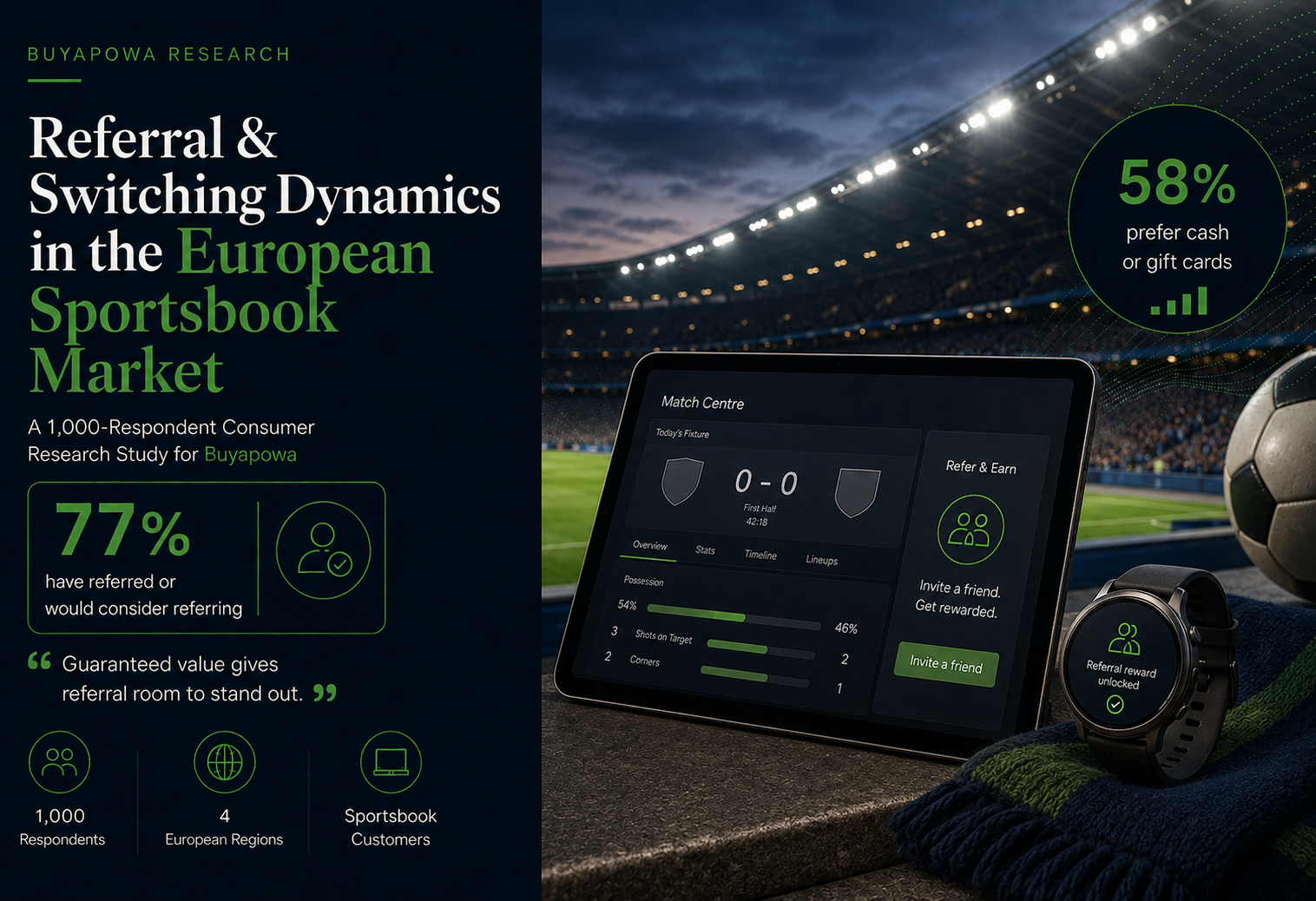
Research with 1,000 sportsbook customers across Europe reveals a sizable referral audience, but the strongest proposition is built on certainty, timing and trust – not simply another free bet.
Sportsbook operators are fighting for attention in one of the most promotion-heavy corners of consumer marketing. Paid media is expensive, affiliate channels are crowded and customers are surrounded by free bets, enhanced odds, deposit offers and cashback. Those mechanics can still acquire customers, but when similar offers appear everywhere, they make it harder for any one operator to build a relationship that lasts.
That matters because sportsbook customers do not behave like subscribers choosing a single provider and staying there. In our research, 74.7% had used at least two sportsbooks during the previous 12 months. The commercial contest is therefore often for primary-brand status and share of wallet, not exclusivity, and the operator that earns a trusted recommendation can enter that contest with an advantage that another paid impression cannot easily reproduce.
We surveyed 1,000 sportsbook customers across Northern, Eastern, Southern and Western Europe to understand where referral fits. The results point to a large audience willing to recommend, a clear preference for rewards with certain value and a need to treat trust as part of the program design rather than as an afterthought.
The referral audience is already there
Almost half of respondents, 47.5%, had already recommended their primary sportsbook. A further 29.2% had not yet referred but said they would consider it, taking the potential referral audience to 76.7%. Operators are not being asked to manufacture an unfamiliar behavior; they are being asked to make an existing one easier to prompt, track and reward.
There is real customer goodwill behind that figure. Nearly two-thirds, 65.2%, were satisfied with their primary sportsbook. When respondents explained what would make them recommend, 40.3% pointed to a good overall experience, 30.9% to reliable deposits and withdrawals and 29.1% to trust. A reward can create a moment of action, but the recommendation still rests on how confidently the customer can put their name behind the operator.
The data also shows how timing can unlock more of that goodwill. Without a reward, 46.1% said they would refer; with a limited-time offer, the figure rose to 59.3%, a 13.2 percentage-point uplift. The increase was consistent across the four European regions, ranging from 12.8 to 14 points, which makes major tournaments, opening weekends and other high-conversation sporting moments natural opportunities for a referral campaign.
The lesson is not to bombard customers with a new invitation every month. Only 14.8% said they wanted referral offers that frequently. A better rhythm is an evergreen program that customers can find whenever recommendation happens naturally, supported by selective campaign bursts when the sporting calendar gives people a relevant reason to talk and act.
Certainty is the point of difference
Sportsbook marketing has trained customers to recognize the free bet, but familiarity is not the same as preference. Asked which referral reward would motivate them most, 32.6% chose cash and 25.5% chose a gift card. Together, those two forms of guaranteed value accounted for 58.1% of first choices, compared with 12.8% for free bets and 8.3% for cashback.
The preference became more pronounced when respondents weighed a smaller, certain reward against a larger benefit carrying qualifying conditions. Some 50.9% chose the smaller guaranteed cash payment or gift card, while 15.9% preferred the larger free bet or bonus. Another 23.6% wanted a hybrid of guaranteed value and a betting-related benefit, meaning 74.5% wanted certainty somewhere in the proposition.
This is a useful distinction for operators. A high headline value can lose its force when customers immediately begin discounting it for wagering requirements, expiry rules or uncertainty over what they will ultimately receive. A more modest reward can feel more valuable when the route to earning it is obvious and the outcome is not conditional on the result of a bet.
It does not follow that free bets should disappear. They remain category-relevant and Southern European customers were more responsive to familiar sportsbook promotions and hybrid rewards than customers elsewhere. The stronger opportunity is to use the free bet as a supporting benefit rather than asking it to carry the whole proposition – for example, combining a clear gift-card reward for the advocate with a welcome free bet for the friend.
The preferred values also give operators a realistic testing range. The most popular band was €25-€49, selected by 34.4%, followed by €10-€24 at 28.1%; in total, 62.5% chose a reward between €10 and €49. Those figures are not a single European price list, because regulation, economics and customer value vary by market, but they suggest that clarity can do more work than extravagance.
Trust turns interest into a working program
A sportsbook referral carries a reputational cost for the person making it. The leading concern, raised by 27.5%, was that the friend might lose money. A further 24.1% were uncomfortable encouraging someone to gamble and 23.6% worried about being associated with a bad experience. These are not objections that a bigger reward resolves; they are signals that the journey must make customers comfortable with both the operator and the invitation they are sending.
The friend therefore needs to be visibly included in the value exchange. Some 71.5% said it was important that the friend should receive a reward too. A two-sided offer makes the recommendation less self-interested, while clear eligibility, responsible gambling tools and plain-language conditions give the advocate more confidence that the friend will understand what happens next.
The practical journey should preserve that sense of control. Messaging services such as WhatsApp were the preferred sharing route for 41.1%, followed by a shareable link at 37.2% and the sportsbook’s own app or website at 30.1%. Those choices point toward a private, customer-led interaction: create a link, select the right person and channel, and add a personal message if appropriate, without forcing a public post or indiscriminate contact upload.
A fast, visible customer journey
Customers also expect that journey to be fast. A one-click route was preferred by 31.9%, while 31.3% wanted to finish in under a minute, so 63.2% expected referral to be almost immediate. Progress should remain just as clear after the share. An online account or referral dashboard was preferred by 32.6%, and 27.7% chose sportsbook-app notifications, giving in-product tracking 60.3% of preference.
Operators can protect the economics without turning the reward into a mystery. The most acceptable trigger was a qualifying bet, chosen by 29%, followed by the friend’s first deposit at 22.2%. Together those options represented 51.2% of respondents, whereas only 4.3% preferred payment after 30 days of activity. The trigger can vary by market, but customers should be able to see what has qualified, what is still pending and when both rewards will arrive.
That combination of certainty and transparency matters because recommendations can move market share. Some 46.1% said they would be likely to try or switch sportsbook following a friend’s recommendation with better benefits. Against a backdrop in which nearly three-quarters already use more than one operator, referral is not just another route to registration; it can help an operator become the brand a customer opens first, recommends most confidently and returns to most often.
The most useful first test is therefore not simply one free-bet value against another. It is a comparison between a familiar betting-led offer, a guaranteed cash or gift-card proposition and a hybrid that combines the two, with a meaningful reward for the friend in every version. Each should be available through an evergreen program, easy to share privately in under a minute and supported by campaign moments chosen from the sporting calendar.
Success should then be judged beyond the number of links shared. Verification, first deposit, qualifying bet, reward fulfillment, fraud, customer value, repeat referral and movement toward primary-brand status all matter. A free bet may still contribute to that result, but the research suggests the distinctive idea is not the bet itself; it is giving customers a clear, trustworthy reason to recommend one sportsbook when they have so many others to choose from.